Cryptostomata
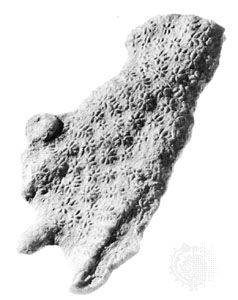
Cryptostomata is an extinct order of bryozoans—small, colonial aquatic animals—that lived from the Ordovician to the Triassic periods (approximately 488…
What is Cryptostomata?
Cryptostomata is an extinct order of bryozoans—small, colonial aquatic animals—that lived from the Ordovician to the Triassic periods (approximately 488 million to 200 million years ago).12
These organisms were characterized by colonies that typically formed foliaceous (leaflike), reticulate (lacy), or branching structures. Their skeletal structure consisted of tubular zooids that were shorter than those found in related trepostomes. The proximal portions of these zooids were thin-walled, while the distal portions were funnel-shaped and separated by extensive calcification. Unlike some other bryozoan groups, cryptostomes lacked interzooidal pores but contained diaphragms, which are transverse partitions within the tubes.23
Cryptostomes evolved rapidly during the Ordovician and became the dominant bryozoans from the beginning of the Devonian until the Permian. They eventually declined and went extinct shortly after the end of the Paleozoic Era.3
What are the main differences between Bryozoa and other colonial animals?
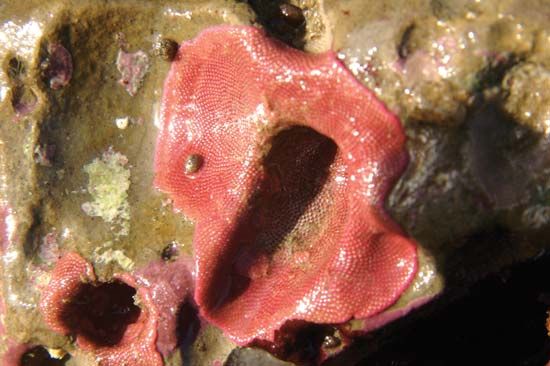
Bryozoans, or “moss animals,” are distinct from other colonial animals due to their unique anatomical structure and physiological organization. While they form colonies composed of numerous interconnected units called zooids, they possess several defining characteristics that set them apart:56
- The Lophophore: Bryozoans are classified as lophophorates, meaning they possess a specialized ring of ciliated tentacles used for filter feeding. This structure creates water currents to direct food particles toward the mouth.57
- Anus Position: Unlike many other colonial invertebrates, the digestive tract of a bryozoan is U-shaped, with the anus positioned outside the ring of tentacles. This feature is the basis for their alternative name, Ectoprocta, which translates to “outside anus”.6
- Colonial Integration: While individual zooids function as complete animals, they are physiologically integrated. They exchange nutrients through interzooidal pores or internal cables, and some species exhibit coordinated responses to stimuli across the colony.68
- Lack of Specialized Systems: Bryozoans notably lack dedicated respiratory, circulatory, and excretory systems, relying instead on their simple body plan to manage metabolic needs.9
How do scientists use fossils to study the history of marine life?
Scientists use the fossil record to reconstruct the history of marine life by analyzing the remains and imprints of organisms preserved in sedimentary rock. This research provides critical insights into evolutionary patterns, environmental changes, and the timing of geological events.11
Key methods include:
- Biostratigraphy and Index Fossils: By identifying index fossils—distinctive, abundant, and rapidly evolving organisms like ammonites or foraminifera—scientists can correlate rock strata across different regions and assign relative ages to geological layers.121314
- Evolutionary Studies: Researchers track morphological changes within animal groups over time to describe evolution and adaptation to specific environments.11
- Paleoenvironmental Reconstruction: The presence of specific fossils, such as coral, helps scientists infer past climates and water conditions. Furthermore, the marine oxygen isotope record, derived from the shells of microfossils, serves as a standard for understanding past global glaciations and temperature fluctuations.1115
- Geochemical Analysis: The skeletons of planktonic organisms significantly influence the geochemistry of the oceans and the composition of deep-sea sediments, providing a record of how marine food webs and seafloor conditions have shifted over millions of years.13
What are the primary characteristics of the phylum Bryozoa?
The phylum Bryozoa, also known as Ectoprocta or Polyzoa, consists of sedentary, aquatic invertebrates characterized by the following primary features:
- Colonial Structure: Bryozoans form colonies composed of numerous interconnected units called zooids. These zooids are produced through asexual budding and remain physically linked, often sharing nutrients through pores or internal cables.518
- Lophophore: Each zooid possesses a lophophore—a specialized circular or crescent-shaped organ bearing ciliated tentacles. This structure is used to collect planktonic food particles from the water.53
- Digestive System: They feature a U-shaped digestive tract. A defining characteristic is that the anus opens near the mouth but remains outside the lophophore, which is why they are sometimes called Ectoprocta (“outside anus”).1918
- Physiological Simplicity: Bryozoans lack dedicated excretory organs and a blood vascular system.19
- Support: Each zooid typically secretes a rigid, calcified, or gelatinous wall to provide structural support for the colony.1918
Sources
- Cryptostomata — Encyclopædia Britannica
- Bryozoa — Merriam-Webster
- moss animal - Annotated classification — Encyclopædia Britannica
- moss animal - Evolution and paleontology — Encyclopædia Britannica
- moss animal — Encyclopædia Britannica
- moss animal - Size range and diversity of structure — Encyclopædia Britannica
- moss animal - Distribution and abundance — Encyclopædia Britannica
- moss animal - Colonies — Encyclopædia Britannica
- lophophorate — Encyclopædia Britannica
- moss animal - Zooids — Encyclopædia Britannica
- index fossil — Encyclopædia Britannica
- fossil record — Encyclopædia Britannica
- Pleistocene Epoch - Marine oxygen isotope record — Encyclopædia Britannica
- Jurassic Period - Protists and invertebrates — Encyclopædia Britannica
- crustacean - Evolution and paleontology — Encyclopædia Britannica
- Tertiary Period - Marine extinctions and recovery — Encyclopædia Britannica
- Tertiary Period - Correlation of Tertiary strata — Encyclopædia Britannica
- lophophore — Merriam-Webster
- moss animal - Food and feeding — Encyclopædia Britannica
- Circulatory system - Animals without independent vascular systems — Encyclopædia Britannica
Published on · 3 min read