Cirripede
Cirripedes are a group of more than 1,000 species of exclusively marine crustaceans belonging to the infraclass Cirripedia. While the most familiar members…
What are cirripedes and how are they classified within the crustacean group?
Cirripedes are a group of more than 1,000 species of exclusively marine crustaceans belonging to the infraclass Cirripedia. While the most familiar members are barnacles, the group also includes highly modified parasitic forms that lack common names.123
Classification and Diversity
Cirripedes are classified within the subphylum Crustacea and are generally placed within the Maxillopoda placed within the Maxillopoda. The infraclass is divided into several groups based on their morphology and lifestyle:23
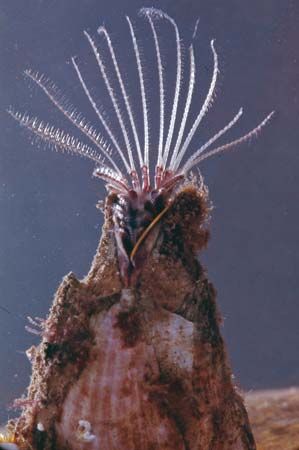
- Thoracica: The principal superorder, which includes the familiar goose barnacles (pedunculate) and acorn barnacles (sessile). These are typically sedentary as adults, often protected by calcareous plates, and use feathery, retractile organs called cirri to capture food.14
- Acrothoracica: Known as burrowing barnacles, these small, shell-less forms burrow into hard materials like coral or mollusk shells.14
- Rhizocephala: A group of highly specialized parasites that infect decapod crustaceans, often resembling fungi rather than typical crustaceans.14
- Ascothoracida: A group of parasites found on echinoderms and cnidarians; some authorities classify them as a separate infraclass due to distinct anatomical differences.43
What is the life cycle of a typical cirripede?
The life cycle of a typical cirripede, such as a barnacle, involves a complex transition from free-swimming larvae to a sedentary adult form.
Reproductive Phase
Most barnacles are simultaneous hermaphrodites that typically engage in cross-fertilization. Using a long, extendable penis, an individual can inject sperm into the mantle cavity of a neighbor. Fertilized eggs are retained within the mantle cavity until they hatch into the first larval stage.17
Larval Development
- Nauplius: The larvae emerge as free-swimming nauplii. These larvae possess distinctive horns on their heads and go through six molting stages over approximately two weeks while feeding on phytoplankton.17
- Cyprid: Following the sixth naupliar stage, the organism undergoes a profound metamorphosis into a nonfeeding, strong-swimming cyprid larva. The cyprid’s primary goal is to locate a suitable substrate or host using light, chemical, and tactile stimuli.17
Settlement and Metamorphosis
Once a suitable location is found, the cyprid uses its antennules to secrete a permanent cement, attaching itself head-down. It then undergoes a final, dramatic metamorphosis, where its swimming legs transform into the feathery cirri used for filter feeding, and it develops its characteristic protective shell.17
What are the main differences between sessile and pedunculate cirripedes?
The primary distinction between sessile and pedunculate cirripedes lies in their physical attachment to a substrate and the structure of their protective coverings.
Pedunculate (Stalked) Barnacles
- Structure: These barnacles are characterized by a body divided into two distinct parts: the capitulum (which houses the main body and cirri) and the peduncle (a flexible, muscular stalk).
- Attachment: They are elevated above the substrate by the peduncle, which may or may not be armored with calcareous plates.
- Examples: The common goose barnacle (Lepas) is a well-known example of this type.
Sessile (Operculate) Barnacles
- Structure: These barnacles lack a stalk and are cemented directly to the substrate. Their bodies are contained within a rigid, often conical or barrel-like wall of calcareous plates.
- Operculum: A defining feature is the presence of an operculum—a set of movable plates at the top of the shell that can open to allow the cirri to extend for feeding and close for protection.
- Examples: This group includes acorn barnacles (Balanus) and wart barnacles (Verruca).
While both groups are highly modified for a sedentary life, sessile barnacles have evolved to be the dominant shallow-water forms, whereas pedunculate barnacles retain a more ancestral body plan that utilizes a stalk for elevation.
What is a cirripede?
A cirripede is any marine crustacean belonging to the infraclass Cirripedia, a group that includes approximately 1,000 described species. While the most familiar members of this group are barnacles, the infraclass also encompasses specialized internal parasites of marine invertebrates, such as crabs, jellyfish, and starfish.29
These organisms are highly modified for a sedentary life. Most adult cirripedes are characterized by their attachment to a substrate—such as rocks, ship hulls, or other animals—often protected by calcareous plates. They typically feed by extending feathery, jointed appendages called cirri into the water to capture plankton.49
The group is taxonomically diverse, including:
- Thoracica: The principal order, containing the well-known goose barnacles and acorn barnacles.49
- Acrothoracica: Small, shell-less burrowing barnacles that inhabit calcareous materials like coral or mollusk shells.49
- Rhizocephala and Ascothoracida: Highly specialized groups that exist primarily as internal parasites.49
Sources
- barnacle — Encyclopædia Britannica
- cirripede — Encyclopædia Britannica
- crustacean - Distribution and abundance — Encyclopædia Britannica
- cirripede - Diversity and distribution — Encyclopædia Britannica
- Cirripedia — Merriam-Webster
- cirripede - Evolution and paleontology — Encyclopædia Britannica
- cirripede - Reproduction and life cycles — Encyclopædia Britannica
- cirripede - Annotated classification — Encyclopædia Britannica
- cirripede — Merriam-Webster
- cirripede - Critical appraisal — Encyclopædia Britannica
Published on · 4 min read