Fiddler Crab
Fiddler crabs, belonging to the genus Uca and related genera, are characterized by distinct physical traits, most notably their sexual dimorphism.
What are the distinctive physical features of fiddler crabs?
Fiddler crabs, belonging to the genus Uca and related genera, are characterized by distinct physical traits, most notably their sexual dimorphism.123
Key Physical Features
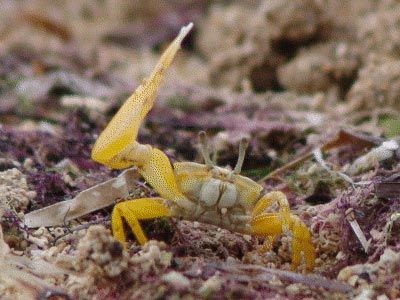
- Asymmetrical Claws: The most prominent feature of the male fiddler crab is one greatly enlarged front claw, which it holds in a manner resembling a violin player. In contrast, females possess two relatively small, equal-sized claws.123
- Coloration: Males are typically more brightly colored than females, displaying a range of hues including coral red, bright green, yellow, and light blue. Females are generally duller in color.13
- Size: These crabs are relatively small, with common North American species typically ranging from 2.5 to 3 cm (1 to 1.2 inches) in body size.1
- Eyestalks: Like other decapod crustaceans, they possess movable peduncles known as eyestalks that bear an eye at the tip.4
Males use their enlarged claw for ritualized displays, such as waving to attract mates or signaling intent to other crabs. If a male loses its large claw, it has the ability to regenerate it.531
How do fiddler crabs use their oversized claw, and what is its purpose?
Male fiddler crabs use their oversized claw primarily for communication, courtship, and territorial defense. The claw serves several specific functions:12
- Courtship and Mating: Males wave their enlarged claw in rhythmic, species-specific patterns to attract females. This display acts as a signal to establish the male’s identity and intent.12
- Territorial Signaling: The claw is used to defend burrows and establish territory. By waving the claw or performing vertical movements, males communicate with other crabs, helping to resolve competition for space and resources through ritualized displays rather than physical combat.21
- Sound Production: In addition to visual signaling, males may use the claw to send sound signals, which further assist in courtship and territorial interactions.1
While the claw is a powerful tool for these social and reproductive behaviors, it is not typically used for feeding, as the crab uses its smaller claws to forage for algae and organic matter. If a male loses this significant appendage, it has the biological capacity to regenerate it during subsequent molting cycles.64
How do fiddler crabs communicate and interact with each other?
Fiddler crabs, members of the genus Uca, engage in complex social interactions that rely heavily on ritualized visual and auditory signaling. These behaviors are primarily driven by the need to compete for resources such as food, shelter, and mates.12
Communication and Interaction
- Visual Signaling: The most distinctive interaction involves the male’s enlarged claw. Males perform rhythmic waving displays with this claw to attract females and signal their identity and intent to other males. This process of ritualization—where simple movements are exaggerated and made more conspicuous—allows crabs to communicate effectively while minimizing the risk of costly physical combat.127
- Auditory Signaling: In addition to visual displays, male fiddler crabs use sound signals to further facilitate courtship and territorial interactions.2
- Territoriality: Fiddler crabs are highly territorial, often competing for burrows in the sand or mud. Rather than engaging in death struggles, they frequently resolve status and territorial disputes through these formalized, ritualized displays.12
- Social Structure: Because they often live in large numbers, these crabs have developed sophisticated social behaviors that allow them to navigate their environment and interact with neighbors efficiently.12
What is the significance of fiddler crabs in scientific research?
Fiddler crabs are significant in scientific research primarily due to their physiological adaptations to challenging environments. Specifically, they have been studied for their ability to regulate their internal osmotic concentration when exposed to fresh water, a critical survival mechanism for animals inhabiting salt marshes that are subject to tidal action and rainfall.1
Beyond their osmoregulatory capabilities, these decapod crustaceans serve as important models for understanding biological processes such as:
- Regeneration: Research into the ability of male fiddler crabs to regrow their oversized claws after loss provides insights into the mechanisms of tissue regeneration.9
- Behavioral Ecology: Their complex social structures, characterized by ritualized communication and territorial displays, offer a window into the evolution of animal signaling and mating strategies.9
While they are widely recognized for these biological traits, they also play a functional role in their ecosystems by aerating the soil through their burrowing activities.9
Sources
- fiddler crab — Encyclopædia Britannica
- malacostracan - Defense and aggression — Encyclopædia Britannica
- fiddler crab — Merriam-Webster
- Reproductive behaviour - Crustaceans — Encyclopædia Britannica
- eyestalk — Merriam-Webster
- Regeneration - Arthropods — Encyclopædia Britannica
- Why do crabs walk sideways? — Encyclopædia Britannica
- Animal communication - Evolution of signals — Encyclopædia Britannica
- Salt marsh — Encyclopædia Britannica
Published on · 3 min read