Cithaeron
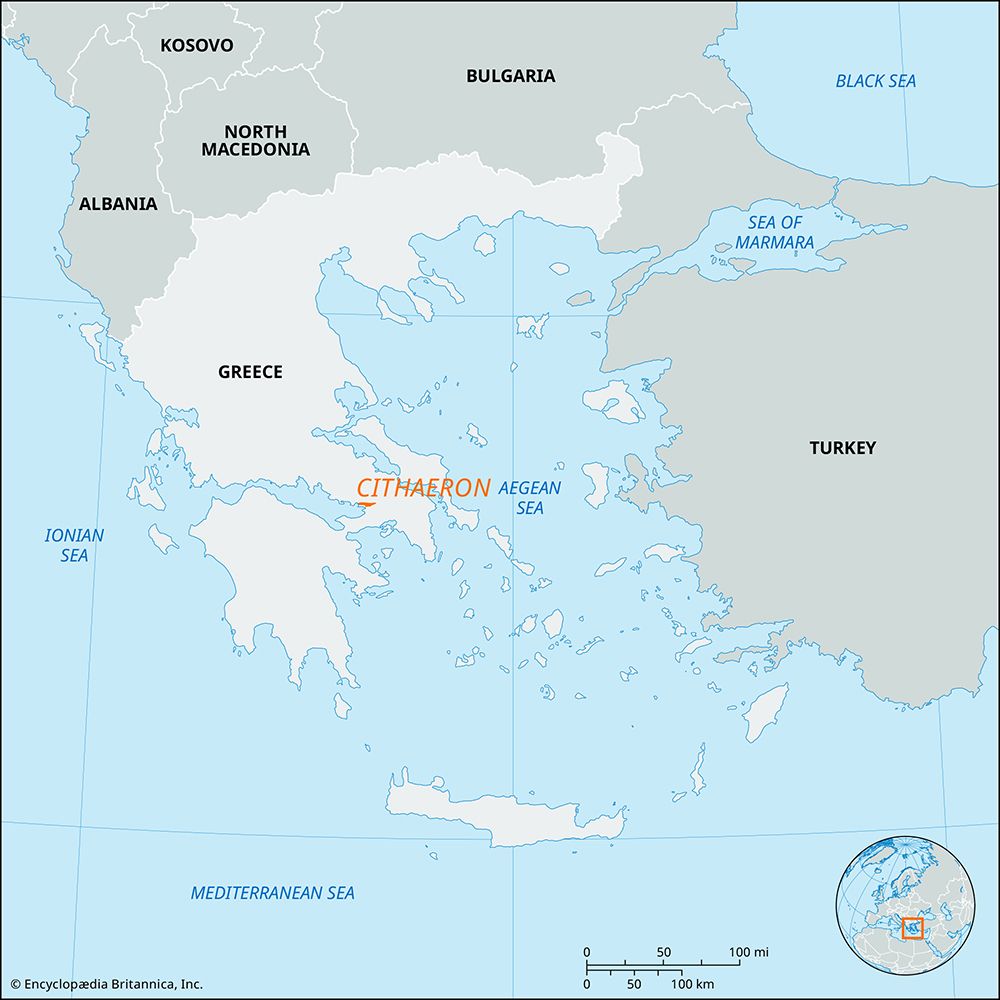
Cithaeron (Modern Greek: Kithairón) is a mountain range in Greece that serves as a natural boundary separating Boeotia from Megaris and Attica. Reaching a…
What is Cithaeron?
Cithaeron (Modern Greek: Kithairón) is a mountain range in Greece that serves as a natural boundary separating Boeotia from Megaris and Attica. Reaching a maximum elevation of 4,623 feet (1,409 meters), the range extends westward to the Gulf of Corinth.12
Historically, the mountain was significant as the location of the Battle of Plataea during the Greco-Persian Wars and was traversed by the ancient road connecting Athens and Thebes.1
Cithaeron is perhaps best known for its prominence in Greek mythology. It was the site of several legendary events, including the transformation of Actaeon into a stag, the death of Pentheus, and the abandonment of the infant Oedipus. Additionally, the mountain served as a sacred setting for the mystic rites of Dionysus and the Daedala festival held in honor of Hera.1
What happened at the Battle of Plataea?
The Battle of Plataea, fought in July 479 BCE, was the decisive land engagement of the Greco-Persian Wars. Following the Persian naval defeat at Salamis, King Xerxes returned to Asia, leaving his general Mardonius in command of a large army in northern Greece.34
The Greek alliance, led by the Spartan Pausanias, confronted the Persians near Plataea. After initial skirmishes and a failed night maneuver by the Greeks, Mardonius launched an attack on the disorganized Greek forces. The well-armed Greek hoplite infantry gained the upper hand in close-quarters combat. Mardonius was killed, causing the Persian forces to break and flee.3
The victory was a turning point that effectively ended Persian ambitions to conquer the Greek mainland. Casualties were lopsided, with approximately 30,000 Persian losses compared to 2,000 Greek losses. The battle was later commemorated through annual sacrifices to Zeus the Liberator, honoring the soldiers who fought for Greek liberty.134
Who was the god Dionysus and what were his rites?
Dionysus was a major deity in the Greek pantheon, recognized as the god of fruitfulness, vegetation, wine, and ecstasy. Often depicted as the son of Zeus and the mortal Semele, he was considered “twice-born” and was frequently associated with the Roman god Bacchus.6
Dionysian Rites and Festivals
The rites of Dionysus, known as orgia or Bacchanalia, were characterized by ecstatic worship and a “sacred madness”. Key elements included:67
- Ecstatic Rituals: Followers, particularly women known as maenads, would retreat to the hills wearing fawn skins and ivy crowns. They danced by torchlight to the rhythm of the aulos (double pipe) and handheld drums, often shouting the ritual cry, “Euoi!”67
- Symbolism and Power: Participants carried the thyrsus—a fennel wand tipped with ivy—and were believed to possess preternatural strength and the ability to charm animals.6
- Sacrificial Feasts: In some traditions, the rites involved omophagia, the ritual tearing apart and consumption of living victims, symbolizing the god’s incarnation in the sacrificial beast.6
- Cultural Influence: The cult was deeply tied to the arts. Greek drama, including tragedy and comedy, evolved from these ritual performances, and the god was honored through dithyrambs and festivals like the Great Dionysia.67
What is the story of Oedipus and his connection to the mountain?
In Greek mythology, the connection between Oedipus and Mount Cithaeron is rooted in his infancy and the attempt to circumvent his tragic fate.
After an oracle warned King Laius of Thebes that his son would eventually kill him, Laius sought to prevent this by ordering the infant to be exposed—a form of infanticide—on the slopes of Mount Cithaeron. The mountain, a range separating Boeotia from Attica, served as the site where the baby was abandoned to die. However, a shepherd took pity on the child, leading to his eventual adoption by the king and queen of Corinth.
This act of abandonment on Cithaeron was the first step in the fulfillment of the prophecy Oedipus spent his life trying to escape. The mountain itself holds a significant place in mythology, also serving as the scene for the mystic rites of Dionysus and other legendary events, such as the transformation of Actaeon.
Sources
- Cithaeron — Encyclopædia Britannica
- Cithaeron — Merriam-Webster
- Battle of Plataea — Encyclopædia Britannica
- Plataea — Encyclopædia Britannica
- ancient Greek civilization - Plataea — Encyclopædia Britannica
- Dionysus — Encyclopædia Britannica
- mystery religion - Rites and festivals — Encyclopædia Britannica
- Western dance - Dance in Classical Greece — Encyclopædia Britannica
- Oedipus — Encyclopædia Britannica
- Oedipus Rex — Encyclopædia Britannica
Published on · 3 min read