Venericardia
Venericardia is a genus of pelecypods (clams) that were particularly abundant during the Eocene Epoch, which lasted from approximately 57.8 to 36.6 million…
What is Venericardia?
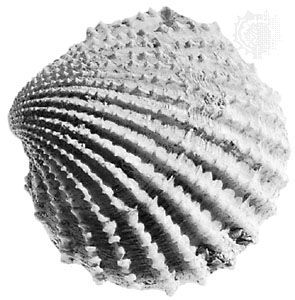
Venericardia is a genus of pelecypods (clams) that were particularly abundant during the Eocene Epoch, which lasted from approximately 57.8 to 36.6 million years ago.1
These clams are characterized by their generally large, distinctive shells, which consist of two halves known as valves. The exterior of these shells features transverse ribs that radiate from the apex, interrupted by a series of concentric growth rings. Internally, the valves possess specific structural features, including nodes along the edges and thickened, raised bars at the apex, which serve as the surfaces where the valves articulate.1
What are pelecypods?
Pelecypods, also known as Bivalvia (or bivalves), are a class of more than 15,000 species of mollusks that includes clams, oysters, mussels, scallops, and cockles.234
The name “pelecypod” is derived from the Greek words pelekys (ax) and pous (foot), referring to the ax-shaped foot used by many members of this class for locomotion. Key characteristics of pelecypods include:53
- Shell Structure: They possess a shell divided into two valves (left and right) that are connected by a hinge.24
- Body Plan: They have a laterally compressed body and have lost the distinct head and radular (rasping) organ found in most other mollusks.23
- Feeding: Most species are sedentary and function as suspension or deposit feeders, often using modified respiratory gills called ctenidia to filter food from the water.23
- Habitat: They are found in diverse environments, ranging from marine to limnic (freshwater) habitats, at depths from 0 to 10,700 meters.3
What was the climate like during the Eocene Epoch?
The Eocene Epoch (56 million to 33.9 million years ago) was characterized by a generally warm and humid climate, featuring widespread temperate and subtropical forests rather than extensive grasslands.6
The epoch began with the Paleocene-Eocene Thermal Maximum (PETM), a period of intense global warming where temperatures rose by more than 5 °C (9 °F). During this time, high-latitude Arctic sea surface temperatures reached approximately 23 °C (73 °F), comparable to modern subtropical seas. Following the PETM, global temperatures briefly declined before rising again during the “Eocene Optimum,” a period of peak warmth.78
After this optimum, the climate entered a steady cooling trend toward the Eocene-Oligocene boundary. This cooling was likely driven by tectonic movements, specifically the opening of sea passages between Antarctica, Tasmania, and South America, which isolated Antarctica within a cold polar sea and altered global oceanic circulation. Decreasing atmospheric carbon dioxide concentrations are also believed to have contributed to this irreversible cooling trend.78
How do fossils help scientists understand ancient environments?
Fossils serve as essential tools for scientists to reconstruct ancient environments and understand the history of life on Earth. Through the field of paleoecology, researchers analyze the relationships between ancient organisms and their surroundings to interpret the conditions of the past.10
Fossils provide direct evidence of ancient climates and habitats in several ways:
- Environmental Indicators: Certain organisms have specific environmental requirements. For example, the presence of specific coral species indicates the existence of warm, shallow waters, while certain plant fossils suggest warm, swampy conditions similar to modern wetlands like the Everglades or the Pantanal.11
- Climatic Shifts: Palynology—the study of ancient pollen and spores—allows scientists to track changes in vegetation over time. Because these particles are wind-dispersed and resistant to decay, they provide a record of successive climatic changes in a region.12
- Geographic Context: When fossils typical of warm climates are discovered in modern polar regions, it provides strong evidence that the Earth’s crust has shifted position over geologic time.11
Beyond environmental reconstruction, fossils are used to date sedimentary rock layers and correlate them across different geographic locations, helping scientists build a continuous fossil record of Earth’s history.131114
Sources
- Venericardia — Encyclopædia Britannica
- bivalve — Encyclopædia Britannica
- pelecypod — Merriam-Webster
- mollusk - Annotated classification — Encyclopædia Britannica
- bivalve — Merriam-Webster
- Climate change - Cenozoic climates — Encyclopædia Britannica
- Paleocene-Eocene Thermal Maximum — Encyclopædia Britannica
- Eocene Epoch — Encyclopædia Britannica
- Paleocene Epoch — Encyclopædia Britannica
- index fossil — Encyclopædia Britannica
- fossil record — Encyclopædia Britannica
- paleoecology — Merriam-Webster
- geology - Palynology — Encyclopædia Britannica
- dating - Principles and techniques — Encyclopædia Britannica
- trace fossil — Merriam-Webster
Published on · 3 min read