Climax
The term climax carries distinct meanings depending on the context, primarily in literature and ecology.
What is climax?
The term climax carries distinct meanings depending on the context, primarily in literature and ecology.
In Literature and Rhetoric
Derived from the Greek word for “ladder,” a climax represents the point of highest interest or emotional response in a narrative. In dramatic structure, it serves as the turning point or crisis where the rising action shifts toward falling action. In rhetoric, it refers to arranging words or ideas in an ascending order of importance.1
In Ecology
In ecology, a climax community is the final, stable stage of biotic succession in a given environment. At this stage, the community is dominated by prominent, long-lived species that successfully reproduce while preventing new species from gaining a foothold. While this state of equilibrium appears stable, it is not permanent, as long-term shifts in climate and evolutionary processes eventually alter the environment. A specific type, known as a biotic climax, is driven primarily by the influence of living organisms.234
What are the other stages of a story’s plot?
In the traditional five-act dramatic structure, often referred to as Freytag’s Pyramid, the plot is organized into five distinct stages that guide the narrative arc. Beyond the climax, these stages include:6
- Exposition: The introductory phase where the author establishes the setting, introduces the characters, and provides necessary background information.
- Rising Action: A series of events that build tension, complicate the situation, and lead the characters toward the central conflict.
- Climax (Crisis): The turning point of the narrative where the protagonist’s fate is sealed and the direction of the plot shifts.6
- Falling Action: The stage following the climax where the consequences of the turning point unfold and the tension begins to dissipate.
- Denouement (Resolution): The final outcome of the story, where conflicts are resolved and the narrative reaches its conclusion.
While these stages provide a classic framework, it is important to note that modern storytelling often experiments with these structures, and the importance of plot itself has been debated throughout the history of literary criticism.2
How does ecological succession begin in a new environment?
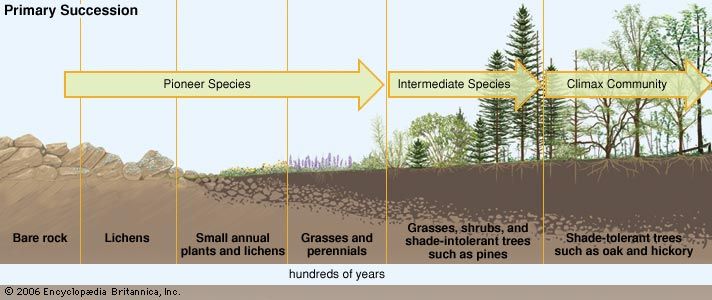
Ecological succession in a new, barren environment is known as primary succession. This process begins in areas that lack soil or cannot sustain life, such as lava-sterilized landscapes, newly formed sand dunes, or rock exposed by retreating glaciers.78
The colonization process typically follows these steps:
- Arrival of Pioneer Species: The first organisms to colonize the area, known as pioneer species—such as bacteria, lichens, and mosses—arrive via wind or water. These species are adapted to harsh, nutrient-poor conditions and reproduce quickly.79
- Soil Formation: As pioneer species grow, they release acids that break down rock. When they die, their decomposing organic matter mixes with mineral particles to create the first pockets of soil.79
- Increased Complexity: As soil accumulates, it supports more complex life. Hardy, fast-growing plants like grasses arrive, followed by shrubs and eventually trees.79
- Community Transition: As taller plants become established, they shade out the sun-loving pioneer species. Animal species also begin to arrive, further contributing to the ecosystem’s development.79
- Climax Community: Over decades, the community transitions through intermediate stages until it reaches a climax community, a relatively stable state dominated by prominent, long-lived species.78
What is the difference between a climax and a turning point in a story?
While the terms “climax” and “turning point” are often used interchangeably in casual conversation, they serve distinct functions in literary analysis.
A turning point, or peripeteia, is the specific moment in a drama where the protagonist’s fortune shifts—often from good to bad—setting the plot on a steady path toward its denouement. It acts as a structural pivot where the rising action is reversed into falling action.512
A climax, derived from the Greek word for “ladder,” refers to the point of highest emotional intensity or interest in a story. While the climax often functions as the decisive crisis or turning point, the two do not always coincide. In some narratives, the emotional peak may occur separately from the structural shift that dictates the story’s final outcome. Essentially, while a turning point marks a change in direction, a climax marks the peak of the audience’s engagement and the narrative’s tension.1213
Sources
- ecological succession: Top Questions — Encyclopædia Britannica
- climax — Encyclopædia Britannica
- climax — Encyclopædia Britannica
- biotic climax — Merriam-Webster
- climax — Merriam-Webster
- plot — Encyclopædia Britannica
- primary succession — Encyclopædia Britannica
- pioneer species — Encyclopædia Britannica
- secondary succession — Encyclopædia Britannica
- ecological succession — Encyclopædia Britannica
- What Is the Difference Between Primary and Secondary Ecological Succession? — Encyclopædia Britannica
- turning point — Merriam-Webster
- peripeteia — Encyclopædia Britannica
Published on · 3 min read