Biome
Temperature and precipitation are primary determinants of biome distribution, as they dictate the environmental conditions that shape ecological communities…
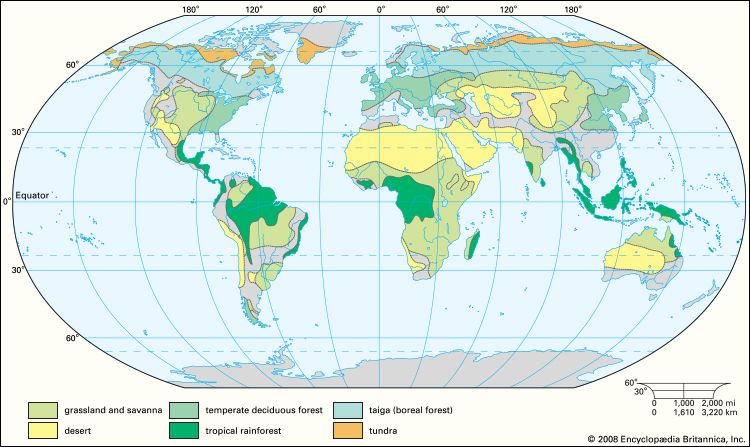
How do climate factors like temperature and precipitation influence biome distribution?
Temperature and precipitation are primary determinants of biome distribution, as they dictate the environmental conditions that shape ecological communities and the life strategies of the species within them.1
- Temperature: This factor influences the metabolic and physiological requirements for plant growth. For example, in tropical regions, consistently high temperatures support tropical rainforests, whereas in mountain ecosystems, decreasing temperatures at higher altitudes create distinct zones, eventually reaching a tree line where conditions become too harsh for tree growth.23
- Precipitation: The total amount and seasonal distribution of rainfall are critical. Tropical rainforests require high, evenly distributed annual rainfall, while regions with pronounced dry seasons support tropical deciduous forests. In mountains, relief forces air to rise and cool, creating orographic precipitation on windward slopes and rain shadows on leeward sides, which significantly alters local vegetation.23
These factors often interact with topography and latitude to create complex bioclimatic regions. Because species adapt to these long-term patterns, rapid climate change poses a significant threat to existing ecosystems and biodiversity.245
How do transitional zones between biomes, called ecotones, function?
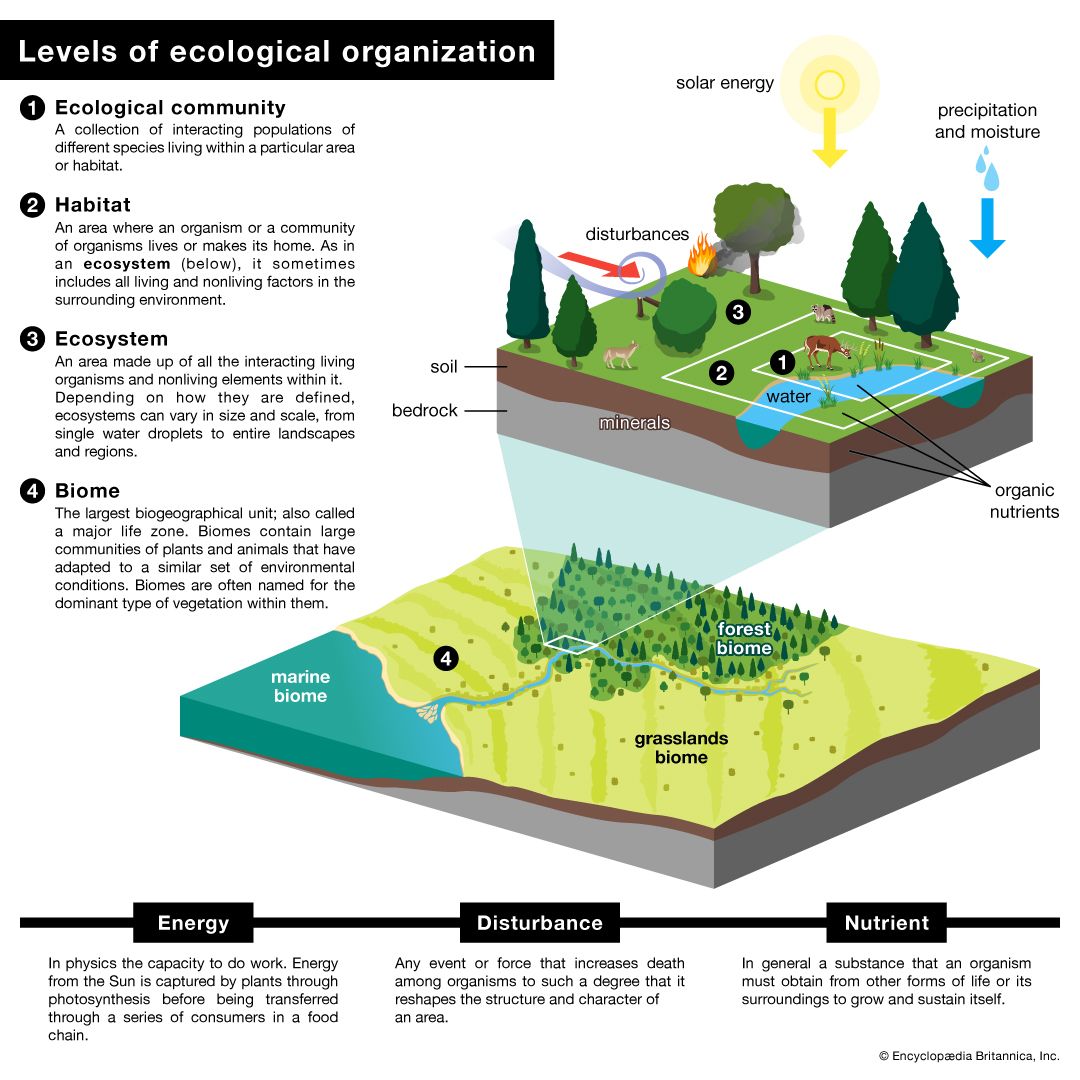
An ecotone is a transitional zone of vegetation occurring between two distinct biological communities, such as a forest and a grassland. These zones function as junction areas where the characteristics of both bordering communities blend together.67
Key functions and features of ecotones include:
- Increased Biodiversity: Ecotones often exhibit a higher population density and a greater number of species than the surrounding communities. This phenomenon is known as the edge effect, where the abrupt transition creates a unique habitat that may host species from both sides, as well as specialized organisms adapted specifically to the transition zone.687
- Ecological Utility: Many species rely on these transitional areas for essential life activities, including courtship, nesting, and foraging.6
- Dynamic Interactions: Ecotones can be sites of intense biological interaction. For example, in North America, the brown-headed cowbird frequently exploits ecotones between mature forests and younger patches to parasitize the nests of other birds.7
Ecotones can exist as broad belts or small pockets and are also found at aquatic-terrestrial boundaries, such as marshes, estuaries, and lagoons.6
What are the main types of terrestrial biomes and their characteristics?
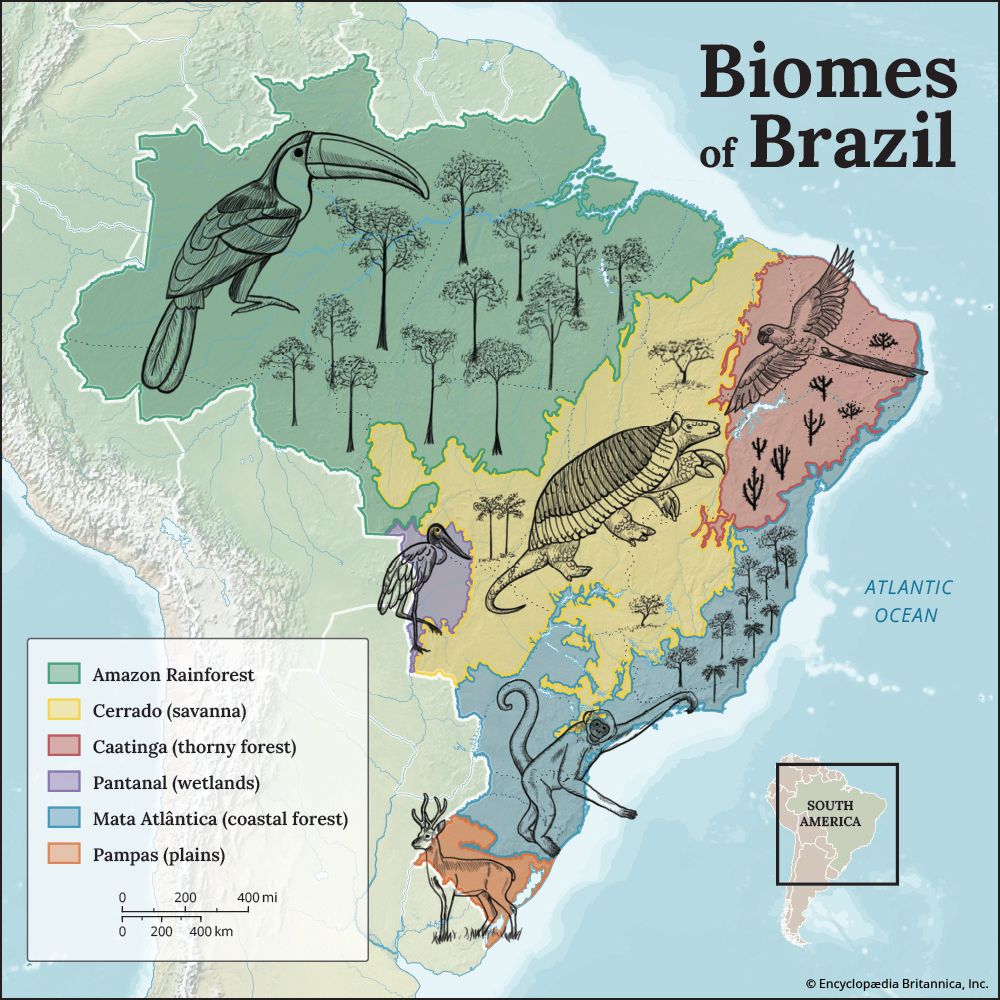
Terrestrial biomes are large-scale biological communities defined by their dominant vegetation and the environmental conditions they inhabit. While classifications vary, scientists often recognize five major types: aquatic, grassland, forest, desert, and tundra, though some systems divide these into 14 distinct biomes.1011
Major Terrestrial Biomes
- Forests: These biomes are characterized by a continuous canopy of trees. They include:
- Tropical Rainforests: Found in equatorial regions with high, year-round rainfall and consistently high temperatures.12
- Temperate Forests: Located between 25° and 50° latitude, these are divided into deciduous forests (warm summers, frosty winters) and evergreen forests (mild, frost-free winters).13
- Taiga (Boreal Forest): A circumpolar belt of evergreen conifers adapted to long, cold winters and short growing seasons.1
- Grasslands: These exist as intermediates between forests and deserts, where moisture is insufficient for dense tree growth but enough to prevent desertification. They are categorized into tropical grasslands (often associated with savannas) and temperate grasslands.14
- Deserts: Defined by extreme aridity, these regions lack the moisture necessary to maintain a continuous, permanent vegetation cover.14
- Tundra: The coldest biome, characterized by low temperatures and a lack of trees, often merging with the taiga at its southern limit.101
These biomes are not merely products of current climate; their distribution is also influenced by historical geologic events and evolutionary history.11
What is biome succession and how does it occur over time?
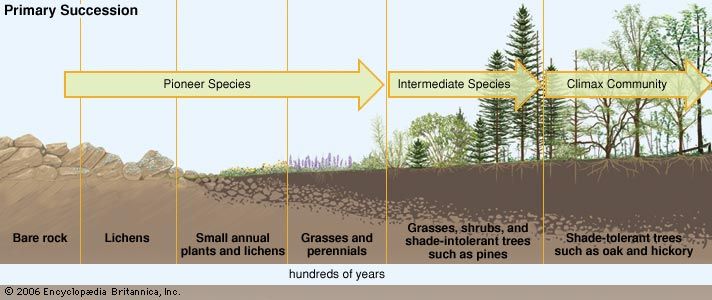
Ecological succession is the process by which the structure of a biological community evolves over time through a partially predictable sequence of species changes. This progression occurs as species modify their environment—altering factors like soil mineral composition or light availability—making the habitat more suitable for subsequent species.15
Succession is categorized into two primary types:
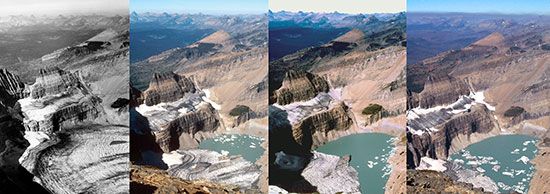
- Primary succession: Occurs in essentially lifeless areas where soil cannot yet sustain life, such as regions formed by lava flows, sand dunes, or retreating glaciers. Pioneer species—such as lichens, mosses, and bacteria—colonize these areas, breaking down rock and forming soil.1516
- Secondary succession: Occurs in areas where a community previously existed but was removed by a disturbance, such as a wildfire, flood, or human activity. Because the soil retains nutrients and seeds, the recovery process is typically faster than in primary succession.17
Over time, these stages may lead to a climax community, a stable state where the species composition remains consistent because the resident species successfully reproduce and prevent invaders from gaining a foothold.18
Sources
- Tropical rainforest - Environment — Encyclopædia Britannica
- Mountain ecosystem - Environment — Encyclopædia Britannica
- Global warming - Environmental consequences of global warming — Encyclopædia Britannica
- United States - The bioclimatic regions — Encyclopædia Britannica
- biogeographic region — Encyclopædia Britannica
- ecotone — Encyclopædia Britannica
- edge effect — Merriam-Webster
- community ecology - Ecotones — Encyclopædia Britannica
- Wetland - Effects of climate change — Encyclopædia Britannica
- biome — Encyclopædia Britannica
- Taiga — Encyclopædia Britannica
- Climate classification - Empirical classifications — Encyclopædia Britannica
- Temperate forest — Encyclopædia Britannica
- Grassland - Origin — Encyclopædia Britannica
- ecological succession — Encyclopædia Britannica
- pioneer species — Encyclopædia Britannica
- secondary succession — Encyclopædia Britannica
- climax — Encyclopædia Britannica
- plant - Succession and zonation — Encyclopædia Britannica
Published on · 4 min read