Clouded Leopard
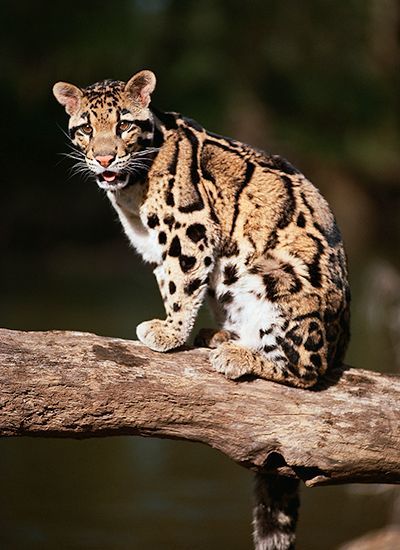
There are two distinct species of clouded leopard, each with its own geographic range:
Where are clouded leopards primarily found in the wild?
There are two distinct species of clouded leopard, each with its own geographic range:
- Neofelis nebulosa: This species is found on the mainland of southeastern Asia, primarily inhabiting forests and other wooded regions.12
- Neofelis diardi: Also known as the Bornean clouded leopard, this species is found on the islands of Borneo and Sumatra.12
Both species are known for being arboreal, meaning they spend much of their time in trees. Their populations have faced significant declines due to threats such as deforestation and hunting.12
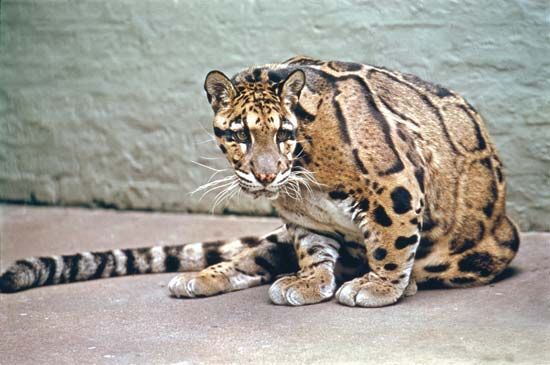
How does the clouded leopard’s size compare to other wild cats?
The clouded leopard is classified as a medium-sized cat. While it is sometimes grouped with “big cats” in older or alternative classifications, it is significantly smaller than members of the genus Panthera, such as the leopard, lion, tiger, and jaguar.123
For comparison, a male clouded leopard typically weighs about 23 kg (50 pounds) and reaches a body length of approximately 106 cm (42 inches). In contrast, the common leopard (Panthera pardus) is much larger, with an average weight ranging from 50 to 90 kg (110 to 200 pounds) and a body length of about 210 cm (84 inches).23
Despite its smaller stature, the clouded leopard possesses unique anatomical features; it is a short-legged cat with upper-canine teeth that are proportionately longer than those of any other cat species.2
How does the clouded leopard’s lifestyle and behavior differ from other big cats?
The clouded leopard is distinct from the “big cats” of the genus Panthera (such as the lion, tiger, and jaguar) in both its classification and its specialized lifestyle. While historically grouped with these roaring cats, the clouded leopard belongs to its own distinct genus, Neofelis.13
Regarding their behavior and lifestyle, key differences include:
- Arboreal Specialization: Unlike many larger cats that are primarily terrestrial, the clouded leopard is highly arboreal, living and hunting extensively in trees.12
- Dietary Focus: They prey on birds and small mammals, such as monkeys and pigs, reflecting their tree-dwelling habits. In contrast, larger Panthera species often target medium-to-large ungulates like antelopes or deer.13
- Anatomy: The clouded leopard is a short-legged cat with upper-canine teeth that are proportionately longer than those of any other cat species, an adaptation that differs from the dental structure of the larger Panthera cats.1
While both clouded leopards and common leopards are nocturnal and agile climbers, the clouded leopard’s life is more fundamentally tied to the forest canopy.13
What is the scientific name of the clouded leopard and how is it classified?
There are two distinct species of clouded leopard, both belonging to the genus Neofelis:14
- Neofelis nebulosa: Found on the mainland of southeastern Asia.12
- Neofelis diardi: Also known as the Bornean clouded leopard, found on the islands of Sumatra and Borneo.12
These two species are genetically distinct and are thought to have diverged approximately 1.4 million years ago.1
In terms of biological classification, the clouded leopard is a member of the family Felidae and the subfamily Pantherinae. While they were historically placed in the genera Panthera or Felis in older classification systems, they are now recognized within their own genus, Neofelis.41
Sources
- clouded leopard — Encyclopædia Britannica
- clouded leopard — Merriam-Webster
- leopard — Encyclopædia Britannica
- feline - Evolution and classification — Encyclopædia Britannica
Published on · 3 min read