Club Moss
Club mosses are classified as primitive, seedless vascular plants belonging to the class Lycopodiopsida. Within this class, they are placed in the order…
What is the taxonomic classification of club mosses?
Club mosses are classified as primitive, seedless vascular plants belonging to the class Lycopodiopsida. Within this class, they are placed in the order Lycopodiales, which consists of the single family Lycopodiaceae.
Under the taxonomic consensus known as the PPG I system, this family includes 16 extant genera, such as Lycopodium, Huperzia, and Lycopodiella. While they are often referred to as “mosses,” they are distinct from true mosses (division Bryophyta), which are nonvascular plants.1234
How do club mosses disperse their spores?
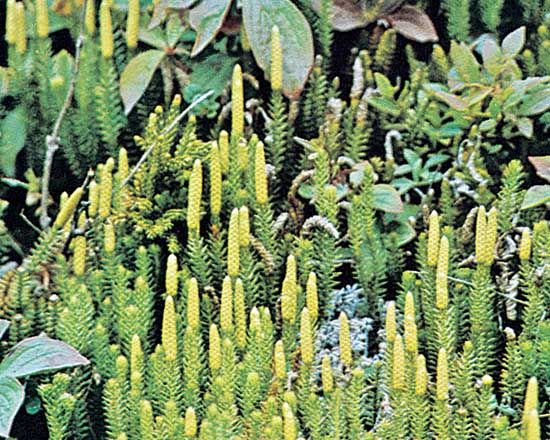
Club mosses (family Lycopodiaceae) are homosporous plants, meaning they produce a single type of spore. These spores are housed within kidney-shaped sporangia located at the base of specialized leaves called sporophylls. In many species, these sporophylls are clustered into conelike structures known as strobili, though some species, such as the shining club moss (Huperzia lucidula), bear their spore capsules scattered along the branches.
While the specific mechanical processes for spore release in club mosses differ from the specialized annular mechanisms found in some ferns, the spores are generally shed from the sporangia and dispersed by the wind. Once released, the spores must land in a suitable environment to germinate and develop into a gametophyte, which is the sexual phase of the plant’s life cycle.
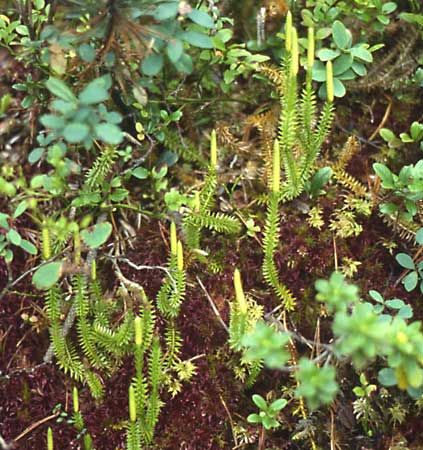
What are the unique characteristics of club moss plants in terms of their structure and reproduction?
Club mosses (family Lycopodiaceae) are primitive, seedless vascular plants that exhibit several unique structural and reproductive characteristics.
Structural Characteristics
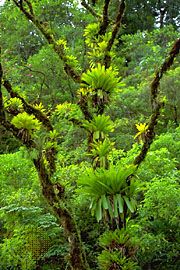
- Growth Habit: These plants are typically low-growing, evergreen herbs. Their stems may creep along the ground or rise erectly from rhizomes, and some species function as epiphytes.
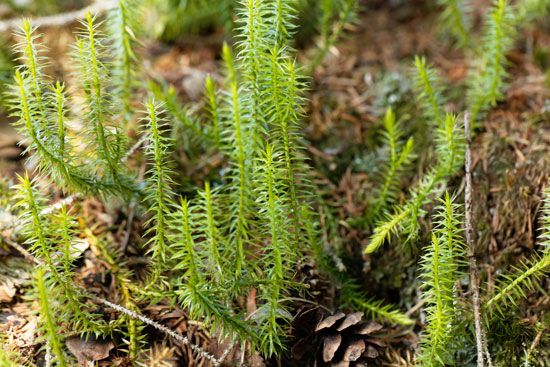
- Leaves and Stems: They possess small, needlelike or scalelike leaves that are often arranged spirally or in vertical rows. Each leaf contains a single unbranched midvein.
- Branching: Branching is generally dichotomous (forking into two equal parts).
Reproductive Characteristics
- Spore Production: Club mosses are homosporous, meaning they produce only one type of spore. These spores are housed in kidney-shaped capsules located at the base of specialized leaves called sporophylls.
- Strobili: In many species, these sporophylls are aggregated into distinct, club-shaped conelike structures known as strobili. However, some species lack these structures, instead bearing spore capsules along their branches.
- Life Cycle: They undergo an alternation of generations between the spore-producing sporophyte (the familiar plant) and the sexual gametophyte. These gametophytes are often subterranean and, in many north temperate species, rely on a symbiotic fungus for development.
What are some common species of club mosses, and where can they typically be found?
Club mosses (family Lycopodiaceae) are a diverse group of seedless vascular plants found primarily in tropical mountains and northern forests across both hemispheres.2
Here are some common species and their typical habitats:
- Common club moss (Lycopodium clavatum): Also known as running pine or stag’s horn moss, this species is native to open, dry woods and rocky areas in the Northern Hemisphere.2
- Shining club moss (Huperzia lucidula): Found in North America, this species typically inhabits wet woods and rocky environments.2
- Ground pine (Dendrolycopodium obscurum): This plant is native to moist woods and bog margins in northern North America and eastern Asia.2
- Alpine club moss (Diphasiastrum alpinum): Native to cold woods and alpine mountains throughout northern North America and Eurasia.2
- Bog club mosses (Lycopodiella species): These are found in bogs and various wetland habitats globally.2
- Pygmy club moss (Phylloglossum drummondii): A unique species found in parts of Australia and New Zealand.2
Sources
- club moss — Merriam-Webster
- club moss — Encyclopædia Britannica
- moss — Encyclopædia Britannica
- Plant - Class Lycopodiopsida — Encyclopædia Britannica
- lycophyte — Encyclopædia Britannica
- lycophyte - Annotated classification — Encyclopædia Britannica
- Plant reproductive system - Mosses — Encyclopædia Britannica
- lycophyte - Life cycle — Encyclopædia Britannica
- Fern - The sporangium — Encyclopædia Britannica
- lycophyte - Form and function — Encyclopædia Britannica
- Plant - Division Bryophyta — Encyclopædia Britannica
- lycopodium — Merriam-Webster
Published on · 3 min read