Tempskya
Tempskya is a genus of fossil tree ferns that existed during the Mesozoic Era, approximately 65 to 250 million years ago. It is the sole member of the family…
What is Tempskya?
Tempskya is a genus of fossil tree ferns that existed during the Mesozoic Era, approximately 65 to 250 million years ago. It is the sole member of the family Tempskyaceae within the order Polypodiales.1
These plants were noted for their unusual structure. They possessed an unbranched trunk that could reach up to 6 meters (20 feet) in height and 40 cm (16 inches) in diameter. The upper two-thirds of the trunk were densely covered in small leaves. The lower portion of the trunk was composed almost entirely of fibrous roots, while the stems were scattered among these roots, becoming free but compressed together as they extended into the upper part of the trunk.1
What other types of plants lived during the Mesozoic Era?
During the Mesozoic Era (approximately 252 to 66 million years ago), terrestrial ecosystems were dominated by gymnosperms, or “naked-seed” plants, which thrived alongside various non-seed plants.345
Dominant Gymnosperms
Gymnosperms were the primary vegetation for much of the era, including several groups that remain extant today and others that are now extinct:
- Conifers: These cone-bearing plants, such as ancestors of modern pines, formed a significant portion of Mesozoic forests.35
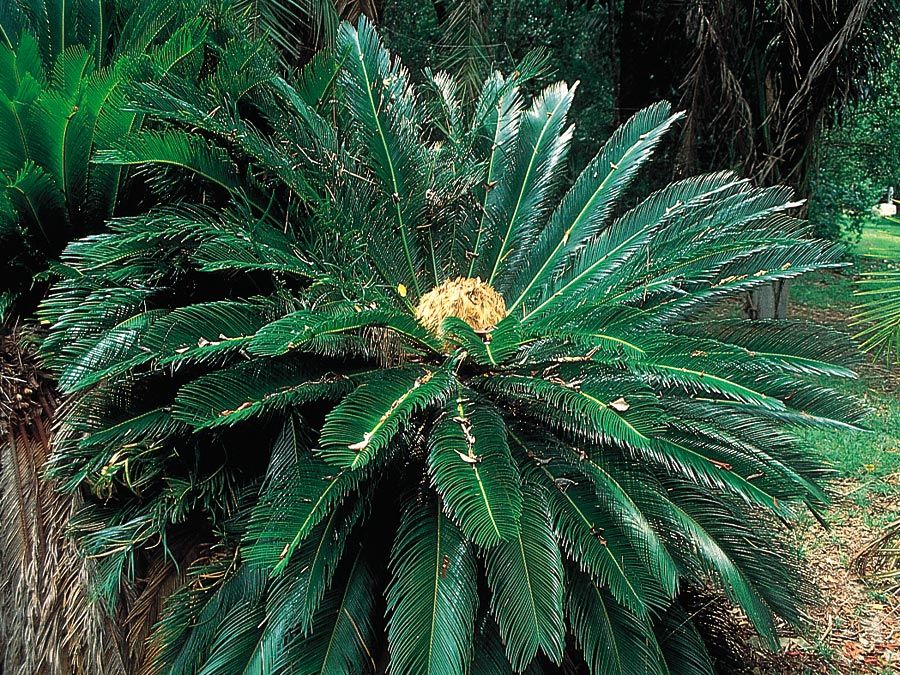
- Cycads and Cycadeoids: The Jurassic Period is often called the “Age of Cycads” due to their widespread proliferation. While cycads survive today, the cycadeoids were an extinct group of palmlike plants that produced reproductive structures in rosettes.36
- Ginkgos: The ginkgo was a widespread gymnosperm during this era, though it is represented by only one living species today.35
- Seed Ferns: Early in the era, groups like Dicroidium were prominent, particularly in the southern supercontinent of Gondwana.37
Non-Seed Plants
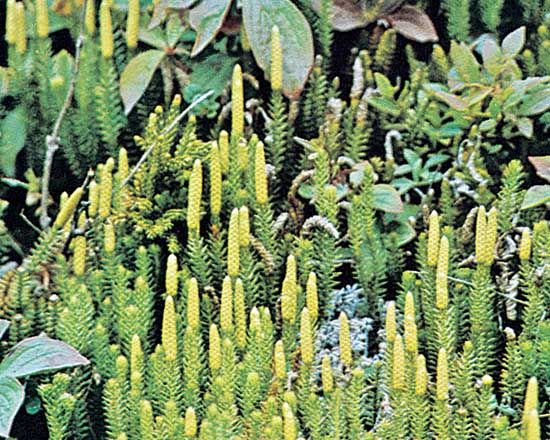
Ferns, horsetails, and lycopods (relatives of modern club mosses) served as important understory vegetation, particularly in moist or wetland environments.7
The Rise of Angiosperms
While gymnosperms dominated for most of the Mesozoic, angiosperms (flowering plants) began to emerge and diversify during the Cretaceous Period. By the middle to late Cretaceous, these plants—including early ancestors of magnolia, laurel, and sycamore families—rapidly rose to dominance, aided by coevolution with insect pollinators.85
How do scientists determine the age of plant fossils like Tempskya?
Scientists determine the age of plant fossils like Tempskya primarily through a combination of biostratigraphy and radiometric dating.
Biostratigraphy and Index Fossils
The relative age of fossil-bearing rock is often established using biostratigraphy, which involves identifying and arranging fossils within sedimentary layers. This method relies on the principle of faunal succession, which observes that specific plant and animal forms appear in a predictable order throughout geologic history. Geologists use index fossils—distinctive, widespread, and short-lived species—to correlate rock layers across different geographic regions and define boundaries in the geologic time scale boundaries in the geologic time scale.11
Radiometric Dating
To assign absolute ages to these rock layers, scientists use radiometric dating. This technique measures the radioactive decay of isotopes within minerals. By analyzing the ratio of “parent” radioactive atoms to “daughter” atoms in a sample, researchers can calculate the time elapsed since the rock or mineral formed.12
When volcanic ash layers are present near fossil deposits, they serve as highly effective “key beds.” Because these layers settle over vast areas in an instant of geologic time and often contain crystals suitable for radiometric measurement, they provide precise absolute dates that help calibrate the relative ages established by fossils.11
What makes tree ferns different from modern ferns we see today?
Tree ferns are a specialized group of ferns within the order Cyatheales that differ significantly from the typical ferns encountered in most environments today. The primary distinctions lie in their physical structure and growth habit:
- Arborescent Habit: Unlike most modern ferns, which are herbaceous and grow close to the ground, tree ferns possess an arborescent (treelike) habit, with some species reaching heights of 25 meters (80 feet) or more.1819
- Trunk Composition: While seed-bearing trees rely on bark and wood for support, the trunks of tree ferns are composed of rhizomes that have been modified to grow vertically. These trunks are embedded in a dense, fibrous mantle of adventitious roots.18
- Morphological Features: Tree ferns are primarily categorized into two main families, Cyatheaceae and Dicksoniaceae, which are distinguished by their leaf coverings. Dicksoniaceae leaves are typically covered in hairs, whereas Cyatheaceae are characterized by scales and sometimes sharp spines on their petioles.18
- Evolutionary History: While modern ferns are relatively uniform in their basic structure, tree ferns have a distinct fossil record dating back to the Triassic Period. Although they were common during the Jurassic and Cretaceous periods, the specific genera we see today only became evident during the early Cenozoic.18
Sources
- Tempskya — Encyclopædia Britannica
- bryophyte - Annotated classification — Encyclopædia Britannica
- Jurassic Period - Plants — Encyclopædia Britannica
- gymnosperm — Encyclopædia Britannica
- Angiosperm - Paleobotany and evolution — Encyclopædia Britannica
- Plant - Evolution of seed plants and plant communities — Encyclopædia Britannica
- Did you know? — Merriam-Webster
- Cycadeoidophyta — Encyclopædia Britannica
- Tertiary Period - Flowering plants and grasses — Encyclopædia Britannica
- Triassic Period - Plants — Encyclopædia Britannica
- index fossil — Encyclopædia Britannica
- biostratigraphy — Merriam-Webster
- dating - Principles and techniques — Encyclopædia Britannica
- Origins of agriculture - Research techniques — Encyclopædia Britannica
- dating - Principles of isotopic dating — Encyclopædia Britannica
- Tertiary Period - Correlation of Tertiary strata — Encyclopædia Britannica
- Earth sciences - Micropaleontology — Encyclopædia Britannica
- tree fern — Encyclopædia Britannica
- Fern - Fossil record — Encyclopædia Britannica
- Fern - Ecology — Encyclopædia Britannica
- Fern - Comparisons with leaves of other plant groups — Encyclopædia Britannica
- Fern - Size range and habitat — Encyclopædia Britannica
Published on · 3 min read