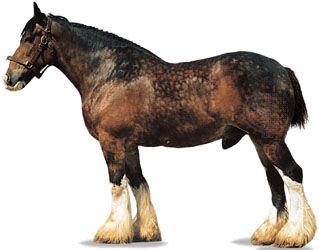
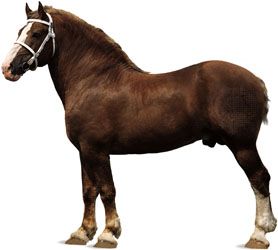
Clydesdale
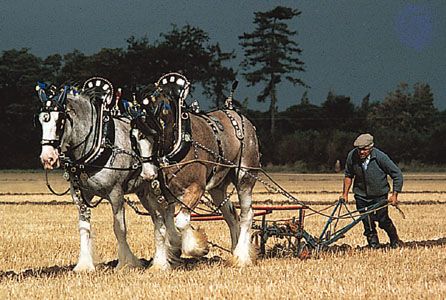
The Clydesdale is a heavy draft-horse breed distinguished by several specific physical traits:
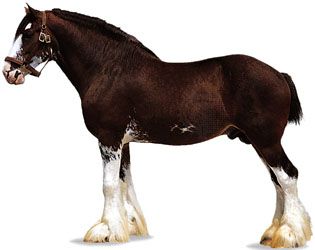
What are the physical characteristics that distinguish Clydesdale horses from other breeds?
The Clydesdale is a heavy draft-horse breed distinguished by several specific physical traits:
- Size and Build: These horses are large, typically averaging 17 to 18 hands (68 to 72 inches) in height and weighing approximately 2,000 pounds.1
- Leg Characteristics: A defining feature of the breed is the presence of “feather,” which consists of long, silky hair covering the lower legs. They are also noted for their well-formed legs and feet, as well as a distinctive, high-stepping action when walking or trotting.12
- Appearance: Clydesdales possess attractive heads and are commonly found in bay, dark brown, or black coat colors, which are frequently accented by prominent white markings.1
While they share a history with other draft breeds like the Shire, their specific combination of high-stepping movement and extensive leg feathering helps set them apart.1
Where did Clydesdale horses originate, and how did they get their name?
The Clydesdale horse breed originated in Lanarkshire, Scotland, in the region surrounding the River Clyde1.1
The breed derives its name directly from this geographic origin, as it was developed in the valley of the River Clyde, often referred to as the Clydesdale area. The breed was significantly improved around 1715 through the crossbreeding of local mares with a Flemish stallion, and later, Shire blood was introduced to further refine the stock.231
What were Clydesdale horses traditionally used for throughout history?
Clydesdale horses were traditionally bred and utilized as draft animals, a role defined by their capacity to pull heavy loads. Throughout history, horses categorized as draft breeds—including the Clydesdale—have been essential for a variety of demanding tasks, such as:1
- Agricultural Work: They were frequently employed for farm labor, including pulling plows to prepare fields for planting.1
- Transportation and Hauling: These horses were used to pull various wheeled vehicles, such as carts, wagons, and carriages, to transport bulk commodities or heavy equipment.1
- Industrial and Forestry Operations: Beyond the farm, they were utilized to haul logs out of forests during lumbering operations and were sometimes used to draw barges or assist in tasks like threshing grain and pumping water.1
By utilizing a harness with a rigid, padded collar, these powerful animals could efficiently transfer their muscle strength to perform these labor-intensive duties, often working in teams to move exceptionally heavy loads.1
What is the history of draft horses in agriculture?
The history of draft animals in agriculture dates back to before 3000 BCE in Mesopotamia, where they were used for farm work and pulling wheeled vehicles. While cattle were historically the most common draft animals, horses eventually supplanted them in many regions due to their efficiency and strength.4
A pivotal development in this history was the invention of the horse collar, which originated in China. Before this, older harness bands pressed against an animal’s windpipe, severely restricting its power. The rigid, padded collar allowed horses to exert their full strength, enabling them to perform heavier tasks like plowing and hauling.5
Throughout the 19th century, it was common to see long teams of draft animals—sometimes numbering up to 24—used to pull bulk commodities or large machine parts. Despite the horse’s utility, many farmers continued to use oxen because they were less expensive to purchase and maintain. Today, the use of draft animals persists in less-developed regions, where they remain valued for their low maintenance, the utility of their manure, and their ability to thrive on locally grown feed.45
Sources
- Clydesdale — Encyclopædia Britannica
- Clydesdale — Merriam-Webster
- River Clyde — Encyclopædia Britannica
- Draft animal — Encyclopædia Britannica
- horse - General features — Encyclopædia Britannica
- Origins of agriculture - Plows and plowing — Encyclopædia Britannica
Published on · 3 min read