Coast Redwood
Coast redwood trees (Sequoia sempervirens) are endemic to the fog belt of the Coast Ranges in western North America. Their native range extends from southern…
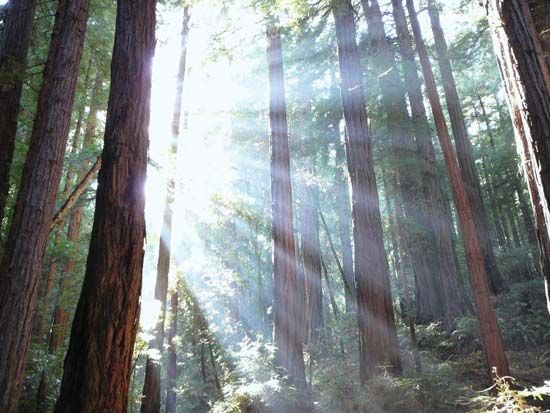
Where are coast redwood trees primarily found, and what kind of habitat do they prefer?
Coast redwood trees (Sequoia sempervirens) are endemic to the fog belt of the Coast Ranges in western North America. Their native range extends from southern Monterey County in California to southwestern Oregon.12
These coniferous evergreen trees thrive in this specific coastal habitat, which provides the consistent moisture they require. They are typically found at elevations up to 1,000 meters (3,300 feet) above sea level. Coast redwoods are remarkably fire-adapted, possessing thick, fibrous, and fire-resistant bark that helps them survive the wildfires common to their environment. While they are a highly valued timber species, they are currently listed as an endangered species.1
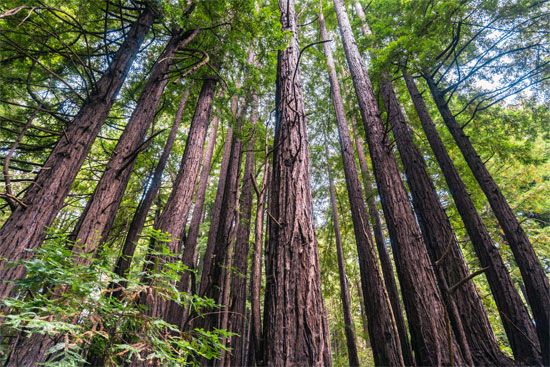
What are the main threats to coast redwood populations, and what conservation efforts are in place to protect them?
The primary threat to coast redwood populations is commercial logging, which has significantly reduced their historical extent and continues to occur outside of protected areas. While the trees are exceptionally fire-adapted due to their thick, fire-resistant bark, they remain vulnerable to the increasing intensity of wildfires, which can cause the loss of individual trees.42
Conservation efforts focus on the preservation of old-growth forests through the establishment of protected lands. Redwood National Park, designated a World Heritage site, serves as a critical sanctuary by protecting virgin groves of these ancient trees. This national park operates in conjunction with several state parks, such as Jedediah Smith Redwoods, Del Norte Coast Redwoods, and Prairie Creek Redwoods, to maintain these ecosystems. Despite their status as an endangered species on the IUCN Red List, it is important to note that they are not currently protected under the U.S. Endangered Species Act.42
What is the cultural significance of coast redwood trees to indigenous peoples of the Pacific Northwest?
For the indigenous peoples of the Northwest Coast, the coast redwood (Sequoia sempervirens) was a vital natural resource that supported their traditional technologies and way of life. Along with other coniferous species like the giant arborvitae, the redwood provided the raw materials necessary for a sophisticated woodworking culture.2
The cultural significance of the tree was rooted in its utility and the skill with which it was harvested and shaped:
- Construction and Housing: In northwestern California, the redwood was essential for architecture. Indigenous groups in this area constructed homes over central pits, utilizing redwood planks for the side walls and building pyramid-style roofs.5
- Watercraft: The trunks of these massive trees were hollowed out to create dugout canoes. These vessels were critical for transportation, trade, and the pursuit of marine resources, with specific designs—such as those with upturned rounded ends and rounded hulls—developed by northwestern California tribes.5
- Artistic Expression: The wood’s workability allowed for extensive carving and embellishment. Everyday items, ceremonial masks, and structural elements were often decorated with intricate designs, reflecting the high value placed on craftsmanship and symmetry in Northwest Coast visual arts.2
How long can coast redwood trees live, and what factors contribute to their longevity?
Coast redwood trees (Sequoia sempervirens) are among the longest-lived species on Earth, with individuals known to live as long as 2,000 years. While they reach maturity between 400 and 500 years of age, they often live for an average of 600 years.82
Several factors contribute to their remarkable longevity:
- Fire Resistance: Coast redwoods are exceptionally fire-adapted. They possess thick, fibrous, and deeply furrowed bark that can reach 30 cm (12 inches) or more in thickness on older trees. This bark is sapless and provides significant protection against fire damage.28
- Resilience to Pests and Decay: The wood of the coast redwood is naturally resistant to decay, insects, and fungi, which helps protect the trees from common biological threats that might otherwise shorten their lifespan.2
- Regenerative Ability: When a tree is damaged by fire, wind, or logging, it has the capacity to sprout new growth from the sapwood below the injured surface, allowing the organism to persist even after significant trauma.2
- Environmental Stability: These trees thrive in the coastal fog belt, which provides consistent moisture, supporting their growth and health over centuries.28
Sources
- Coast Ranges — Encyclopædia Britannica
- coast redwood — Encyclopædia Britannica
- Sequoia — Encyclopædia Britannica
- Redwood National Park — Encyclopædia Britannica
- Northwest Coast Indian — Encyclopædia Britannica
- Northwest Coast Indian - Subsistence, settlement patterns, and housing — Encyclopædia Britannica
- Northwest Coast Indian - Technology and the visual arts — Encyclopædia Britannica
- How Can Some Trees Survive for Thousands of Years? — Encyclopædia Britannica
- giant sequoia — Encyclopædia Britannica
- Pacific mountain system - Plant life — Encyclopædia Britannica
Published on · 3 min read