Sequoia
Sequoia is a genus of conifers in the cypress family that consists of a single living species, the redwood (Sequoia sempervirens). While the giant sequoia…
What is Sequoia?
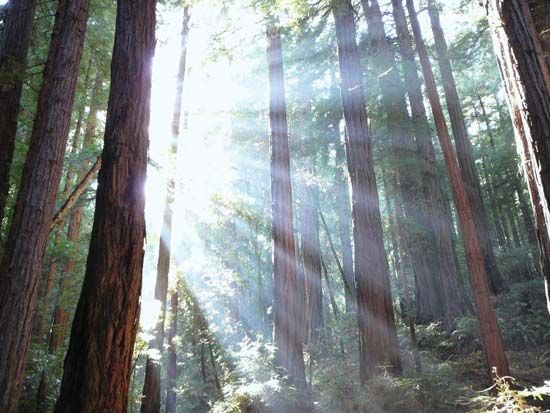
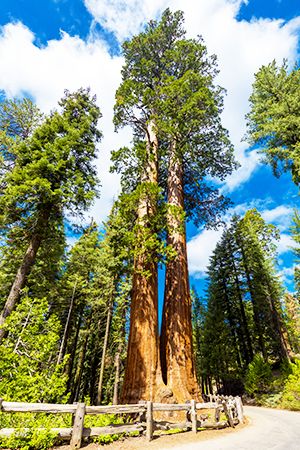
Sequoia is a genus of conifers in the cypress family that consists of a single living species, the redwood (Sequoia sempervirens). While the giant sequoia (Sequoiadendron giganteum) was historically classified within this genus, it is now recognized as the sole species of the genus Sequoiadendron.12
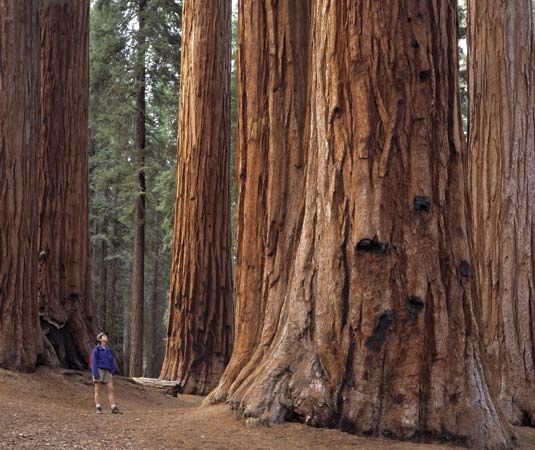
The redwood is native to the fog belt of the California coast and is known for being the tallest living tree. In contrast, the giant sequoia is the most massive tree by volume and is found in scattered groves on the western slopes of the Sierra Nevada mountains. These massive trees are protected in areas such as Sequoia National Park, which was established in 1890. The name of the genus commemorates the Cherokee leader Sequoyah.123
How do giant sequoias rely on wildfires to reproduce?
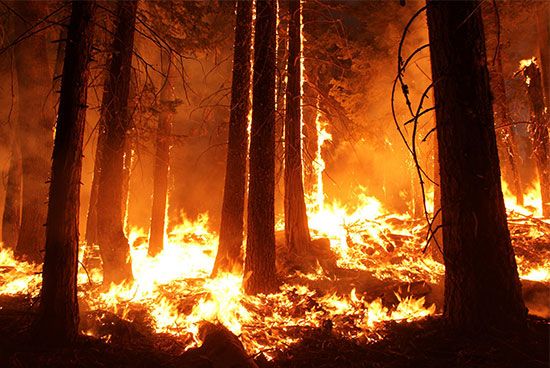
Giant sequoias (Sequoiadendron giganteum) rely on wildfire as a critical ecological disturbance for successful reproduction.24
The process functions through several key mechanisms:
- Cone Opening: The tree’s compact cones remain closed while on the branches, protecting the seeds inside. They are triggered to open and release their seeds immediately following the heat of a wildfire.24
- Seedbed Preparation: Fires clear the forest understory, removing competing vegetation and exposing bare soil. This creates an ideal, ash-fertilized seedbed that stimulates germination and the establishment of new seedlings.4
- Competitive Advantage: Giant sequoias are unable to regenerate effectively among the more shade-tolerant species that accumulate over time in the absence of fire. Periodic burning prevents these other species from dominating the landscape, ensuring the sequoias have the space and light required to grow.4
While most adult conifers are susceptible to fire, the giant sequoia is uniquely adapted to survive these events due to its thick, fire-resistant bark.24
What are the main differences between giant sequoias and coast redwoods?
While both the giant sequoia (Sequoiadendron giganteum) and the coast redwood (Sequoia sempervirens) belong to the cypress family (Cupressaceae), they are distinct species with unique characteristics and habitats.
Key Differences
- Size and Bulk: The coast redwood is the tallest living tree, with some specimens exceeding 112 meters (367 feet). In contrast, the giant sequoia is the most massive tree by volume; while shorter than the tallest redwoods, it possesses a much greater bulk and circumference at its base.25
- Habitat: Coast redwoods are endemic to the fog belt along the Pacific coast from southwestern Oregon to central California. Giant sequoias are found in scattered groves at higher elevations (900 to 2,600 meters) on the western slopes of the Sierra Nevada mountains.25
- Classification: The giant sequoia is the only species in the genus Sequoiadendron, whereas the coast redwood is the sole species in the genus Sequoia.21
- Wood Quality: The wood of the giant sequoia is more brittle than that of the coast redwood, which is a highly valued timber species used extensively in construction and furniture making.25
Who was the Cherokee leader Sequoyah, and why was the tree named after him?
Sequoyah (c. 1775–1843) was a prominent Cherokee silversmith and warrior who famously created the Cherokee syllabary. Born in the Tennessee country, he never learned to read or write English. Recognizing that written language was a source of power and knowledge for white settlers, he spent over a decade developing a system of 86 symbols to represent the syllables of the Cherokee language. By 1821, his system was successfully adopted by the Cherokee Nation, enabling rapid literacy and the publication of books and newspapers in their native tongue.6
The giant redwoods (Sequoia sempervirens) and the big trees of the Sierra Nevada (Sequoiadendron giganteum) were named in his honor. The genus name Sequoia was applied to these trees to commemorate his significant contribution to indigenous literacy and cultural preservation.67
Sources
- Sequoia — Encyclopædia Britannica
- giant sequoia — Encyclopædia Britannica
- Sequoia National Park — Encyclopædia Britannica
- conifer - Sporophyte phase — Encyclopædia Britannica
- coast redwood — Encyclopædia Britannica
- Sequoyah — Encyclopædia Britannica
- Sequoiadendron — Merriam-Webster
Published on · 3 min read