Cochlospermum
Cochlospermum is a genus comprising approximately 15 species of tropical trees belonging to the family Bixaceae (sometimes classified as Cochlospermaceae).…
What is Cochlospermum?
Cochlospermum is a genus comprising approximately 15 species of tropical trees belonging to the family Bixaceae (sometimes classified as Cochlospermaceae). These plants are native to regions in tropical America, Africa, India, and Myanmar.12
Key characteristics and uses include:
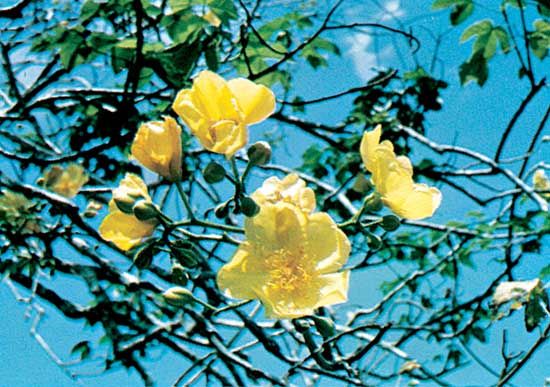
- Appearance: They are known for their palmate leaves and bright-yellow, cup-shaped flowers, such as those of the buttercup tree (C. vitifolium). Their seeds are typically covered in a silky down, and the genus name is derived from the Greek word for a spiral shell, referencing the plant’s coiled embryo.12
- Economic Utility: Various species are valued for their practical applications. The bark of some species is used to make rope, while others are sources of dye—such as the red dye from C. angolense and the yellow dye from C. planchoni. Additionally, C. religiosum produces a gum called kondagogu, which serves as a substitute for gum tragacanth.1
How are plant dyes extracted from seeds and roots?
Historically, the extraction of natural dyes from plant parts like roots and seeds relied on traditional methods that often involved complex, guarded processes. While ancient hieroglyphs document these techniques, many early attempts to isolate colorants failed because natural dyes are often unstable and exist as part of complex mixtures that were difficult to separate with primitive tools.3
A primary example of root-based extraction is alizarin, a red dye obtained from the roots of the madder plant, Rubia tinctorum. In many cases, these colorants are naturally water-soluble due to the presence of sugar residues, though these sugars are frequently lost during the isolation process.34
Because many natural dyes do not adhere well to certain fibers, craftsmen used mordants—inorganic metal salts such as alum, iron, copper, or tin—to fix the dye to the fabric. These mordants react with the dye to create a less soluble compound, ensuring the color remains on the material.5
What are the characteristics of the Malvales order?
The Malvales order, often referred to as the hibiscus or mallow order, is a medium-sized group of angiosperms consisting of 10 families and approximately 6,000 species. These plants are primarily woody and are distributed across diverse habitats globally.6
Common Characteristics
Members of this order share several distinct botanical features:
- Vegetative Traits: Leaves typically exhibit palmate venation and a swollen petiole apex. The bark is often tough and fibrous due to bands of fibers in the phloem. Mucilage cells and stipules are also common.7
- Floral Structure: Flowers frequently feature numerous stamens that develop from initial primordia. The sepals are often valvate (meeting edge-to-edge), while the petals typically overlap in a contorted fashion. Many species lack a nectary disc.7
- Seed and Fruit: The seeds are often hairy or associated with hairy capsule interiors, and the seed coat typically contains a layer of thickened, palisade-like cells.7
The order includes economically significant plants such as cotton, cocoa, kapok, and balsa.8
What is gum tragacanth and how is it used?
Gum tragacanth is a dried, mucilage-forming gum obtained primarily from the shrub Astragalus gummifer, which is native to arid regions of Iran, Asia Minor, and Greece. Unlike some other plant gums that dissolve into clear water solutions, tragacanth forms a mucilage by absorbing large amounts of water. It is valued commercially for its chemical stability and long shelf life.101112
The gum is utilized across several industries:
- Pharmaceuticals: It serves as a binding agent in pill manufacture and as a demulcent (coating) for medicinal purposes.1011
- Food Processing: It functions as an emulsifier in condiments and salad dressings, and as a thickener in various sauces.1012
- Cosmetics and Lubricants: Its mucilage is used in lotions and jelly lubricants, including spermicidal jellies.10
Commercial tragacanth is typically available in the form of powder, flakes, or ribbons.10
Sources
- Cochlospermum — Encyclopædia Britannica
- Cochlospermum — Merriam-Webster
- dye - Natural dyes — Encyclopædia Britannica
- dye - Mordants — Encyclopædia Britannica
- Rubiaceae — Encyclopædia Britannica
- Malvales — Encyclopædia Britannica
- Malvales - Common characteristics — Encyclopædia Britannica
- Malvales - Malvaceae , Cistaceae, and Muntingiaceae — Encyclopædia Britannica
- Sapindales - Meliaceae — Encyclopædia Britannica
- tragacanth — Encyclopædia Britannica
- gum — Encyclopædia Britannica
- tragacanth: Top Questions — Encyclopædia Britannica
Published on · 3 min read