Coelacanth
Modern coelacanths (genus Latimeria) are impressive, slow-growing creatures that typically reach an average length of 5 feet (1.5 meters) and weigh…
How large can coelacanths grow, and what is their average lifespan?
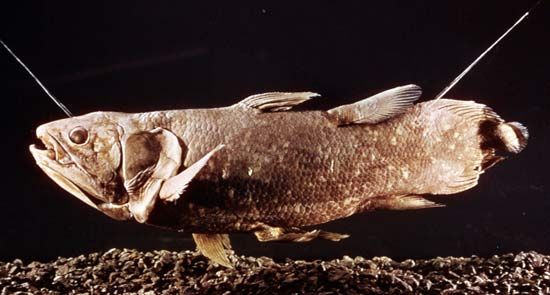
Modern coelacanths (genus Latimeria) are impressive, slow-growing creatures that typically reach an average length of 5 feet (1.5 meters) and weigh approximately 100 pounds (45 kg). While these modern species are larger than most of their fossil ancestors, some ancient forms—such as those from the genera Mawsonia and Rebellartrix—were significantly larger, growing between 13.1 and 19.6 feet (4 to 6 meters) in length.1
Regarding their lifespan, coelacanths are exceptionally long-lived. Research analyzing growth rings in the scales of African coelacanths indicates that these fish do not reach sexual maturity until they are between 40 and 69 years old, and they may live for as long as 100 years.1
What is the origin of the name ‘coelacanth’ and what does it mean?
The name “coelacanth” is derived from the Greek words koilos, meaning “hollow,” and akantha, meaning “spine.” This descriptive name refers to the fish’s distinctively hollow fin spines.21
The term was first used in 1857 and was originally applied to members of the order Coelacanthiformes, a group of lobe-finned fishes known primarily from Paleozoic and Mesozoic fossils. While the name is now most commonly associated with the living genus Latimeria, it historically encompasses a wide variety of fossil species that appeared approximately 400 million years ago.21
What are the unique physical characteristics of coelacanths that distinguish them from other fish?
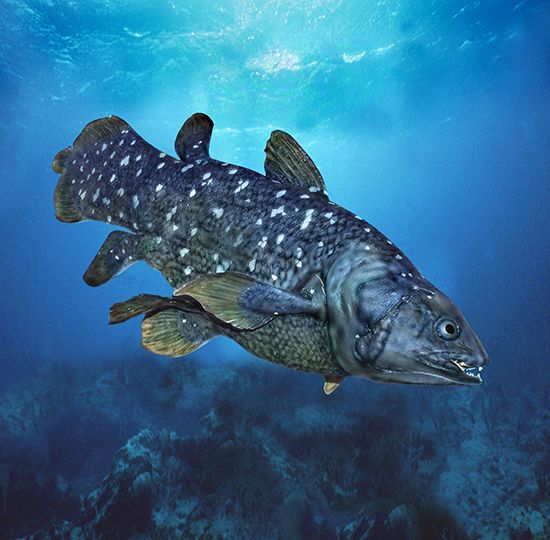
Coelacanths possess several unique anatomical features that distinguish them from other fish, reflecting their status as ancient lobe-finned fishes:
- Intracranial Joint: A defining characteristic is the division of the skull into two distinct units—an anterior (ethmosphenoidal) and a posterior (oto-occipital) section—connected by a strong hinge. Powerful subcranial muscles allow the fish to close this joint.3
- Limb-like Fins: Unlike most fish, coelacanths have pectoral and pelvic fins attached to fleshy, muscular stalks supported by internal skeletal elements. These structures are homologous to the bones found in the limbs of land-dwelling vertebrates.31
- Sensory Organs: The snout contains a specialized “rostral organ” lined with electroreceptive cells, which helps the fish navigate and detect prey in deep-sea environments.3
- Primitive Heart and Notochord: Their heart exhibits nearly perfect bilateral symmetry and is considered highly primitive. Additionally, their skeletal axis remains largely cartilaginous, as the vertebral column is incompletely ossified, allowing the notochord to persist throughout their lives.3
- Internal Anatomy: They possess a large, fat-filled cylinder in the abdomen, which is believed to be a vestigial remnant of a lung apparatus.3
Are there different species of coelacanths, and if so, how do they differ?
There are two living species of coelacanth, both belonging to the genus Latimeria. While they share the same fundamental anatomy—such as their heavy, mucilaginous bodies, limblike fins, and primitive internal organs—they are distinguished primarily by their geographic distribution and conservation status:
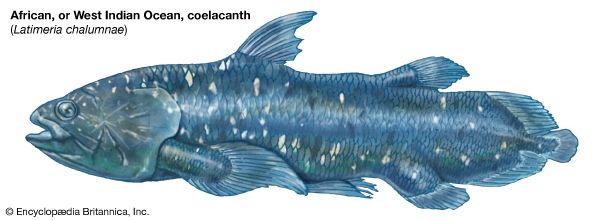
- African Coelacanth (Latimeria chalumnae): This species was the first to be discovered in modern times, famously identified in 1938 near the coast of South Africa. It is found in the Indian Ocean near the coasts of southeastern Africa, Madagascar, and the Comoros. It is currently classified as a critically endangered species.13
- Sulawesi Coelacanth (L. menadoensis): Discovered in the late 1990s, this species inhabits the waters near northern Sulawesi, Indonesia. It is named after the island of Manado Tua, where it was first collected. It is classified as a vulnerable species.13
Both species are long-lived, slow-growing, and inhabit mesopelagic waters at depths of approximately 650 to 1,300 feet (200 to 400 meters). They are both live-bearers that produce well-developed young.1
Sources
- coelacanth — Encyclopædia Britannica
- coelacanth — Merriam-Webster
- crossopterygian — Encyclopædia Britannica
Published on · 3 min read