Paleozoic Era
The Paleozoic Era is a major interval of geologic time that began approximately 538.8 million years ago and concluded about 252 million years ago. It is…
What are the major subdivisions or periods within the Paleozoic Era?
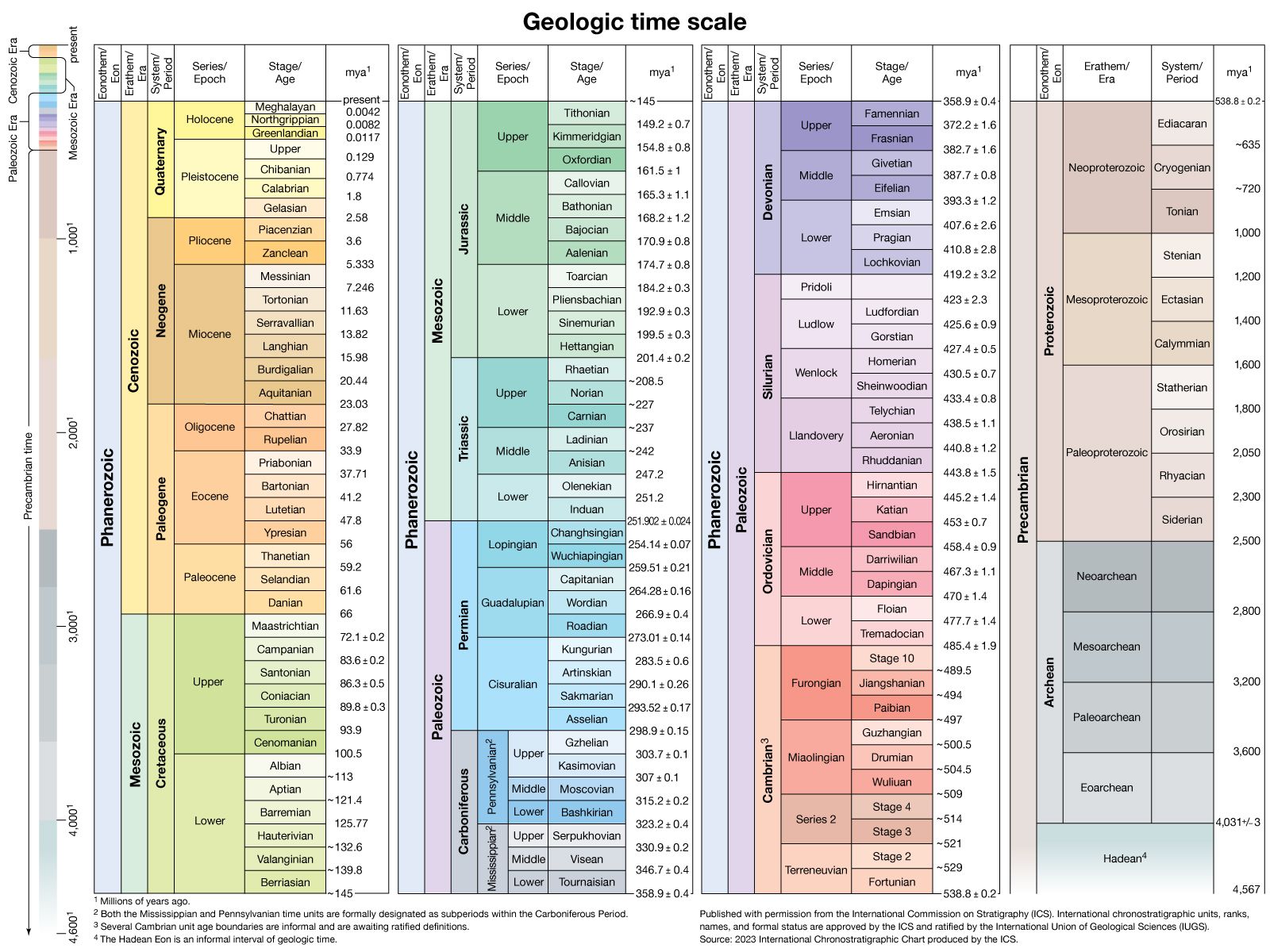
The Paleozoic Era is a major interval of geologic time that began approximately 538.8 million years ago and concluded about 252 million years ago. It is divided into six distinct periods, listed here from oldest to youngest:
- Cambrian Period (538.8 million to 485.4 million years ago): Marked by the “Cambrian explosion,” a rapid diversification of marine animal life.1
- Ordovician Period (485.4 million to 443.8 million years ago): Characterized by high sea levels and the intense diversification of marine invertebrates.21
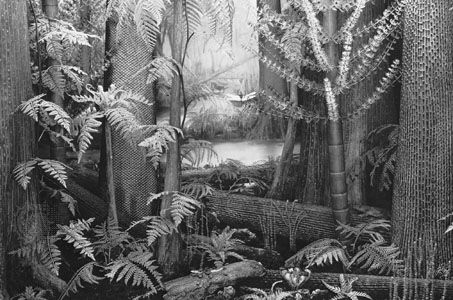
- Silurian Period (443.8 million to 419.2 million years ago): A time when the first vascular plants and invertebrate animals became established on land.1
- Devonian Period (419.2 million to 358.9 million years ago): Notable for the evolution of amphibians from fish.1
- Carboniferous Period (358.9 million to 298.9 million years ago): A period of significant coal formation and the evolution of winged insects and amniote eggs.1
- Permian Period (298.9 million to 252.2 million years ago): Concluded with the largest mass extinction event in Earth’s history.1
What major extinction event marked the end of the Paleozoic Era, and what were its causes?
The end of the Paleozoic Era was marked by the Permian-Triassic extinction event, which stands as the most extensive mass extinction in Earth’s history. This crisis resulted in the loss of approximately 85 to 95 percent of marine invertebrate species and caused significant reductions in the diversity of terrestrial vertebrates and plants.7
Potential Causes
While the exact trigger remains a subject of scientific debate, researchers generally agree that the extinction was likely driven by a combination of catastrophic environmental changes rather than a single event. Key theories include:7
- Volcanic Activity: The prolonged eruption of the Siberian Traps—a massive flood basalt province—is a primary focus. These eruptions likely injected vast quantities of carbon dioxide into the atmosphere, leading to significant global warming and climate instability.8
- Oceanic Anoxia: Evidence from organic-rich shales suggests that widespread oceanic anoxia (a lack of dissolved oxygen) occurred across various depths and latitudes. This was potentially caused by a weakening of oceanic circulation, which would have been devastating to marine life, particularly bottom-dwelling organisms.7
- Disruption of the Carbon Cycle: Significant shifts in the carbon cycle, evidenced by stable isotope ratios, suggest a major disruption in biological processes. This may have been exacerbated by volcanic gases and the burning of coal seams or forests, which further altered atmospheric composition.8
- Temperature Crises: Studies of fossil shell materials indicate extreme fluctuations in ocean surface temperatures, which may have exceeded the thermal tolerance of many specialized marine invertebrates.9
Unlike the later Cretaceous-Paleogene (K-T) extinction, there is no consistent evidence, such as an iridium anomaly, to support a large-scale asteroid impact as the primary cause of the Permian-Triassic crisis.7
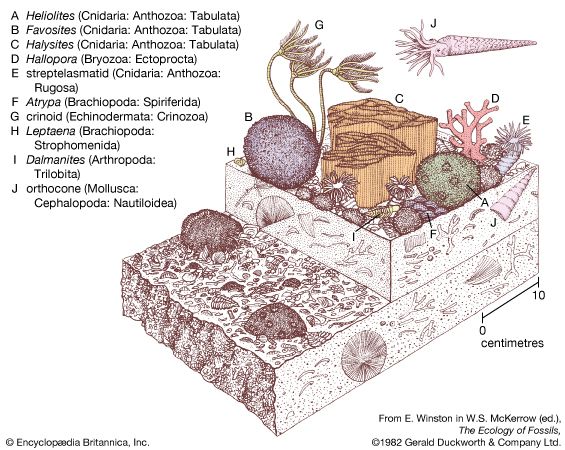
What types of fossils are commonly found from the Paleozoic Era, and what can they tell us about ancient ecosystems?
The fossil record of the Paleozoic Era provides a detailed history of life, primarily documenting the evolution of marine organisms and the subsequent colonization of land. Because these fossils are often found in sedimentary rock deposited in shallow seas, they serve as vital indicators of ancient environments and geologic time.613
Common Paleozoic Fossils
Many Paleozoic fossils are classified as index fossils, which are distinctive, abundant, and geographically widespread, making them ideal for dating rock strata:614
- Trilobites: These three-lobed marine arthropods are the most dominant fossils in Cambrian rocks and remained significant through the Ordovician.615
- Brachiopods: Often resembling clams, these filter-feeding lamp shells were highly diverse and predominate in strata from the Ordovician through the Permian.615
- Corals and Crinoids: Corals and crinoids (echinoderms) were essential reef-builders, particularly during the Devonian Period.15
- Graptolites and Conodonts: Graptolites are useful for dating Ordovician to Silurian rocks, while conodonts—primitive chordates with tooth-shaped remains—are used for Ordovician to Permian strata.6
- Fusulinids: These single-celled, amoeba-like organisms with complex shells are characteristic of Carboniferous and Permian rocks.6
- Ammonoids: These extinct mollusks became abundant in the Devonian and are key for correlating strata through the Mesozoic.615
Insights into Ancient Ecosystems
Fossils allow scientists to reconstruct past climates and environments. For example, the presence of specific coral species indicates warm, shallow-water conditions. If such fossils are discovered in regions that are now polar, it provides evidence that the Earth’s crust has shifted over time. Furthermore, the transition of life from water to land is captured in the fossil record, showing how plants and animals evolved to overcome dependence on moist environments, such as the development of amniote eggs and seeds.13616
What were some of the key geological events that occurred during the Paleozoic Era?
The Paleozoic Era (538.8 million to 252 million years ago) was a transformative interval characterized by significant tectonic activity, the assembly of supercontinents, and dramatic shifts in global climate and sea levels.17
Tectonic Assembly and Supercontinents
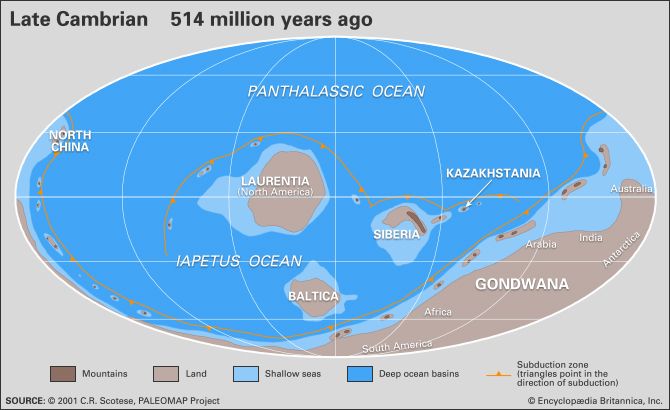
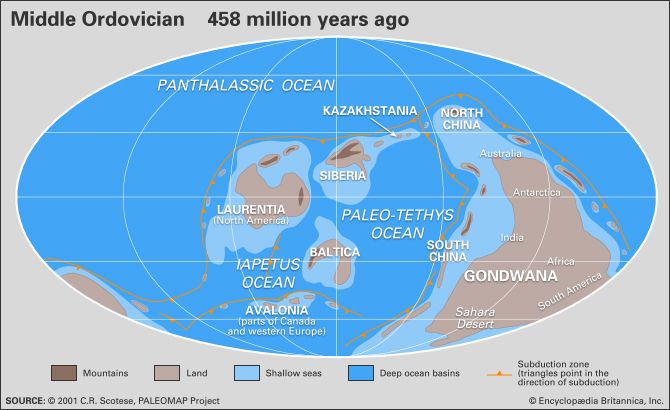
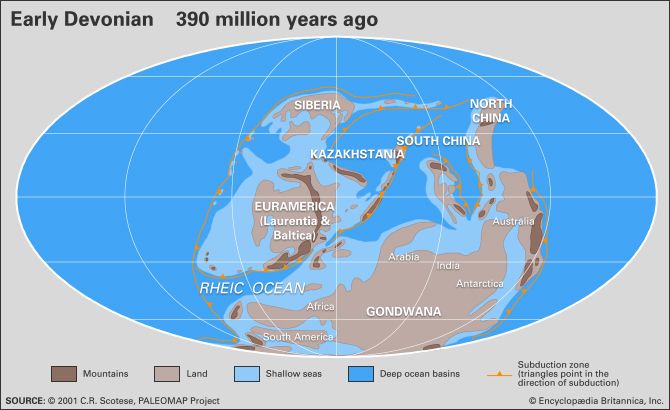
The era was defined by the movement and collision of major landmasses. At the start of the Paleozoic, the supercontinent Gondwana—comprising present-day Africa, South America, Australia, Antarctica, and the Indian subcontinent—was already forming. Throughout the era, other cratons such as Laurentia (North America and Greenland), Baltica (Scandinavia and western Europe), and Siberia drifted across the globe.1718
These movements led to major collisional events, including the closing of the Iapetus Ocean, which resulted in the formation of mountain ranges such as the Appalachians, the Caledonides, and the Urals. By the end of the era, these tectonic processes culminated in the final amalgamation of all major landmasses into the supercontinent Pangea.171920
Sea-Level Changes and Climate
The Paleozoic experienced significant fluctuations in sea level, often driven by the expansion and contraction of ocean basins and the presence of continental ice sheets.621
- Continental Flooding: For much of the era, shallow seas episodically inundated large portions of the continents, creating environments that fostered the diversification of marine life.17
- Glacial Episodes: The era saw distinct “icehouse” phases, most notably during the Carboniferous and Permian periods, when extensive glaciers covered parts of Gondwana.21
- Volcanism: The late Paleozoic was marked by intense magmatic activity, including the eruption of the Siberian Traps, which contributed to extreme environmental changes and the massive end-Permian extinction event.182017
Sources
- Cambrian Period: Top Questions — Encyclopædia Britannica
- Ordovician Period — Encyclopædia Britannica
- Paleozoic — Merriam-Webster
- Paleogene Period — Encyclopædia Britannica
- Carboniferous Period - Significant geologic events — Encyclopædia Britannica
- Paleozoic Era — Encyclopædia Britannica
- Mesozoic Era - Mesozoic life — Encyclopædia Britannica
- Permian Period - Marine invertebrates — Encyclopædia Britannica
- Permian Period - Temperature crises — Encyclopædia Britannica
- Triassic Period - Permian-Triassic extinctions — Encyclopædia Britannica
- Permian extinction - Alteration of the carbon cycle — Encyclopædia Britannica
- K–T extinction — Encyclopædia Britannica
- fossil record — Encyclopædia Britannica
- Devonian Period - Invertebrates — Encyclopædia Britannica
- plant - Evolution of seed plants and plant communities — Encyclopædia Britannica
- index fossil — Encyclopædia Britannica
- Cambrian Period — Encyclopædia Britannica
- South America - The formation of Pangea — Encyclopædia Britannica
- paleogeography - Agents of paleogeographic change — Encyclopædia Britannica
- Climate change - Phanerozoic climates — Encyclopædia Britannica
- Europe - Caledonian orogenic belt — Encyclopædia Britannica
Published on · 5 min read