Coffea
Coffee plants are susceptible to several significant plant diseases and pests that can severely impact global production.
What are the major diseases and pests that affect coffee plants?
Coffee plants are susceptible to several significant plant diseases and pests that can severely impact global production.
Major Diseases
- Coffee Rust: Caused by the fungus Hemileia vastatrix, this is a devastating foliar disease. It manifests as yellowish, oily spots on leaves that eventually turn orange-red and brown, leading to leaf drop and significantly reduced yields or tree death.12
- Coffee Berry Disease: Caused by the fungus Colletotrichum coffeanum, this disease primarily attacks Coffea arabica plants. While Coffea canephora (Robusta) is generally resistant to these fungal threats, it is often considered to produce lower-quality beans than Arabica.12
Major Pests
- Coffee Berry Borer: The beetle Stephanoderes hamjei is a prominent parasite that damages the seeds of both Arabica and Robusta coffee plants.1
Management strategies include the use of fungicide sprays, shifting cultivation to higher altitudes, and utilizing agroforestry practices to reduce the risks associated with monocultures.2
How do different species of Coffea vary in terms of flavor profiles and caffeine content?
The global coffee industry is primarily supplied by two species of the genus Coffea: Coffea arabica and C. canephora (commonly known as Robusta). These species differ significantly in their chemical composition and sensory profiles:34
- Coffea arabica: This species is widely regarded for producing a brew that is milder, more aromatic, and more flavorful than Robusta. Because of these qualities, it is highly valued in the specialty coffee market.354
- C. canephora (Robusta): As the name implies, this plant is hardier and more resistant to pests, making it cheaper to produce. However, it is generally considered less flavorful than Arabica and is frequently used in inexpensive commercial coffee blends.345
- Caffeine Content: A key chemical distinction is that Robusta contains approximately twice the caffeine content of Arabica.354
While these two species dominate the market, other species exist with distinct characteristics. For instance, C. liberica is sometimes noted for having a flavor profile superior to Robusta, though its cultivation is limited by high susceptibility to disease. Additionally, C. eugenoides is grown on a very small scale for specialty coffee and is notable for its low caffeine content.4

What is the life cycle of a coffee plant, from seed to fruit-bearing?
The life cycle of a coffee plant begins in a nursery, where seedlings or cuttings are raised before being transplanted into coffee plantations at the start of the rainy season.7
Once planted, the young coffee plants require three to four years of care, which primarily involves trimming to establish a strong, balanced framework and to stimulate future fruiting. After this period, the plants begin to produce fruit. The cycle from blooming to the maturation of the fruit varies by variety and climate: it takes approximately seven months for Coffea arabica and about nine months for Coffea canephora (Robusta).78
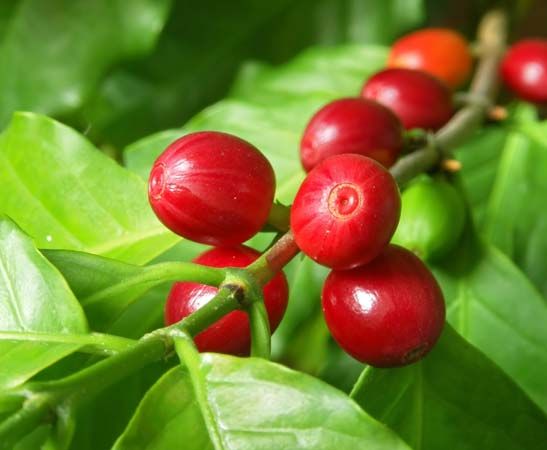
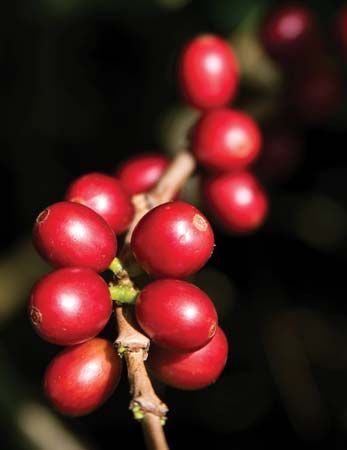
The ripened fruits, known as coffee cherries, are typically red-purple when fully mature and are harvested by hand. Each cherry generally contains two coffee seeds, or “beans,” positioned flat against one another. Occasionally, a cherry contains only one seed, known as a peaberry. Following harvest, the seeds must be removed from the fruit and dried before they are ready for roasting.89
How has climate change impacted coffee plant cultivation and production globally?
Climate change poses a significant threat to the global coffee industry, primarily through projected increases in extreme heat and drought, which jeopardize the stability of production in vulnerable regions. Because coffee plants require specific climatic conditions—typically temperatures between 23 and 28 °C (73 and 82 °F) and consistent rainfall—rising global temperatures are forcing farmers to struggle to adapt their cultivation practices.82
One of the most severe impacts of global warming is the exacerbation of coffee rust, a devastating fungal disease. While some plantations have attempted to mitigate this by moving crops to higher, cooler altitudes where the fungus struggles to reproduce, global warming is expected to facilitate the spread of the disease into these higher elevations as well.11
To combat these environmental pressures, there is a renewed interest in agroforestry or shade-grown coffee. This method, which mimics natural forest conditions, can help slow the spread of disease and provide broader environmental benefits, such as improved water filtration and carbon sequestration.1112
Sources
- Coffee production - Diseases — Encyclopædia Britannica
- Coffee rust — Encyclopædia Britannica
- coffee — Encyclopædia Britannica
- What’s the difference between coffee and tea? — Encyclopædia Britannica
- Coffee production — Encyclopædia Britannica
- Coffea — Encyclopædia Britannica
- Coffee production - Harvesting and processing — Encyclopædia Britannica
- Coffee production - Cultivation — Encyclopædia Britannica
- coffee - Processing the bean — Encyclopædia Britannica
- seed - Afterripening, stratification, and temperature effects — Encyclopædia Britannica
- coffee: Top Questions — Encyclopædia Britannica
- history of coffee — Encyclopædia Britannica
- Coffee production - Shade-grown and sun-grown coffee — Encyclopædia Britannica
Published on · 3 min read