Colobus
Colobus monkeys are a group of approximately two dozen species of Old World monkeys native to Africa, classified into three distinct genera within the…
What are the different species of colobus monkeys, and how do they differ?
Colobus monkeys are a group of approximately two dozen species of Old World monkeys native to Africa, classified into three distinct genera within the subfamily Colobinae. All colobus monkeys are largely thumbless and possess complex, multi-chambered stomachs adapted for fermenting a vegetarian diet of leaves and seeds.12
The three genera are distinguished primarily by their coloration and social behaviors:
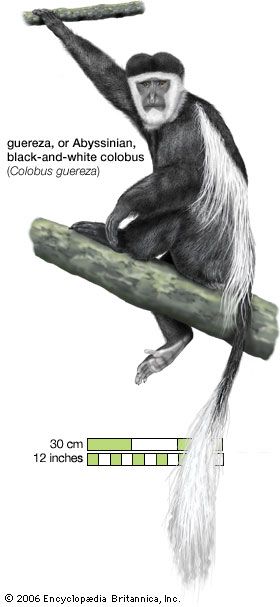
- Black-and-white colobus (Colobus): These seven species are slender with long, silky fur. They live in small, territorial groups and are known for their loud “jumping-roaring” displays.1
- Red colobus (Piliocolobus): Comprising 17 species, these monkeys are brown or black with red markings. Unlike their black-and-white relatives, they live in large, non-territorial troops and lack dramatic vocal displays.1
- Olive colobus (Procolobus verus): This is a small, quiet, and secretive species with olive-colored fur, found in West Africa.1
A unique feature shared by red and olive colobus—but not black-and-white colobus—is that subadult males develop perineal swellings that mimic those of females, likely to avoid eviction from the troop.1
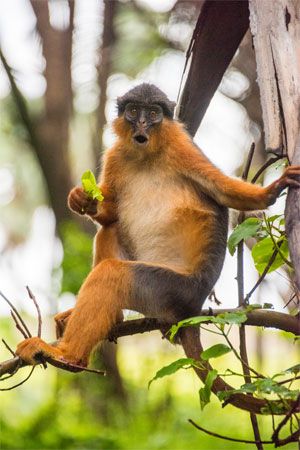
What are the distinguishing physical characteristics of colobus monkeys?
Colobus monkeys are characterized by several distinct physical traits adapted to their arboreal lifestyle and specialized diet. As members of the subfamily Colobinae, they possess complex, multi-chambered stomachs designed for the bacterial fermentation of leaves and seeds.13
Key physical characteristics include:
- Thumblessness: All three genera of colobus monkeys are generally thumbless.1
- Body Size and Build: They are slender, long-tailed monkeys. Black-and-white colobus are approximately 55–60 cm (22–24 inches) long, while red colobus species are about half a meter (1.6 feet) long, excluding their tails.1
- Coloration: They are categorized by their fur color:
- Perineal Swellings: A unique feature of red and olive colobus is the presence of perineal swellings in subadult males that mimic those of females, a trait not found in black-and-white colobus.1
What is the lifespan of a colobus monkey, and how does it compare to other primates?
Sorry, the Britannica knowledge base does not contain information regarding the specific lifespan of colobus monkeys or how it compares to other primates.
How have colobus monkeys adapted to life in the trees?
Colobus monkeys have evolved several specialized physical and behavioral adaptations that allow them to thrive in an arboreal environment:
- Locomotion: As “semibrachiators,” colobus monkeys are highly agile in the trees. They move primarily through a quadrupedal “galloping” gait along branches, but they are also adept at leaping across large gaps and occasionally swinging by their arms. Their long tails, which are significantly longer than their bodies, serve as essential tools for balance and stability during these movements.145
- Digestive Specialization: To exploit the abundant but nutrient-poor foliage found in the canopy, colobus monkeys possess complex, multi-chambered stomachs. This system allows for the bacterial fermentation of cellulose and hemicellulose, enabling them to derive necessary nutrients from a diet of leaves and seeds that other primates might struggle to process.467
- Hand Structure: Colobus monkeys have evolved to be generally thumbless, or have significantly reduced thumbs. While the exact evolutionary rationale for this reduction is not fully understood, it is considered a specific adaptation for their unique style of arboreal locomotion.43
Sources
- colobus — Encyclopædia Britannica
- primate - Distribution and abundance — Encyclopædia Britannica
- monkey - Old World monkeys versus New World monkeys — Encyclopædia Britannica
- primate - Four types of locomotion — Encyclopædia Britannica
- primate - Hands and feet — Encyclopædia Britannica
- primate - Diet — Encyclopædia Britannica
- hand — Encyclopædia Britannica
- Tail — Encyclopædia Britannica
Published on · 3 min read