Gibbon
Gibbons communicate primarily through loud, musical vocalizations that can travel over long distances. These calls serve as essential territorial markers for…
How do gibbons communicate with each other, and what is special about their vocalizations?
Gibbons communicate primarily through loud, musical vocalizations that can travel over long distances. These calls serve as essential territorial markers for both sexes within their monogamous family groups.1
What makes their vocalizations particularly special is the use of a specialized throat sac, which acts as an amplifier to project their sound across the tropical forests of Southeast Asia. Their most characteristic vocal display is the “great call,” which typically takes the form of a duet. In this performance, the female usually leads the sequence, while the male contributes less complex notes. While most species produce musical tones, some, such as the siamang and the hoolock gibbon, possess larger throat sacs that allow for much harsher, booming, or shrieking calls.1
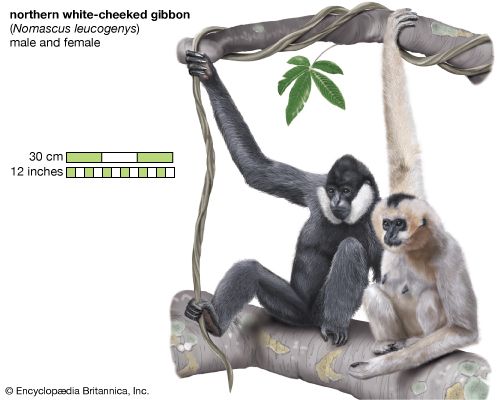
What are the unique physical characteristics of gibbons that distinguish them from other primates?
Gibbons, often referred to as “lesser apes,” possess several unique physical characteristics that distinguish them from the great apes and other primates:
- Specialized Locomotion: Gibbons are the most highly developed brachiators among primates. They are anatomically adapted for swinging from branch to branch with great speed and agility, featuring elongated forelimbs, highly mobile shoulder joints, and long, hooklike fingers.21
- Throat Sac: Unlike great apes, gibbons possess a specialized throat sac used to amplify their loud, musical vocalizations, which serve as territorial markers.1
- Body Build: While they share a humanlike, tailless build with great apes, gibbons are generally smaller and lack the higher cognitive abilities and self-awareness observed in their larger relatives. They also feature denser body hair.13
- Terrestrial Movement: When on the ground, gibbons move in a distinct manner compared to the knuckle-walking great apes; they walk erect on their hind limbs with their arms held aloft or behind them.14
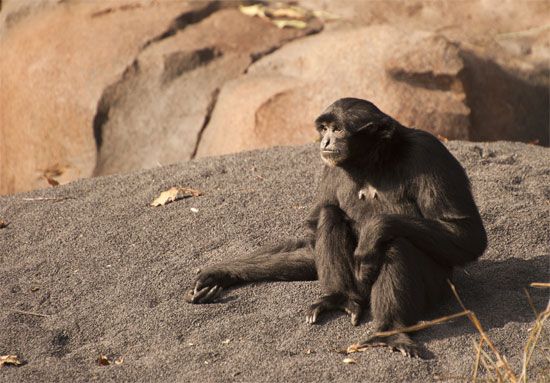
How do gibbons move through the forest canopy, and what makes their locomotion unique?
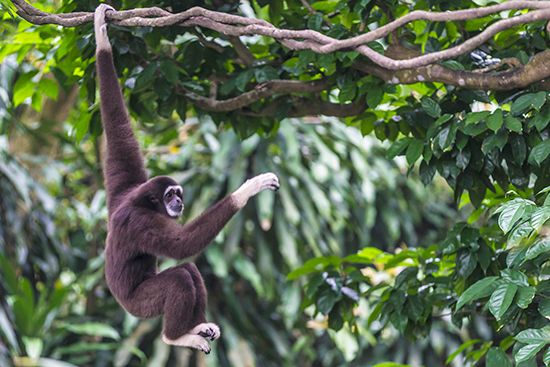
Gibbons move through the forest canopy using a specialized form of arboreal locomotion known as brachiation. This method involves swinging from one hold to another using only the arms, allowing for rapid and continuous forward movement through thick tree canopies.524
The uniqueness of this locomotion lies in the gibbon’s specific anatomical adaptations:
- Arm Structure: Their forelimbs are elongated, often as long as or longer than their body, which provides the necessary reach for swinging.51
- Shoulder Mobility: They possess highly motile shoulder joints that allow the body to pivot and swing forward with great agility.52
- Grip: Their long, hooklike fingers are perfectly adapted for grasping branches securely while suspended.2
During this process, the gibbon suspends its body from a branch, releases one hand, and pivots on the opposite shoulder to swing forward. At the end of the swing, the free arm reaches out to grab the next branch, and the sequence repeats. While this is their primary mode of travel, gibbons are also capable of walking erect on their hind limbs when they occasionally descend to the ground.514
How are gibbons classified within the primate family, and what are their closest relatives?
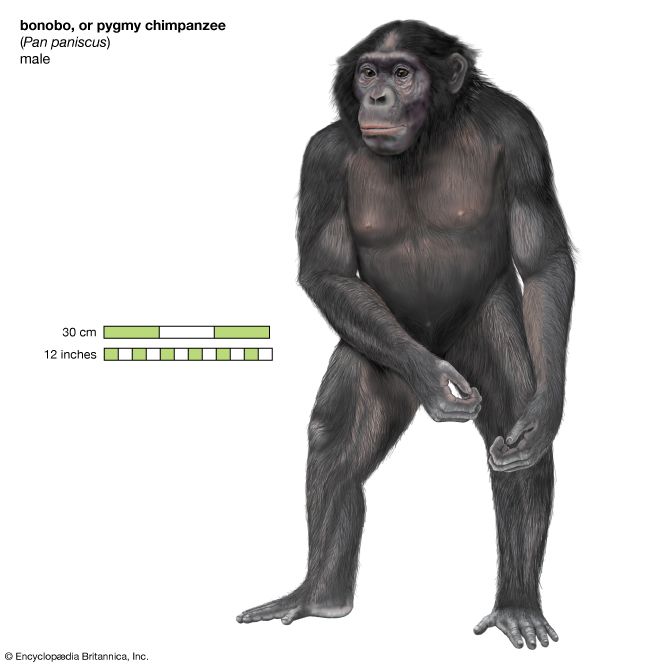
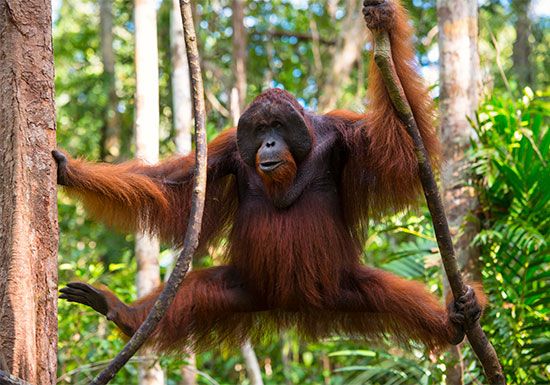
Gibbons are classified within the primate order as members of the family Hylobatidae. Within the broader superfamily Hominoidea, they are distinguished from the family Hominidae—which includes humans, chimpanzees, bonobos, gorillas, and orangutans—and are commonly referred to as “lesser apes” due to their smaller size and lack of certain higher cognitive abilities found in the “great apes”.31
Regarding their evolutionary relationships, gibbons and the family Hominidae diverged from a common ancestor approximately 18 million years ago. While they share a tailless, humanlike build with the great apes, molecular data indicate that the four genera of gibbons (Hoolock, Hylobates, Nomascus, and Symphalangus) are as genetically distinct from one another as chimpanzees are from humans.31
Sources
- gibbon — Encyclopædia Britannica
- brachiation — Encyclopædia Britannica
- ape — Encyclopædia Britannica
- human muscle system - Evolutionary context — Encyclopædia Britannica
- Locomotion - Brachiation — Encyclopædia Britannica
- bat - Annotated classification — Encyclopædia Britannica
Published on · 3 min read