Gerbil
Gerbils (subfamily Gerbillinae) are rodents adapted to arid environments, characterized by several distinct physical traits that aid their survival in harsh…
What are the physical characteristics that distinguish gerbils from other rodents?
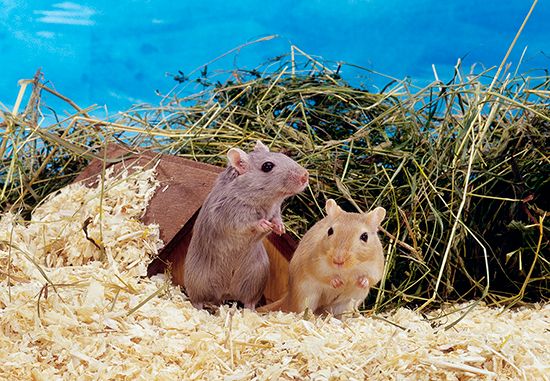
Gerbils (subfamily Gerbillinae) are rodents adapted to arid environments, characterized by several distinct physical traits that aid their survival in harsh habitats.
Key physical characteristics include:
- Limbs and Movement: All gerbils possess long hind feet, which facilitate their characteristic movement of walking or scampering on all four limbs and fleeing in running leaps when alarmed.1
- Sensory Features: They are generally distinguished by fairly large eyes and ears.1
- Body and Fur: Their body forms range from stout and compact to slender and gracile. They have soft, dense, and sometimes silky fur, typically featuring gray, tan, brown, or reddish-brown upperparts with white to grayish underparts.1
- Tail Variation: Tail length varies significantly by species—some are much longer than the head and body, while others are shorter. Adaptations include the fat-tailed gerbil’s club-shaped tail for fat storage and the bushy-tailed jird’s extremely bushy, white-tipped tail.1
- Dentition: Most species have six upper and six lower cheek teeth, though the fat-tailed gerbil is a notable exception with only four lower cheek teeth.1
What do gerbils eat in their natural habitat, and how does this compare to their diet as pets?
In their natural habitat, most gerbils are opportunistic feeders that primarily consume seeds, roots, nuts, green plant parts, and insects. Some species have more specialized diets; for instance, the Indian gerbil is known to eat eggs and young birds, while the fat-tailed gerbil subsists exclusively on insects. In regions with cold winters, they may rely on cached food stored within their burrows.1
Regarding their diet as pets, the provided search results do not contain information on the specific nutritional requirements or recommended diets for domesticated gerbils. Therefore, I cannot provide a comparison between their natural diet and the food they are typically fed in captivity.
How have gerbils been used in scientific research, and what have we learned from them?
The Mongolian gerbil (Meriones unguiculatus) is frequently utilized as a laboratory animal due to its hardy nature, gentle temperament, and convenient size for caged conditions.21
In scientific research, gerbils have been particularly valuable in studies concerning sound reception and auditory sensitivity. Researchers have employed both behavioral and electrophysiological methods to map the hearing capabilities of these rodents, contributing to a broader understanding of how mammalian nervous systems process auditory information. Additionally, the Mongolian gerbil is noted for its high capacity for temperature regulation, a trait that has made it a subject of interest in biological studies regarding environmental adaptation.12
How long do gerbils typically live, both in the wild and as pets?
The provided search results do not contain information regarding the typical lifespan of gerbils, either in their natural habitat or as pets. Consequently, I cannot provide an answer to your query based on the available data.
Sources
- gerbil — Encyclopædia Britannica
- Mongolian gerbil — Merriam-Webster
- sound reception - Common laboratory animals — Encyclopædia Britannica
Published on · 2 min read