Golden Mole
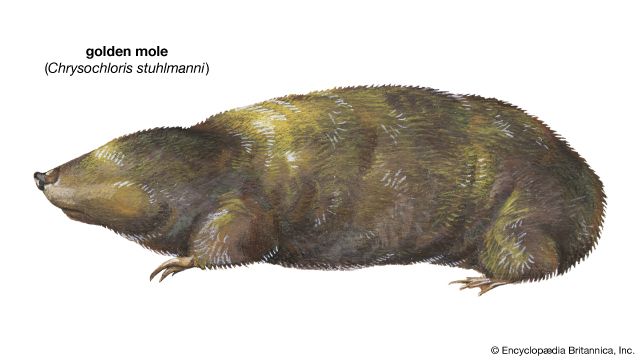
Golden moles are insectivores that primarily consume insects, earthworms, and lizards.
What is the diet of golden moles and how do they find food underground?
Golden moles are insectivores that primarily consume insects, earthworms, and lizards.1
To find food, these animals utilize specialized burrowing behaviors. Many species forage by excavating shallow subsurface tunnels or deeper burrows, using their leathery muzzles, forefeet, and pickax-shaped claws to loosen soil. Once the soil is displaced, they push the debris behind them to clear their path.1
Some species, such as the giant golden mole, forage along the surface, while others, like Grant’s golden mole, are adapted to sandy environments. Grant’s golden mole “swims” through sand using its limbs and muzzle to navigate just below the surface at night. Because they are blind, these creatures rely on their physical adaptations to navigate their subterranean or sandy habitats effectively.1
How have golden moles evolved over time, and what are their closest relatives?
Golden moles are a distinct group of mammals that constitute their own order, Chrysochloridea. Because they are sufficiently different from other moles and insectivores, they are classified separately within the mammalian class. Their evolutionary history, as evidenced by the fossil record, can be traced back to the Early Miocene Epoch, approximately 23.8 to 11.2 million years ago, in Africa.1
Regarding their lineage, golden moles are considered part of a larger group of mammals referred to as insectivores. Their closest living relatives are believed to be the African tenrecs (family Tenrecidae).1
What role do golden moles play in African folklore or culture?
Sorry, the Britannica knowledge base does not contain information regarding the role of golden moles in African folklore or culture.
What is the geographical distribution of golden moles?
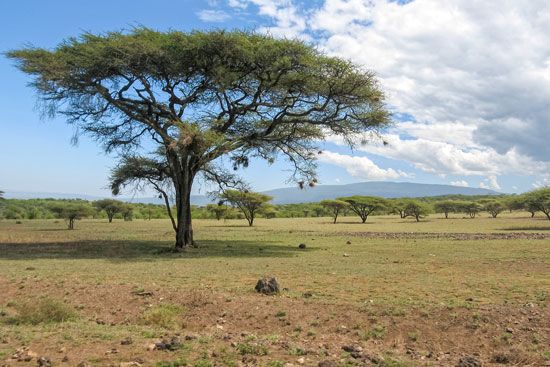
Golden moles are found exclusively in sub-Saharan Africa, where they occupy a diverse range of environments. Their geographical distribution spans from coastal lowlands up to elevations of 3,300 metres (10,800 feet).1
Within this region, these animals inhabit various landscapes, including:
- Forests and savannas1
- Grasslands and rocky hillsides1
- Sandy riverbeds and sand dunes1
- Cultivated fields and golf courses1
While they are widespread across these habitats, they show a distinct preference for loamy or sandy soils, generally avoiding clay or compacted ground. For instance, the giant golden mole is a forest dweller in South Africa, whereas Grant’s golden mole is specifically adapted to life in sand dunes.1
Sources
- golden mole — Encyclopædia Britannica
- Algae - Evolution and paleontology of algae — Encyclopædia Britannica
- mollusk - Evolution and paleontology — Encyclopædia Britannica
- golden mole — Merriam-Webster
Published on · 2 min read