Douc
There are three recognized species of douc, which are colorful langur monkeys belonging to the genus Pygathrix. These primates are distinguished primarily by…
How many species of douc primates are there, and how do they differ?
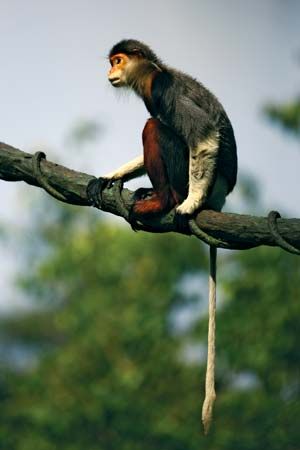
There are three recognized species of douc, which are colorful langur monkeys belonging to the genus Pygathrix. These primates are distinguished primarily by their geographic range and physical coloration:1
- Red-legged douc (P. nemaeus): Found between 14° and 20° N latitude, this species is characterized by maroon-colored legs below the knees and white forearms.1
- Black-shanked douc (P. nigripes): Located south of 14° N, this species features black legs, gray arms, and a darker face.1
- Gray-legged douc (P. cinerea): Discovered in the 1990s, this species is found in isolated forests around 14° N in Vietnam.1
While their ranges overlap in the Southern Highlands of Vietnam, they exhibit very little interbreeding. All three species are currently in danger of extinction due to extensive deforestation in their native habitats of Vietnam, Laos, and Cambodia.1
How do douc primates compare to other types of primates in terms of intelligence and behavior?
Douc primates (Pygathrix) are members of the subfamily Colobinae, a group of Old World monkeys that includes various langurs. Compared to highly intelligent apes like chimpanzees, which are known for complex tool use, cultural transmission of information, and advanced problem-solving, doucs have been only briefly studied in the wild, and their cognitive abilities remain less documented.134
In terms of behavior, doucs are gregarious, living in troops that can range from 4 to over 50 individuals. Like other langurs, they are primarily arboreal and possess specialized, complex stomachs adapted to a diet consisting mostly of young leaves, supplemented by fruit, flowers, and seeds. While some other primate species exhibit complex social structures—such as the monogamous pairs of the joja or the intense dominance hierarchies and infanticidal behaviors seen in Hanuman langurs—doucs are generally characterized by their social grouping and specific dietary adaptations.15
Because they have not been the subject of extensive behavioral research, it is difficult to draw direct comparisons regarding their intelligence relative to the more thoroughly studied great apes.134
Where are douc primates primarily found in the wild?
Douc primates (genus Pygathrix) are primarily found in the tropical forests of central and southern Vietnam, southern Laos, and northeastern Cambodia.1
Within these regions, the three species occupy specific geographic areas:
- Red-legged douc (P. nemaeus): Inhabits areas between 14° and 20° N latitude.1
- Black-shanked douc (P. nigripes): Found south of 14° N, with ranges overlapping the red-legged douc in the Southern Highlands of Vietnam.1
- Gray-legged douc (P. cinerea): Located in a few isolated forests around 14° N in Vietnam.1
What is the diet and feeding behavior of douc primates?
Douc primates (Pygathrix) belong to the subfamily Colobinae, a group of Old World monkeys often referred to as “leaf-eating monkeys”. Despite this classification, they are not exclusively folivorous; their diet is varied and seasonal.71
Diet and Feeding Habits
- Primary Food Sources: Doucs feed primarily on young leaves, which provide essential nutrients.1
- Supplemental Foods: Depending on the season, their diet is supplemented with fruit, flowers, and seeds.71
- Digestive Adaptations: Like other members of the Colobinae subfamily, such as langurs and colobus monkeys, doucs possess specialized, complex stomachs. These anatomical adaptations are necessary to process the cellulose and hemicellulose found in leaves, which require complex digestive fermentation.71
While many primates exhibit omnivorous tendencies, the douc’s reliance on leaves is a specific dietary strategy that influences their ecology and habitat use within the tropical forests they inhabit7.1
Sources
- douc — Encyclopædia Britannica
- primate - Distribution and abundance — Encyclopædia Britannica
- langur — Encyclopædia Britannica
- chimpanzee - Intelligence — Encyclopædia Britannica
- Primatology — Encyclopædia Britannica
- banded leaf monkey — Merriam-Webster
- primate - Diet — Encyclopædia Britannica
- primate - Forest and savanna — Encyclopædia Britannica
Published on · 3 min read