Comb-footed Spider
A comb-footed spider is any member of the family Theridiidae, a diverse group comprising more than 2,500 species and 130 genera distributed globally. They…
What is comb-footed spider?
A comb-footed spider is any member of the family Theridiidae, a diverse group comprising more than 2,500 species and 130 genera distributed globally. They are also commonly referred to as cobweb weavers due to the irregular, tangled, netlike webs they construct.1234
The name “comb-footed” is derived from a distinctive row of curved, comblike bristles located on the tarsus (the “foot”) of their hind legs. These specialized bristles allow the spiders to adeptly fling silken strands over prey that has become ensnared in their webs, a technique known as attack wrapping.142
While the family includes many harmless species, it is also home to the genus Latrodectus, commonly known as black widows, which are recognized for their venomous bites. These spiders exhibit fascinating behaviors, ranging from complex web-building strategies—such as the “ballista” trap used by some species to launch ants into their snares—to unique mating rituals.143
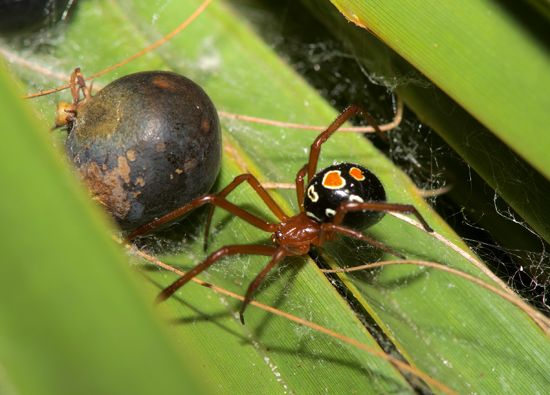
How do black widow spiders differ from other comb-footed spiders?
While all comb-footed spiders (family Theridiidae) share the characteristic of having a row of strong, curved bristles on their hind legs used to fling silk over prey, black widow spiders (genus Latrodectus) are distinguished by several specific traits:
- Venom Potency: Unlike many other comb-footed spiders, black widows possess a potent nerve toxin that is dangerous to mammals, including humans. While their bites are rarely fatal and the spiders are generally not aggressive, the venom can cause severe muscle pain, cramping, nausea, and respiratory difficulty.4567
- Warning Coloration: Black widows are known for their distinct warning markings, most notably a reddish to yellow, hourglass-shaped design on the underside of the abdomen. Because these spiders typically hang upside down in their webs, this mark is highly conspicuous.45
- Mating Behavior: The genus is famously named for the female’s habit of occasionally consuming the male after mating, a behavior that is not a defining characteristic of all other comb-footed species.46
While they share the family’s typical irregular, tangled cobweb structure, each species within the Latrodectus genus has its own unique habits and geographic distribution, ranging from North America to Australia and beyond.45
What makes the Hawaiian happy face spider unique?
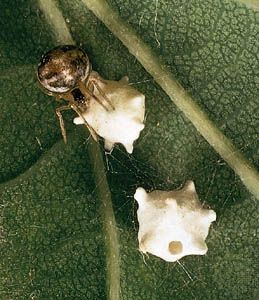
The Hawaiian happy face spider (Theridion grallator) is a unique member of the comb-footed spider family (Theridiidae). Its most distinctive feature is the pattern on its abdomen, which often resembles a smiling human face. This striking coloration is highly variable among individuals, serving as a form of camouflage or a potential deterrent to predators within its native Hawaiian habitat.2
As a member of the genus Theridion, it shares the family’s characteristic row of bristles on its hind legs, which it uses to throw silk over its prey. While many other spiders in this family are known for their complex or specialized hunting strategies—such as the ballista-like traps used by some species to capture ants—the Hawaiian happy face spider is primarily celebrated for its remarkable and iconic appearance.2
How do different spider families use their silk to catch prey?
Spiders employ a diverse array of strategies to utilize silk for capturing prey, ranging from passive traps to active hunting techniques.
Web-Building Strategies
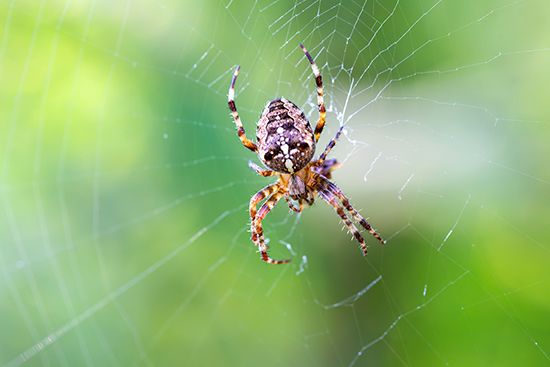
- Orb Weavers: Families such as Araneidae and Tetragnathidae construct elaborate, circular nets that act as air filters to trap flying insects. These webs are highly efficient, covering large areas with minimal silk.8
- Cobweb Spiders: Members of the family Theridiidae build irregular, three-dimensional webs with sticky anchor threads. They use a row of curved bristles on their hind legs to throw additional silk over struggling prey.89
- Cribellate Spiders: The Uloboridae family uses woolly, non-sticky silk. Some species, like Hyptiotes, hold a partial orb web under tension, releasing it to entangle prey upon contact.8
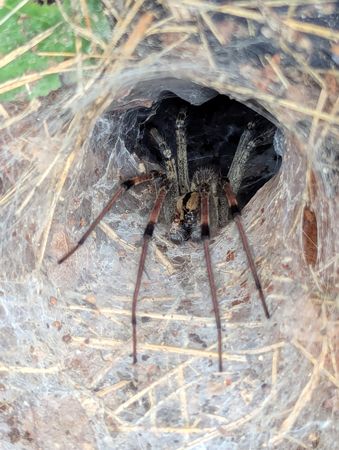
- Funnel-Weavers: These spiders live in silk tubes that expand into sheetlike webs, which vibrate when prey walks across them, alerting the spider.2
Active and Specialized Silk Use
- Net-Casting Spiders: These spiders build small, flat webs that they hold between their front legs, throwing them over passing insects at night.8
- Bolas Spiders: These ambush predators release a single thread tipped with a sticky droplet. They swing or throw this “bola” at moths, which are often lured by chemical signals mimicking female moths.2
- Spitting Spiders: Unique among hunters, these spiders shoot a zigzag stream of sticky material from their fangs to immobilize prey before biting.2
- Trap-Door Spiders: These spiders construct silk-lined burrows, often with hinged doors, and dart out to capture passing insects.2
Sources
- comb-footed spider — Merriam-Webster
- comb-footed spider — Encyclopædia Britannica
- spider - Annotated classification — Encyclopædia Britannica
- black widow — Encyclopædia Britannica
- spider - Venom — Encyclopædia Britannica
- 9 of the World’s Deadliest Spiders - Black Widow Spider ( Latrodectus mactans ) — Encyclopædia Britannica
- spider - Importance — Encyclopædia Britannica
- spider - Spiderwebs — Encyclopædia Britannica
- spider - Stalking prey — Encyclopædia Britannica
Published on · 3 min read