Folding-door Spider
A folding-door spider is a large, burrowing spider belonging to the family Antrodiaetidae. These spiders are named for their unique method of sealing their…
What is folding-door spider?
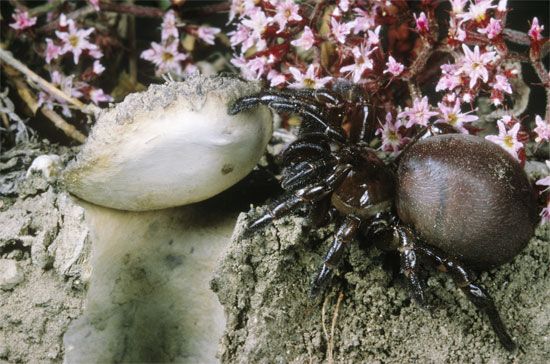
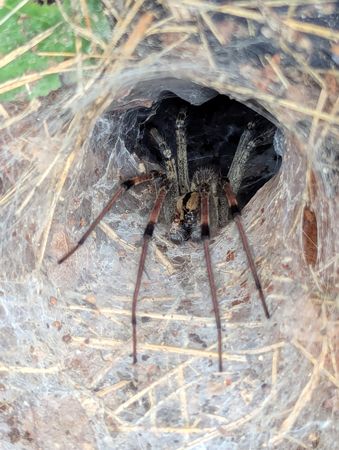
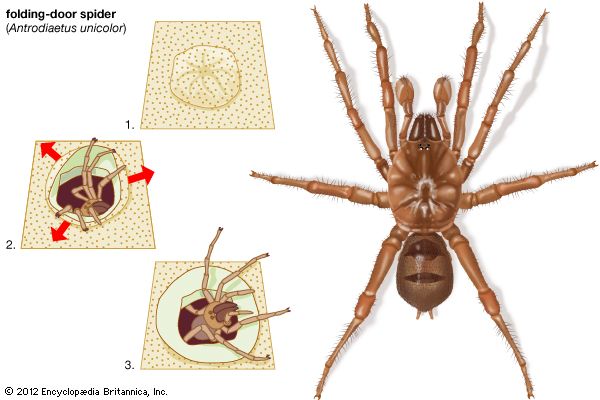
A folding-door spider is a large, burrowing spider belonging to the family Antrodiaetidae. These spiders are named for their unique method of sealing their burrows: they pull the sides of a flexible, silk-lined rim together, functioning much like bifold doors.12
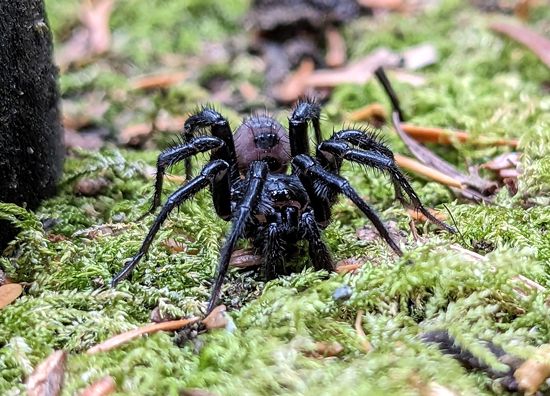
Physically, they are stocky with brown bodies, thick legs, and large fangs. As members of the infraorder Mygalomorphae, they possess downward-striking fangs used to impale prey. While they are large, they are generally docile and possess relatively small venom glands; although a bite may be painful, it is not considered dangerous to humans.21
These spiders are ambush predators that spend most of their lives in the same burrow, waiting for nocturnal insects or other arthropods to pass by. They are primarily found in North America, though some species inhabit Japan. Because they often have specific habitat requirements and do not disperse far, they are considered vulnerable to habitat loss.2
How do trapdoor spiders differ from folding-door spiders?
While folding-door spiders and trapdoor spiders are both members of the infraorder Mygalomorphae and share similar burrowing habits, they are distinguished by specific anatomical and structural differences.12
Key Differences
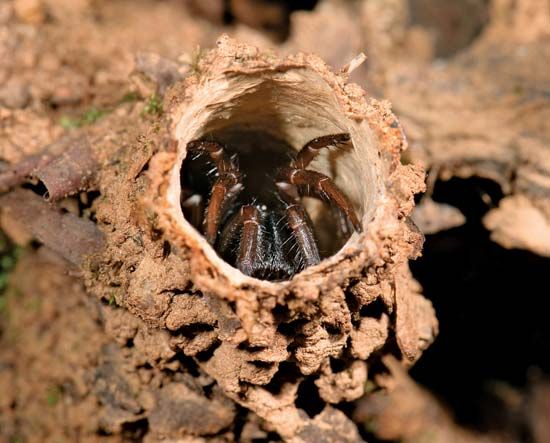
- Burrow Entrance: The most notable difference is the design of the burrow door. A folding-door spider creates a flexible, silk-lined rim that it pulls together like a bifold door to seal the entrance. In contrast, a trapdoor spider constructs a distinct, silken-hinged door that functions as a lid to cover its burrow.312
- Abdominal Anatomy: Folding-door spiders (family Antrodiaetidae) are characterized by the presence of one to three hard plates, known as sclerites, on the upper surface of their abdomens. Trapdoor spiders do not possess these specific abdominal sclerites.12
- Taxonomy: Although they were once classified together in the family Ctenizidae, they are now placed in separate families. Folding-door spiders belong to the family Antrodiaetidae, whereas trapdoor spiders are categorized across several families, including Ctenizidae, Actinopodidae, Halonoproctidae, and Migidae.12
Despite these differences, both groups are reclusive ambush predators that rely on their burrows for protection and hunting, and both are considered vulnerable to habitat loss due to their limited dispersal range.12
What are the characteristics of the Mygalomorphae infraorder?
The infraorder Mygalomorphae (formerly known as Orthognatha) comprises a group of spiders that are generally large, long-lived, and primarily inhabit warm climates. They are distinct from other spider groups due to several key anatomical and biological characteristics:4
- Fang Orientation: Unlike araneomorph spiders, mygalomorphs possess chelicerae with fangs that move vertically (up and down) rather than horizontally.54
- Respiratory System: They are characterized by the presence of two pairs of book lungs.54
- Internal Anatomy: Their hearts typically feature four ostia (though rarely three), and the male pedipalps have a simple bulb structure. Additionally, females lack an epigynum (the external genital structure found in many other spiders).4
- Longevity: Mygalomorphs are notably long-lived compared to many other spiders; females can live up to 25 years, and they often require three to four years—or in some cases up to nine—to reach sexual maturity.67
- Behavior and Habitat: Many species are reclusive and spend much of their lives in burrows or silk-lined tubes. During the molting process, these spiders typically turn on their sides or backs, a behavior that differs from many web-building spiders that molt while suspended.846
This infraorder includes well-known families such as tarantulas (Theraphosidae), trapdoor spiders (Ctenizidae and others), purseweb spiders (Atypidae), and folding-door spiders (Antrodiaetidae).84
How do spider wasps hunt burrowing spiders?
Spider wasps (family Pompilidae) are specialized parasitoids that hunt burrowing spiders, such as tarantulas and trapdoor spiders, to provide food for their developing larvae.10
Hunting and Parasitism
The hunting process often involves the wasp actively searching for prey on the ground or hovering above it. Once a suitable host is located, the wasp uses a painful sting to paralyze the spider. The specific method of stinging can vary; for instance, some wasps deliver a refined sting between the spider’s fangs and near the junction of the cephalothorax and abdomen to induce complete immobility. After the spider is paralyzed, the wasp may drag it to a pre-constructed nest or build a cell specifically for the prey. A single egg is then laid on the paralyzed spider, which remains alive to serve as a fresh food source for the hatching larva.103
Defensive Countermeasures
Burrowing spiders have evolved distinct strategies to resist these attacks:
- Physical Resistance: Some trapdoor spiders, such as the California trapdoor spider, retreat into their burrows and use their fangs and claws to hold the trapdoor shut, bracing their legs against the burrow walls to resist the wasp’s attempts to enter.11
- Anatomical Shields: The ravine trapdoor spider utilizes a unique, hardened, and flattened abdominal shield. When a wasp invades the burrow, the spider turns headfirst toward the bottom, using this shield as a plug that effectively blocks the entrance and prevents the wasp from penetrating with its ovipositor.12
Sources
- folding-door spider: Top Questions — Encyclopædia Britannica
- folding-door spider — Encyclopædia Britannica
- trapdoor spider — Encyclopædia Britannica
- Mygalomorphae — Merriam-Webster
- list of spiders — Encyclopædia Britannica
- spider - Annotated classification — Encyclopædia Britannica
- spider - Maturation — Encyclopædia Britannica
- spider - Eggs and egg sacs — Encyclopædia Britannica
- jaw — Encyclopædia Britannica
- spider wasp — Encyclopædia Britannica
- Hymenoptera - Solitary forms — Encyclopædia Britannica
- ravine trapdoor spider — Encyclopædia Britannica
- California trapdoor spider: Top Questions — Encyclopædia Britannica
Published on · 4 min read