Kirtland’s Warbler
The Kirtland’s warbler (Setophaga kirtlandii) is a rare, energetic songbird belonging to the wood warbler family. Named after naturalist Jared Potter…
What is Kirtland’s warbler?
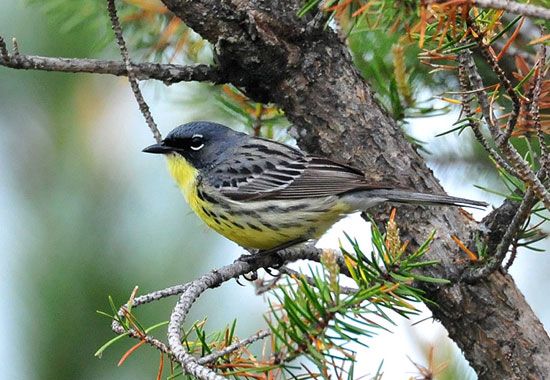
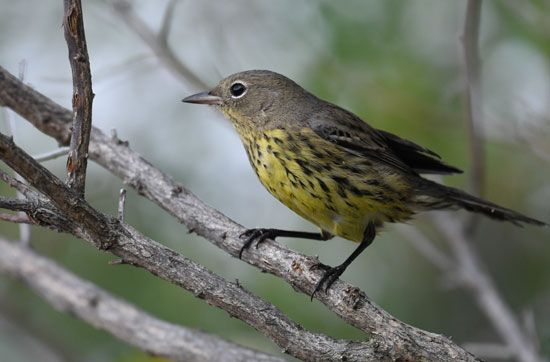
The Kirtland’s warbler (Setophaga kirtlandii) is a rare, energetic songbird belonging to the wood warbler family. Named after naturalist Jared Potter Kirtland, this species is one of North America’s rarest birds, known for its specific breeding requirements and a remarkable conservation recovery.1
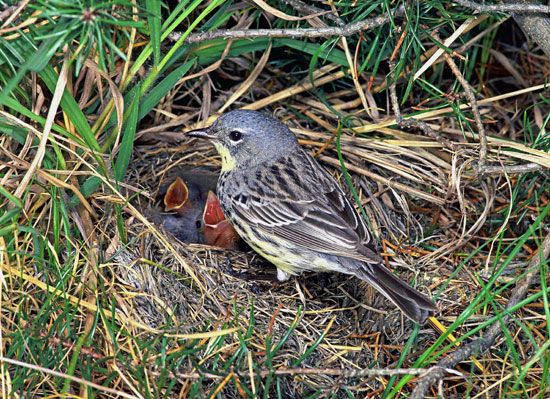
Physically, the bird is relatively large for a warbler, measuring 14–15 cm. Males are characterized by a bright yellow breast, a black mask, and gray upperparts, while females and immature males exhibit more muted, brownish tones. They are primarily insectivores that supplement their diet with fruits and seeds.1
The species breeds almost exclusively in young jack pine stands in Michigan, Wisconsin, and Ontario. Because they are ground-nesters, they rely on the dense, scrubby cover of 5- to 20-year-old trees for protection. Their population declined significantly in the 20th century due to habitat loss and brood parasitism by brown-headed cowbirds. Following intensive management, including controlled burns and cowbird control, the population rebounded, leading to its removal from the endangered species list in 2019.12
What is brood parasitism and how does it affect songbirds?
Brood parasitism is a reproductive strategy in which a bird of one species lays its eggs in the nest of another species, leaving the host to provide all parental care for the offspring. This behavior is a form of kleptoparasitism, as the parasite exploits the host’s energy and resources for the development of its own young.345
Impact on Songbirds
Brood parasitism can have severe consequences for host songbirds, often leading to population declines. The effects include:6
- Resource Competition: Parasitic nestlings, such as those of the brown-headed cowbird, often grow rapidly and may outcompete or displace the host’s own young for food.6
- Nestling Eviction: Some parasites, like certain cuckoos, possess behaviors where the newly hatched parasite physically heaves the host’s eggs or nestlings out of the nest, ensuring it receives the full attention of the foster parents.47
- Egg Removal: Female parasites may remove one or more of the host’s eggs when depositing their own, directly reducing the host’s reproductive success.67
- Energy Drain: Hosts expend significant energy raising a bird that is not their own, which can sometimes grow to exceed the size of the foster parents.67
To mitigate these effects, some host species have evolved to recognize and reject foreign eggs, while parasites have countered with egg mimicry—laying eggs that closely resemble those of the host to avoid detection.7
Why do jack pine trees require fire to reproduce?
Jack pine trees (Pinus banksiana) are considered fire-dependent because they possess serotinous cones, which remain closed and sealed with a protective layer of resin while on the tree.910
These cones do not release their seeds under normal conditions. Instead, they require the intense heat of a wildfire to physically melt the resin, allowing the scales to open and scatter the seeds. This adaptation is highly effective for forest regeneration because the fire also clears the forest understory, exposing the bare mineral soil necessary for the seeds to germinate and thrive in full sunlight.91110
In ecosystems where jack pines dominate, they are often unable to regenerate among more shade-tolerant species that might otherwise outcompete them. By relying on fire, the jack pine ensures that its offspring have a fresh, ash-fertilized seedbed and reduced competition, allowing the species to persist in fire-prone environments.910
What are some other examples of successful endangered species recovery programs?
Successful endangered species recovery programs demonstrate that targeted conservation efforts—such as habitat protection, legal regulation of hunting, and captive breeding—can effectively reverse population declines caused by human activity.
Several prominent examples include:
- Bald Eagle: Once threatened by habitat loss, hunting, and the pesticide DDT, the bald eagle was listed as endangered in 1978. Following the banning of DDT and the enforcement of the Endangered Species Act, the population rebounded significantly, leading to its removal from the U.S. list of endangered and threatened species in 2007.131415
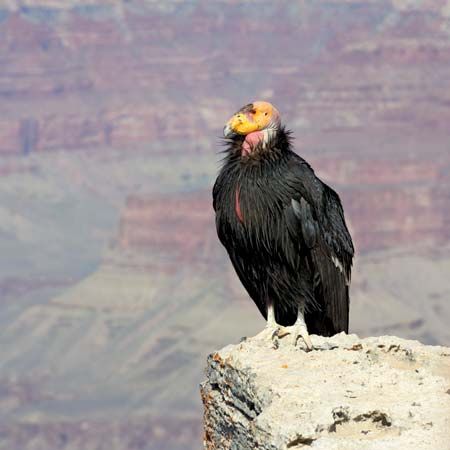
- California Condor: By 1987, this species was declared extinct in the wild with fewer than 30 individuals remaining. A massive conservation project involving captive breeding and reintroduction was launched. Today, the population has grown to approximately 500 individuals, with a significant portion living in the wild.16
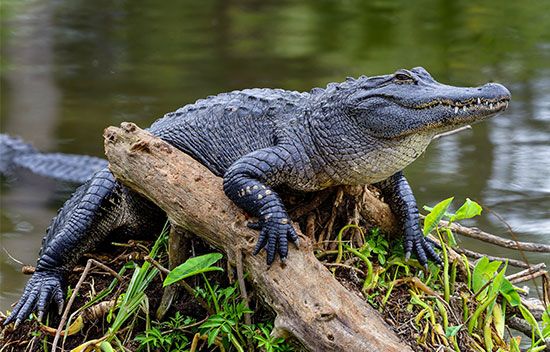
- American Alligator: Following severe population declines due to overhunting for their skin and meat, alligators were classified as endangered in 1967. Legal protections allowed the species to recover substantially, and today they are considered a species of least concern, with wild populations numbering in the hundreds of thousands.1517
Sources
- Kirtland’s warbler — Encyclopædia Britannica
- Kirtland's warbler — Merriam-Webster
- brood parasitism — Merriam-Webster
- Cowbird — Encyclopædia Britannica
- parasitism — Encyclopædia Britannica
- Cuculiform - Brood parasitism — Encyclopædia Britannica
- kleptoparasitism: Top Questions — Encyclopædia Britannica
- brown-headed cowbird — Merriam-Webster
- pine - Physical description and natural history — Encyclopædia Britannica
- conservation - Fire control — Encyclopædia Britannica
- Playing with Wildfire: 5 Amazing Adaptations of Pyrophytic Plants — Encyclopædia Britannica
- Taiga - Natural disturbances — Encyclopædia Britannica
- What Makes a Species Endangered? — Encyclopædia Britannica
- California condor — Encyclopædia Britannica
- Bald eagle — Encyclopædia Britannica
- endangered species - The United States Endangered Species Act — Encyclopædia Britannica
- biodiversity loss - Solutions to biodiversity loss — Encyclopædia Britannica
- American alligator — Encyclopædia Britannica
- American crocodile — Encyclopædia Britannica
Published on · 4 min read