Conch
A conch is a marine snail belonging to the subclass Prosobranchia and the class Gastropoda. These mollusks are characterized by a large, spiral shell with an…
What is conch?
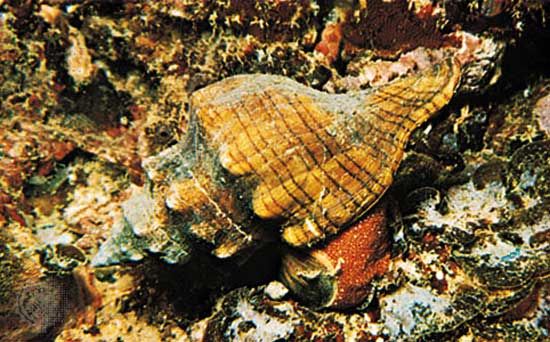
A conch is a marine snail belonging to the subclass Prosobranchia and the class Gastropoda. These mollusks are characterized by a large, spiral shell with an outer whorl that is typically broadly triangular in outline and features a wide lip.123
True conchs belong to the family Strombidae and feed on plant matter in warm waters. A well-known example is the queen conch (Strombus gigas), which is found from Florida to Brazil and is valued for its ornamental, pink-apertured shell. Other varieties include the spider conch and various species within the family Melongenidae, such as the lightning conch and the Australian trumpet, the latter of which is considered the largest living snail.1
Conch meat is a significant food source in the Caribbean and is exported globally. Due to overharvesting, natural populations have declined, leading to efforts to develop commercial farming techniques. Additionally, the shells are highly sought after by collectors and have historically been used in the creation of cameos.13
How do conch shells grow and change throughout their lives?
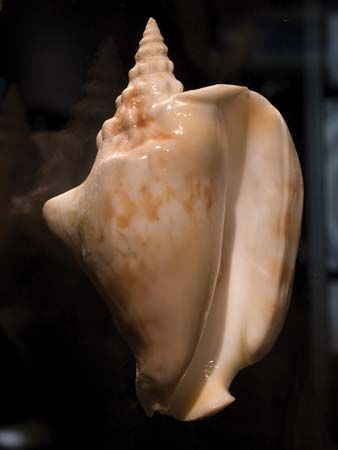
Conch shells grow through a continuous biological process managed by the snail’s mantle, a specialized fleshy organ. As the animal matures, it secretes new shell material along the outer lip of the aperture, the opening of the shell. Generally, the whorls added later in the conch’s life are larger than those formed during its youth.6
The shell formation involves two primary components:
- The Periostracum: The outermost layer, which is a protein mixture known as conchin.6
- Inner Layers: These are composed of calcium carbonate interlaced with a network of conchin and mineral salts. In marine species like the conch, this calcium typically crystallizes as calcite.6
Growth occurs in two stages: first, the mantle makes outward additions to the shell lip, and subsequently, it secretes inner layers to thicken the structure. Throughout their lives, many species evolve elaborate surface ornamentations, such as knobs or spines, which serve as protection against predators. In some conch varieties, such as the spider conch, these modifications result in distinct prongs on the lip.67
What are some traditional ways conch shells have been used as musical instruments?
Conch shells have served as significant musical instruments throughout human history, functioning as early brass instruments by utilizing the player’s lip vibrations to produce sound. Their use likely emerged independently across many global cultures, often beginning as tools for voice distortion or as megaphones in magical and religious rites before evolving into effective trumpets.910
These instruments are valued for their powerful, penetrating sound, which has historically been essential for communication across long distances, as well as for marking ceremonies and rituals. In various regions, such as Oceania, conch trumpets are frequently employed as cult objects. While their technical structure is simple, they often feature elaborate ornamentation, particularly when used to honor gods or chiefs in cultures like those of Polynesia. Despite their limited pitch, their ability to produce a booming, resonant tone has made them a enduring feature of cultural and ritual life worldwide.9110
Why are conch populations currently threatened by overharvesting?
Conch populations are currently threatened by overharvesting primarily due to high demand for their meat and shells. As a popular food source in Caribbean countries, conch is frequently exported to markets in the United States, Europe, and South America. Additionally, the attractive, ornamental shells of species like the queen conch are highly coveted by shell collectors, further intensifying the pressure on natural populations. This widespread exploitation has decimated wild numbers, prompting significant interest in developing commercial farming techniques to meet demand without further depleting the environment.1
Sources
- conch — Encyclopædia Britannica
- conch — Merriam-Webster
- bivalve - Annotated classification — Encyclopædia Britannica
- prosobranch — Encyclopædia Britannica
- queen conch — Merriam-Webster
- gastropod - The shell — Encyclopædia Britannica
- mother-of-pearl - Composition and formation process — Encyclopædia Britannica
- bivalve - External features — Encyclopædia Britannica
- What is the oldest brass instrument? — Encyclopædia Britannica
- Oceanic music and dance - Musical instruments — Encyclopædia Britannica
- wind instrument - Early history — Encyclopædia Britannica
Published on · 3 min read