Condor
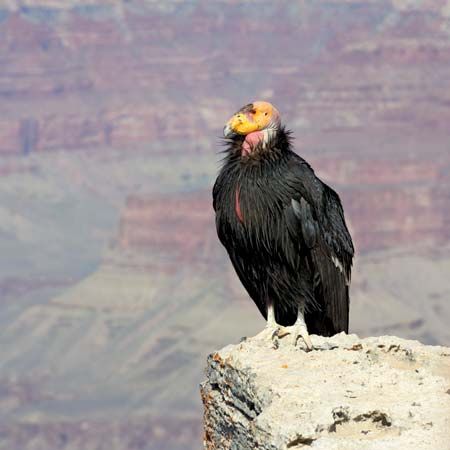
Conservation efforts for the California condor represent one of the most successful conservation projects to date. By the 1980s, the species faced extinction…
How have conservation efforts helped protect and restore condor populations?
Conservation efforts for the California condor represent one of the most successful conservation projects to date. By the 1980s, the species faced extinction in the wild due to habitat loss, environmental pollutants like DDT, and lead poisoning from bullet fragments in carrion.12
In 1987, the last wild condor was brought into protective custody to establish a captive breeding flock in zoos. Scientists carefully managed the small population to maximize genetic diversity and prevent inbreeding. Captive-bred chicks began hatching in 1988, and reintroduction into the wild commenced in 1992.213
These efforts have been remarkably effective. From a low of fewer than 30 individuals, the global population grew to approximately 500 by 2020, with over 300 living in the wild. While challenges such as lead poisoning persist—prompting legislative actions like California’s 2013 ban on lead ammunition—the program has successfully established wild-breeding populations in Arizona, California, and Mexico.13
What are the main threats to condor populations, and why are they considered endangered?
The California condor is classified as critically endangered due to a history of severe population decline caused by human activity and environmental hazards. Historically, the species suffered from the destruction of nests, the taking of eggs, and direct shooting by settlers, alongside a reduction in their natural food supply.1
Today, the primary threats to their survival include:
- Lead Poisoning: This remains a significant cause of mortality. Condors are scavengers that feed on carrion; if an animal carcass contains lead bullet fragments, the birds ingest the toxic metal, which can be fatal.13
- Environmental Pollutants: Pesticides, particularly DDT, have historically harmed the species by interfering with the development of condor embryos.1
- Low Reproductive Rates: Condors have a slow reproductive cycle, typically laying only one egg per nesting season, which makes population recovery a long and delicate process.13
These factors pushed the species to the brink of extinction, leading to their status as critically endangered and necessitating intensive conservation intervention to prevent their total disappearance from the wild.13
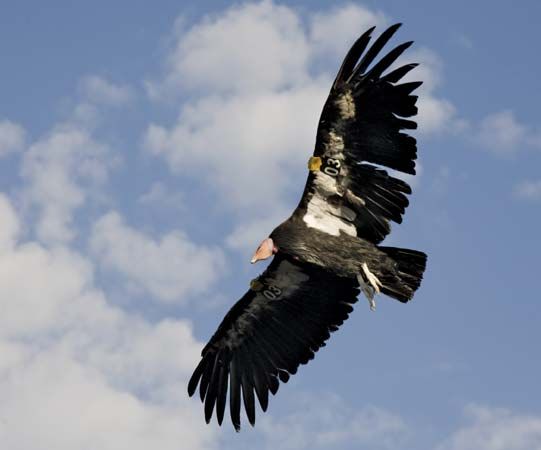
How long do condors typically live, and at what age do they reach maturity?
California condors are long-lived birds that can reach up to 60 years of age.3
Regarding their development, California condors typically reach full maturity between the ages of six and eight years. During their juvenile years, their heads are a darker shade, gradually transitioning to the characteristic red-to-orange color of an adult as they approach this stage of maturity.31
What are the two main species of condors, and how do they differ?
The two main species of condors are the Andean condor (Vultur gryphus) and the California condor (Gymnogyps californianus). Both are among the largest flying birds in the world, but they differ in their physical characteristics, geographic range, and conservation status.3
Key Differences
Feature
Andean Condor
California Condor
Appearance
Black with grayish white wing feathers and a white neck fringe. Males have a large caruncle on the forehead.
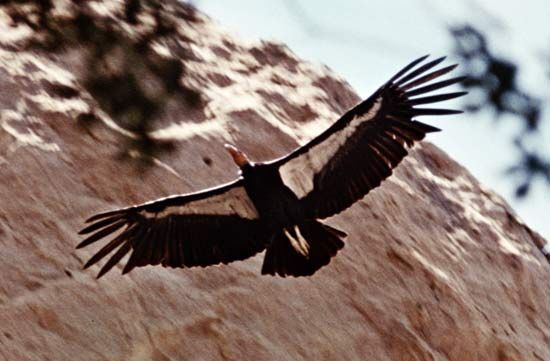
Mostly black with bold white wing linings. Young birds have dark heads that turn red-to-orange at maturity.
Range
Andes Mountains
of South America.
Southern/central
California
,
Arizona
, and
Baja California
.
Nesting
Remote ledges and
caves
at high altitudes.
Cliffs
, rock cavities, or holes in
redwood
trees.
Status
Near threatened.
Critically
endangered
.
While both species are scavengers that feed on carrion, the Andean condor is also known to frequent the Pacific coast to feed on marine animals like fish and seals. Additionally, while most California condors reproduce sexually, researchers have documented instances of parthenogenesis in the species.3
Sources
- California condor — Encyclopædia Britannica
- conservation - Protective custody — Encyclopædia Britannica
- Condor — Encyclopædia Britannica
Published on · 3 min read