Confuciusornis
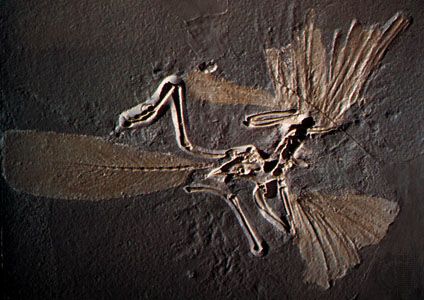
Confuciusornis was an extinct, crow-sized bird from the Late Jurassic and Early Cretaceous periods that shares several features with modern birds, though it…
How does Confuciusornis compare to modern birds in terms of anatomy and capabilities?
Confuciusornis was an extinct, crow-sized bird from the Late Jurassic and Early Cretaceous periods that shares several features with modern birds, though it retains primitive characteristics that distinguish it from living avian groups.1
Anatomical Differences
While Confuciusornis possessed a short tail and a pygostyle—a fusion of terminal tail vertebrae common in modern birds—it differed significantly in its skeletal structure:1
- Forelimbs: Unlike modern birds, whose hand bones are fused into an immobile element, Confuciusornis retained three free fingers, a trait inherited from its theropod ancestors. Additionally, its forearm was shorter than both its hand and its humerus.1
- Growth Rates: Modern birds typically reach full size within a year. In contrast, internal bone analysis indicates that Confuciusornis grew much more slowly, likely taking several years to reach maturity, similar to small dinosaurs.1
Capabilities
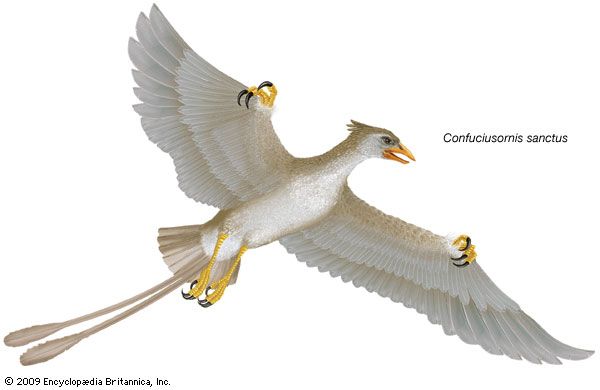
Confuciusornis possessed a full complement of flight feathers, suggesting it was capable of flight. Some specimens exhibit long, thin tail feathers that may have served as sexually dimorphic structures for display.12
How did the discovery of Confuciusornis impact our understanding of Mesozoic birds?
The discovery of Confuciusornis in the Liaoning deposits of China has been instrumental in refining our understanding of avian evolution during the Mesozoic Era. By providing a well-preserved link between primitive forms like Archaeopteryx and more derived birds, it has helped clarify the timeline and characteristics of early avian development.12
Key impacts of this discovery include:
- Evolutionary Progression: Confuciusornis is recognized as being evolutionarily closer to living birds than Archaeopteryx. Its anatomy—specifically the presence of a pygostyle and a reduced tail—demonstrates the transition toward the skeletal structure seen in modern birds, while its retention of three free fingers highlights its lingering connection to theropod ancestors.12
- Growth and Maturation: Analysis of its internal bone structure revealed that Confuciusornis grew much more slowly than modern birds, suggesting that the rapid growth rates characteristic of living avian species did not evolve until the Late Cretaceous.1
- Diversity of Early Birds: The study of the Confuciusornithidae family has challenged the previous reliance on Hesperornis and Ichthyornis as the primary models for Cretaceous birds, revealing a much broader diversity of ancestral avian groups that existed alongside archaic forms.3
What are the key characteristics that define Confuciusornis as a fossil bird genus?
Confuciusornis is a genus of extinct, crow-sized birds that lived during the Late Jurassic and Early Cretaceous periods. It is defined by a unique combination of modern avian features and primitive characteristics inherited from theropod ancestors.1
Key characteristics include:
- Skull and Beak: It possessed a small triangular snout and lacked teeth.1
- Flight and Feathers: It had a full complement of flight feathers, with wings comparable in size to modern flying birds. Some specimens exhibit two long, thin tail feathers, which are hypothesized to be sexually dimorphic structures.12
- Skeletal Structure: Unlike modern birds, Confuciusornis retained three free fingers on its hands. Its forearm was shorter than both its hand and its humerus1.
- Tail and Pygostyle: It featured a short tail with reduced caudal vertebrae, with the terminal vertebrae fused into a pygostyle, a trait common in modern birds.1
- Growth Rate: Internal bone analysis indicates that Confuciusornis grew slowly, taking several years to reach maturity, which is more characteristic of small dinosaurs than modern birds.1
What unique features of Confuciusornis’s beak and skull have been discovered through fossil analysis?
Fossil analysis of Confuciusornis has revealed specific anatomical features regarding its head and snout that distinguish it from earlier avian ancestors.
The primary discovery regarding the skull of Confuciusornis is that it possessed a small, triangular-shaped snout. Notably, unlike many other early bird-like creatures or their theropod ancestors, Confuciusornis lacked teeth entirely. This toothless condition represents a significant evolutionary step toward the beak structures observed in modern birds.1
Sources
- Confuciusornis — Encyclopædia Britannica
- feathered dinosaur — Encyclopædia Britannica
- dinosaur - Dinosaur descendants — Encyclopædia Britannica
Published on · 3 min read