Congo Canyon
Scientists study and explore the Congo Canyon—a massive submarine canyon—using a variety of sophisticated undersea exploration technologies designed to…
How do scientists study and explore the Congo Canyon, given its underwater location?
Scientists study and explore the Congo Canyon—a massive submarine canyon—using a variety of sophisticated undersea exploration technologies designed to overcome the opacity of water to light.
Because electromagnetic radiation cannot penetrate deep into the ocean, researchers rely on acoustic signals to map the canyon’s morphology. Modern systems like Seabeam and GLORIA allow for the creation of accurate, two-dimensional swaths of the seafloor from research vessels. For finer-scale features, scientists use near-bottom systems like the “Deep Tow,” which carries echo sounders and side-scanning sonars close to the canyon floor.12
To study marine sedimentation and the geological history of the canyon, researchers employ:
- Sampling Devices: Grabbing devices and dredges collect surface materials and rock samples.1
- Coring Tools: Coring devices, such as piston corers, extract deep sediment samples that provide records of past environmental conditions.1
- Satellite Data: Measurements of sea-surface topography help scientists infer the shape of the seafloor through gravitational anomalies.12
What is the Congo Canyon and where is it located in the Atlantic Ocean?
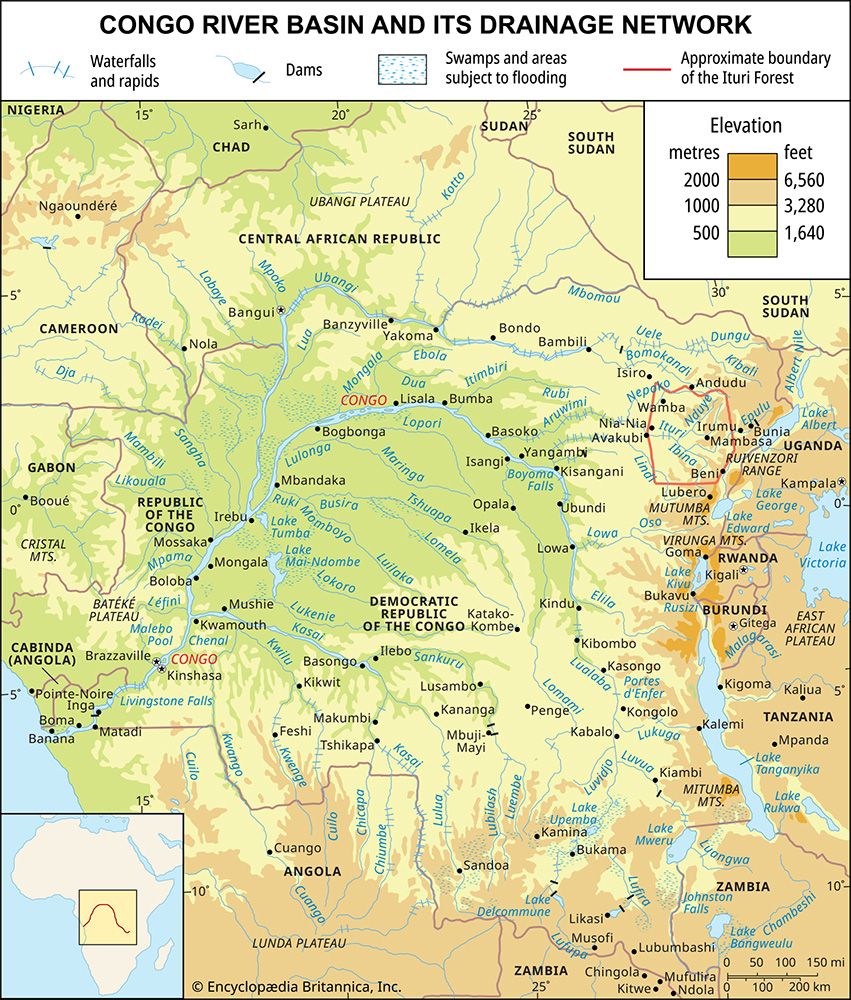
The Congo Canyon is a massive submarine canyon located in the South Atlantic Ocean, incised into the continental shelf and slope of western equatorial Africa.1
The canyon begins 17 miles (28 km) inland within the Congo Estuary and extends approximately 175 miles (280 km) in a westerly direction. It crosses the continental shelf, descends the continental slope, and terminates at the base of the slope in a fan valley at a depth of 8,700 feet (2,650 m). At its most prominent point, the V-shaped canyon reaches a depth of 6,000 feet (1,800 m) with walls rising 3,600 feet (1,100 m) high and a width of 9 miles (14 km).1
Functionally, the canyon serves as a vital conduit, transporting sediments from the Congo River and the continental shelf toward the deep-sea floor, where they are distributed across the fan.1
What role does the Congo Canyon play in deep-sea carbon storage?
The provided search results do not contain information regarding the role of the Congo Canyon in deep-sea carbon storage. While the Congo Canyon is identified as a critical conduit for transporting sediments from the Congo River to the deep-sea floor, the available data does not address its specific function or impact concerning carbon sequestration or storage.
What is the significance of the Congo Canyon in terms of oceanographic research?
The Congo Canyon is significant in oceanographic research primarily as a major submarine canyon that acts as a critical conduit for the transport of sediments from the Congo River and the continental shelf to the deep-sea floor.1
Its importance to the field includes:
- Sediment Distribution: The canyon serves as a primary pathway for material to reach the deep ocean, where it is distributed across a large fan valley. This process helps researchers understand how continental material is moved and deposited in deep-sea environments.1
- Geomorphological Study: As a V-shaped feature extending 175 miles (280 km) and reaching depths of 8,700 feet (2,650 m), it provides a massive natural laboratory for studying the formation and maintenance of submarine landforms.1
- Marine Processes: Like other submarine canyons, the Congo Canyon is central to the study of turbidity currents—the movement of sediment-laden water—which are key agents in shaping the continental slope and the ocean floor.46
Sources
- Congo Canyon — Encyclopædia Britannica
- undersea exploration - Exploration of the seafloor and the Earth’s crust — Encyclopædia Britannica
- ocean basin - Exploration of the ocean basins — Encyclopædia Britannica
- submarine canyon — Encyclopædia Britannica
- Congo River - Study and exploration — Encyclopædia Britannica
- canyon — Encyclopædia Britannica
Published on · 2 min read