Coniferous Forest
Coniferous and deciduous trees differ primarily in their leaf structure and seasonal behavior.
How do coniferous trees differ from deciduous trees in their structure and life cycle?
Coniferous and deciduous trees differ primarily in their leaf structure and seasonal behavior.
Structural Differences
- Leaves: Conifers typically possess needle-shaped or scale-like leaves, which are often coated in a thick, waxy substance to minimize water loss. In contrast, deciduous trees generally have broad, flat leaves.123
- Wood: Conifer wood is often referred to as “softwood” and is structurally simpler, consisting primarily of tracheids that serve both for water transport and structural support. Deciduous trees (angiosperms) typically have “hardwood,” which features a more complex mixture of vessel elements and fibers.45
Life Cycle and Seasonal Adaptations
- Evergreen vs. Deciduous: Most conifers are evergreen, meaning they retain their foliage year-round, though some exceptions like larch and bald cypress are deciduous) and bald cypress are deciduous. Deciduous trees undergo a seasonal cycle where they lose their leaves in autumn as a response to declining day length and temperature, entering a state of winter dormancy.563
- Reproduction: Conifers are gymnosperms that produce seeds in cones, whereas deciduous trees are typically angiosperms that produce seeds through flowers.74
What are the defining characteristics of a coniferous forest?
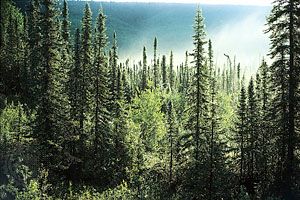
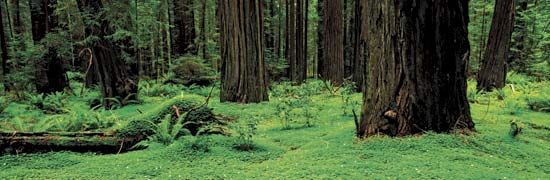
A coniferous forest is a biome primarily composed of cone-bearing, needle-leaved, or scale-leaved evergreen trees. These forests are typically found in regions characterized by long, cold winters and moderate to high annual precipitation.10
Key Characteristics
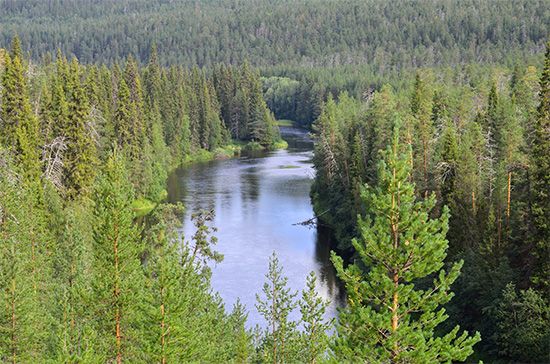
- Dominant Vegetation: The landscape is dominated by species such as pines, spruces, firs, and larches. These trees often grow in nearly uniform stands, with a forest floor covered by mosses, liverworts, lichens, and a layer of low shrubs or herbs.10
- Soil Composition: The forests typically feature light-coloured, acidic soils known as podzols. These soils contain a compacted layer of organic matter called mor, which is rich in fungi but generally low in mineral content and invertebrates like earthworms.10
- Wildlife: While insects are abundant, the cold temperatures limit the presence of cold-blooded vertebrates. Common inhabitants include various birds and mammals such as squirrels, moose, lynx, and wolves10.
- Regional Variations: The northern circumpolar forest is widely known as the taiga or boreal forest. Other subtypes include moist temperate coniferous forests along the North American west coast, as well as subalpine and montane forests found at higher elevations globally.10
Where are coniferous forests typically found around the world?
Coniferous forests are primarily found in the temperate and subarctic regions of the Northern Hemisphere, where they form vast, circumpolar belts of vegetation.1012
Major Geographic Distributions
- Northern Hemisphere (Boreal Forest/Taiga): The most extensive coniferous forests, known as the taiga, stretch across the northern latitudes of North America (covering much of Canada and Alaska) and Eurasia (spanning Russia, Scandinavia, Mongolia, and northern China and Japan).101312
- Mountainous Regions: Coniferous forests occur at various elevations globally as montane and subalpine forests. These include significant stands in the Rocky Mountains, the Appalachians, the Alps, the Urals, and the Himalayas.1012
- Southern Hemisphere: While less dominant than in the north, coniferous forests exist in parts of the Southern Hemisphere, including the Andes, New Zealand, and Australia, often featuring unique endemic species like the monkey puzzle tree and kauri pine.1211
How do coniferous forests contribute to the water cycle?
Coniferous forests play a vital role in the hydrologic cycle by regulating the interception, flow, and storage of water. Their contribution occurs through several key mechanisms:16
- Water Regulation and Filtration: Forests act as sponges and filters. Their canopy, litter layers, and deep soils intercept precipitation, slowing its movement and allowing it to infiltrate the ground. This process helps maintain gradual, reliable streamflow and reduces the risk of flooding compared to sparsely vegetated land.16
- Evapotranspiration: Coniferous species contribute to the atmosphere through transpiration, the process by which trees release water vapor from their needles. Because conifers often maintain their foliage year-round, they can exhibit significant transpirational losses even during winter months, which influences local water yields.16
- Fog Interception: In specific regions, such as the Pacific seaboard of North America, coniferous foliage captures water vapor from fog. This moisture condenses on the needles and drips to the forest floor—a process known as fog drip—providing a significant additional water source for the ecosystem.16
- Soil Storage: Deep forest soils have a high capacity to store water, which helps regulate the water table. By maintaining continuous cover, these forests protect the soil from erosion and ensure that water returning to the system remains relatively pure.16
Sources
- Did you know? — Merriam-Webster
- plant development - Seasonal adaptations — Encyclopædia Britannica
- leaf — Encyclopædia Britannica
- conifer - Distinguishing taxonomic features — Encyclopædia Britannica
- gymnosperm - Pinophyta — Encyclopædia Britannica
- conifer - Leaves — Encyclopædia Britannica
- conifer - Stem — Encyclopædia Britannica
- conifer - Fertilization and embryogeny — Encyclopædia Britannica
- conifer - Sporophyte phase — Encyclopædia Britannica
- Coniferous forest — Encyclopædia Britannica
- conifer - Distribution and abundance — Encyclopædia Britannica
- Taiga - Distribution — Encyclopædia Britannica
- forestry - Occurrence and distribution — Encyclopædia Britannica
- tree - Tree lines — Encyclopædia Britannica
- Temperate forest - Population and community development and structure — Encyclopædia Britannica
- forestry - Watershed management and erosion control — Encyclopædia Britannica
- transpiration — Encyclopædia Britannica
- Climate - Recycled rainfall — Encyclopædia Britannica
Published on · 4 min read