Earthworm
Earthworms are found in nearly all soils worldwide where moisture and organic content are sufficient to sustain them. While they are native to many regions…
How have earthworms been introduced to different ecosystems around the world, and what impact has this had?
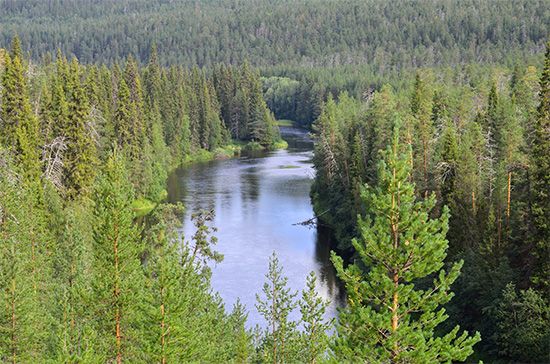
Earthworms are found in nearly all soils worldwide where moisture and organic content are sufficient to sustain them. While they are native to many regions, human activity has been the primary driver of their dispersion over the past 10,000 years. In the eastern United States, for example, 13 species have been introduced from Europe, including the common Lumbricus terrestris.12
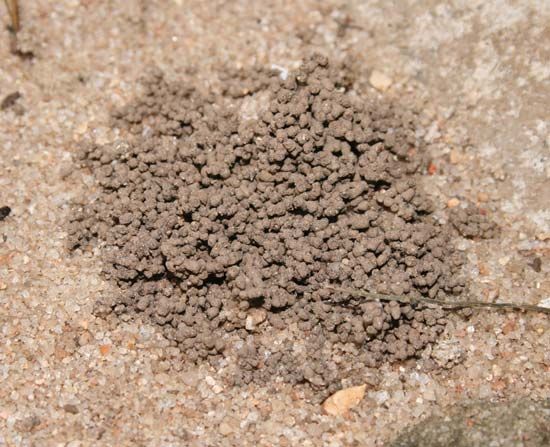
The impact of earthworms on ecosystems is significant due to their role in soil modification. They ingest large quantities of soil and decaying organic matter, which they then discard, effectively aerating the soil and promoting drainage. By drawing organic material into their burrows, they accelerate the decomposition process and increase the availability of nutrients for plants. While these activities generally assist plant growth, the introduction of non-native earthworms into ecosystems that evolved without them can fundamentally alter soil structure and nutrient cycling, potentially disrupting established ecological balances.1
How do earthworms reproduce, and what is the significance of their hermaphroditic nature?
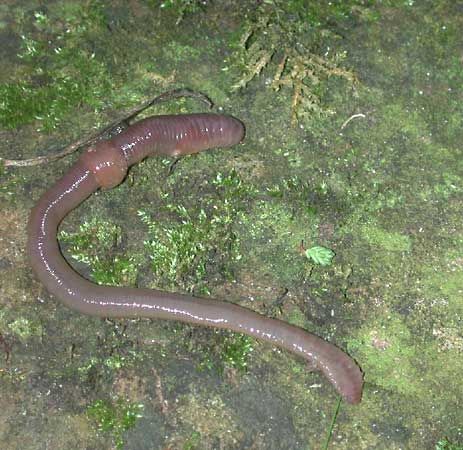
Earthworms are hermaphroditic, meaning each individual possesses both male and female reproductive organs. Despite this, they do not self-fertilize; instead, they engage in reciprocal mating where each worm fertilizes the eggs of another.3
During mating, two earthworms align their bodies in opposite directions and are held together by a sticky mucus. They exchange sperm, which is stored in specialized sacs. Following this, the clitellum—a glandular, girdle-like structure—secretes a mucous tube that slides along the worm’s body. As this tube moves, it collects the worm’s own eggs and the sperm previously received from its partner. As the tube slides off the worm’s head, it closes to form a lemon-shaped cocoon where fertilization occurs.31
The significance of their hermaphroditic nature lies in reproductive efficiency: because every individual is capable of producing both eggs and sperm, any two mature earthworms of the same species can potentially mate. This increases the probability of successful reproduction in environments where finding a mate might otherwise be difficult.3
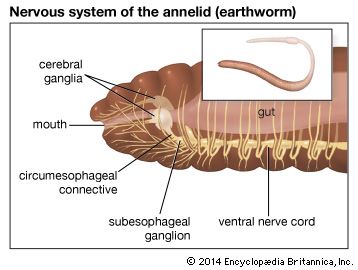
How do earthworms contribute to soil health and ecosystem functioning?
Earthworms are essential contributors to soil health and ecosystem functioning, primarily through their physical and biological interactions with the environment. By ingesting large quantities of soil, sand, and decaying organic matter—often consuming their own body weight in material daily—they act as natural tillers of the earth.1
Their contributions include:
- Soil Aeration and Drainage: As earthworms tunnel through the ground, they create channels that improve soil aeration and promote efficient water drainage.1
- Decomposition: They draw organic material into their burrows, which significantly accelerates the decomposition process. This activity converts decaying matter into more nutritive substances that are readily available for plant uptake.1
- Nutrient Cycling: By processing organic waste and soil, earthworms enhance the fertility of the soil, which indirectly supports plant growth and sustains broader food webs.1
Beyond these direct soil benefits, earthworms serve as a vital food source for a wide variety of birds and other animals, playing a foundational role in many terrestrial ecosystems.1
What are the key characteristics that define earthworms as annelids?
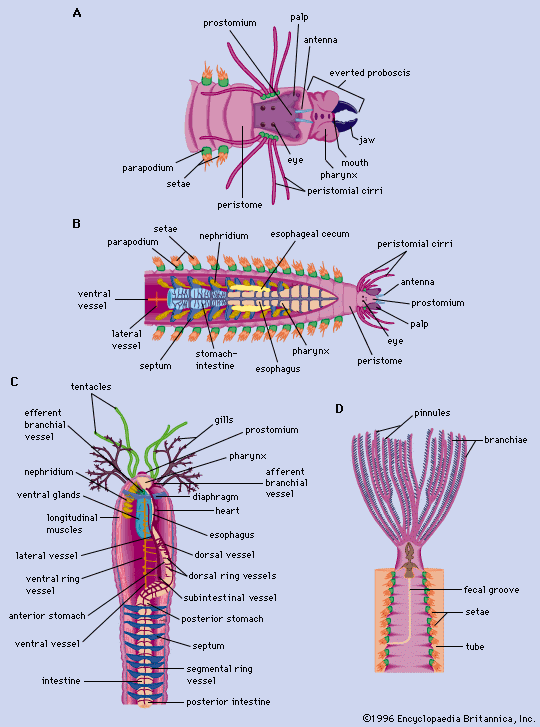
Earthworms are classified as members of the phylum Annelida, a group of invertebrate animals defined by several fundamental biological characteristics:
- Segmentation: The body is divided into a series of ringlike segments, or annulations, which give the phylum its name. Internally, these segments are often separated by partitions, and some organs, such as excretory structures, are duplicated across them.415
- Coelom: Annelids possess a body cavity known as the coelom. This fluid-filled space separates the digestive tract from the body wall and functions as a hydrostatic skeleton, which is essential for movement and internal physiological processes.4657
- Setae: Most annelids, including earthworms, possess movable, bristlelike structures called setae. These are embedded in the body wall and help the animal maintain contact with the ground during locomotion.467
- Body Plan: Their structure is often described as a “tube within a tube,” where the outer body wall encloses the inner digestive tract. The epidermis is typically covered by a thin, protective cuticle composed of protein.6
Sources
- earthworm — Encyclopædia Britannica
- dispersion — Encyclopædia Britannica
- Reproductive behaviour - Segmented worms — Encyclopædia Britannica
- annelid — Encyclopædia Britannica
- annelid - External features — Encyclopædia Britannica
- annelid - Tissues and fluids — Encyclopædia Britannica
- Circulatory system - Annelida — Encyclopædia Britannica
- skeleton - Skeletomusculature of an earthworm — Encyclopædia Britannica
Published on · 3 min read