Cookiecutter Shark
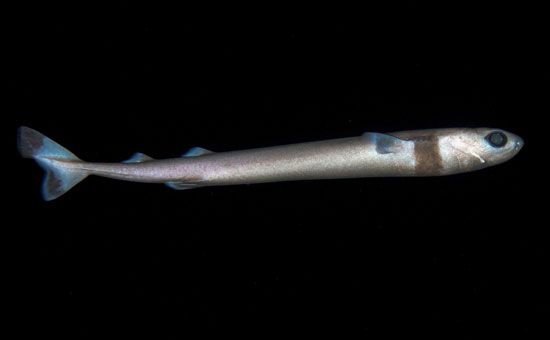
The cookiecutter shark refers to two species of small, cigar-shaped sharks in the genus Isistius. They are named for their unique feeding behavior: they use…
What is a cookiecutter shark?
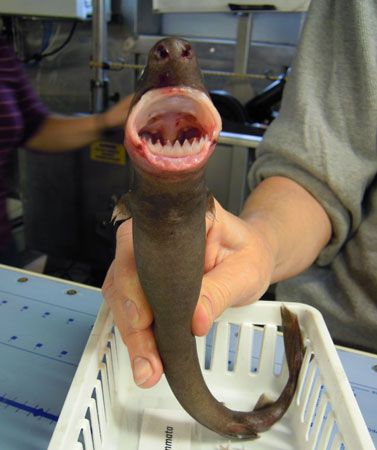
The cookiecutter shark refers to two species of small, cigar-shaped sharks in the genus Isistius. They are named for their unique feeding behavior: they use their fleshy lips to create suction on larger marine animals—such as whales, tuna, and white sharks—before rotating their bodies to carve out circular, cookie cutter-shaped plugs of flesh.1
These fishes possess photophores on their lower bodies that produce a greenish bioluminescence, which scientists believe is used to attract prey. While the smalltooth cookiecutter shark (I. brasiliensis) has a worldwide distribution in tropical and temperate oceans, the largetooth cookiecutter shark (I. plutodus) is less understood and known from fewer specimens.1
Though rare, these sharks have been known to attack human beings and have even damaged equipment on nuclear submarines. Both species are currently classified as of least concern by the International Union for Conservation of Nature.1
Where do cookiecutter sharks live?
Cookiecutter sharks are found in tropical and temperate oceans worldwide, though the distribution of the two species differs significantly.1
Smalltooth Cookiecutter Shark (I. brasiliensis)
This species has a widespread, global distribution. It inhabits the Atlantic, Pacific, and Indian oceans. They are found at a wide range of depths, extending from the ocean surface down to 3,700 meters (about 12,140 feet).1
Largetooth Cookiecutter Shark (I. plutodus)
This species is less understood and has been documented in only a few isolated pockets of the ocean. Specimens have been captured in relatively shallow waters, between 60 and 200 meters (197–656 feet), in specific regions including:
- Atlantic Ocean: Near the coasts of Alabama, Brazil, the Azores islands, and North Africa.1
- Western North Pacific: Off the coast of Okinawa, Japan.1
Both species exhibit vertical migration, moving deeper into the water column during the day and returning toward the surface at night to hunt.1

What does a cookiecutter shark eat?
The cookiecutter shark is a parasitic feeder that targets much larger marine animals, including whales, tuna, and white sharks.1
To feed, the shark uses its large, fleshy lips to create suction against the side of its prey. Once attached, it rotates its body and uses its large, bladelike lower teeth to carve out a circular plug of flesh, leaving a distinct, cookie cutter-shaped scar.1
These sharks also utilize bioluminescence to aid in hunting. They possess photophores on their lower bodies that produce a greenish glow, which scientists believe is used to attract potential prey in the dark water column. While their diet consists primarily of large marine animals, they have also been known to attack human beings and have even damaged equipment on nuclear submarines.1
How does the cookiecutter shark get its name?
The cookiecutter shark gets its name from its unique feeding behavior. These sharks use their large, fleshy lips to create suction against the sides of much larger marine animals, such as whales, tuna, and white sharks.
Once attached, the shark rotates its body and uses its large, bladelike lower teeth to carve out a circular plug of flesh. The resulting wound is distinctively round, resembling a mark that would be left by a kitchen cookie cutter.1
Sources
- cookiecutter shark — Encyclopædia Britannica
Published on · 3 min read