Coot
Sorry, the Britannica knowledge base does not contain this information. While the provided search results offer details on the physical characteristics…
What sounds do coots make, and how do they communicate with each other?
Sorry, the Britannica knowledge base does not contain this information. While the provided search results offer details on the physical characteristics, habitat, and general classification of coots, they do not describe the specific vocalizations or communication methods used by these birds.
Where are coots typically found and what kind of habitats do they prefer?
Coots are found globally, inhabiting a variety of environments across different continents. They are typically located in larger inland waters and streams, where they prefer habitats that provide ample vegetation for feeding and nesting.1
Preferred Habitats
- Inland Waters: Coots thrive in lakes, ponds, and streams.1
- Marshes: They are well-adapted to plant-choked marshes and areas with soft, muddy bottoms, utilizing their lobed toes to walk across these surfaces.1
- Coastal Areas: During winter months, some species, such as the European coot, may move to river mouths or shallow bays of the sea.1
- Nesting Sites: They construct their nests within masses of water plants.1
The genus Fulica is represented by ten species distributed worldwide, including the North American mud hen and various species found throughout South America and the West Indies.1
What are the physical characteristics of coots that distinguish them from other water birds?
Coots are distinct from other water birds primarily due to their unique foot structure and facial features. While they are often described as ducklike, they belong to the rail family and possess specific adaptations for their aquatic lifestyle.1
Key Physical Characteristics
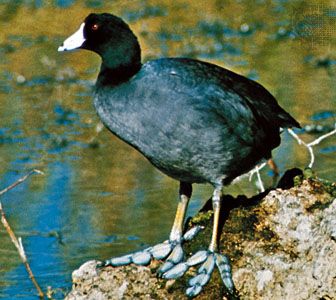
- Lobed Toes: Unlike the webbed feet of ducks, coots have toes fringed by a lobed membrane. This feature is highly functional, allowing them to swim effectively and walk across plant-choked marshes and soft mud.13
- Frontal Shield: A defining feature of the coot is a flattened, fleshy, or horny shield that extends from the short, conical beak onto the forehead. In the African species (F. cristata), this is further distinguished by two red knobs.13
- Plumage and Appearance: Adults typically display sooty black plumage. A notable characteristic is the bare white callus found on the forehead.1
- Flight Mechanics: Despite their appearance, coots are capable of rapid, long-sustained flight. However, they often appear to struggle when taking off from the water, frequently pattering along the surface with their feet before becoming airborne.1
What are some common species of coots and how do they differ?
There are ten recognized species within the genus Fulica, all belonging to the rail family. While they share a general appearance, they exhibit distinct regional and physical variations.1
Notable Species and Differences
- European Coot (F. atra): This species is common across northern parts of the Old World. It measures approximately 45 centimeters (18 inches) in length and can weigh over 900 grams (2 pounds). It is known for its ability to migrate to river mouths or shallow sea bays during winter.1
- North American Coot (F. americana): Often referred to as the “mud hen,” this species closely resembles the European coot in both appearance and behavior.1
- African Coot (F. cristata): This species is uniquely distinguished from its relatives by the presence of two red knobs on its frontal shield.1
- South American Species: The region hosts about six distinct species. Among these is F. gigantea, which is notable for its significant size compared to other coots.1
- Caribbean Coot (F. caribaea): This species is found throughout the West Indies.1
It is important to note that the scoter, a type of diving duck, is sometimes colloquially referred to as a “sea coot,” though it is biologically distinct from the genus Fulica.1
Sources
- Coot — Encyclopædia Britannica
- Ciconiiform - Behaviour — Encyclopædia Britannica
- coot — Merriam-Webster
- Fulica — Merriam-Webster
Published on · 3 min read