Philippine Eagle
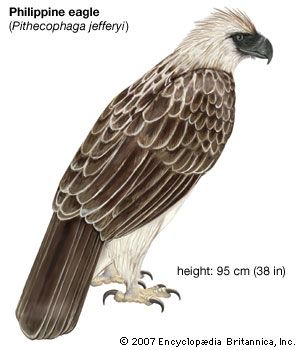
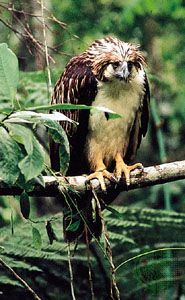
The Philippine eagle (Pithecophaga jefferyi) is a massive bird of prey and the national bird of the Philippines. Standing roughly 1 meter (3.3 feet) tall…
What is Philippine eagle?
The Philippine eagle (Pithecophaga jefferyi) is a massive bird of prey and the national bird of the Philippines. Standing roughly 1 meter (3.3 feet) tall with a wingspan often reaching 2 meters (6.6 feet), it is among the world’s largest eagles.12
This apex predator inhabits mountainous rainforests on the islands of Luzon, Samar, Leyte, and Mindanao. It is easily recognized by its shaggy, long-feathered crest and powerful, hooked bill.2
Tragically, the species is critically endangered, with fewer than 500 mature individuals estimated to remain in the wild. Primary threats include deforestation, habitat loss, and illegal hunting. Protecting this magnificent bird is a moral imperative, as human activity remains the only significant threat to its survival.2
What are some other examples of apex predators in rainforest ecosystems?
Apex predators occupy the highest trophic level in an ecosystem, meaning they have no natural predators of their own. In the complex environments of tropical rainforests, such as the Amazon, several species serve this critical role by regulating populations and maintaining biodiversity.345
Notable examples of apex predators in these ecosystems include:
- Jaguar: As one of the largest members of the cat family (Felidae), the jaguar is a formidable predator in the American tropics, capable of hunting a wide variety of prey.35
- Harpy eagle: Widely considered the most powerful bird of prey in the world, this raptor dominates the forest canopy.5
- Anaconda: These massive, nonpoisonous snakes can reach lengths of up to 30 feet (9 meters), acting as apex predators within the waterways and surrounding forest floor.65
- Puma: While often found in the Andean fringe, these large cats also inhabit parts of the Amazonian basin.65
These predators are essential to the health of their habitats, often acting as keystone species that prevent any single prey population from dominating the community.3
How does deforestation specifically impact the nesting habits of large birds?
Deforestation significantly impacts the nesting habits of large birds by destroying the essential physical structures they require for reproduction. Many large avian species rely on specific, mature trees or forest architectures to support their nests, which are often large and require stable, elevated platforms. When deforestation occurs, these critical nesting sites are removed, leaving birds without the necessary environment to raise their young.19
While the provided search results do not detail the specific nesting mechanics of every large bird, they confirm that habitat loss is a primary threat to species like the Philippine eagle, which depends on intact rainforests. Furthermore, birds that utilize trees, rock crevices, or specific vegetation for nesting are directly displaced when their habitat is degraded or cleared. The loss of these environments forces birds to abandon traditional nesting grounds, often leading to population declines as they struggle to find suitable alternatives in fragmented landscapes.9110
We could dive deeper into how habitat fragmentation specifically affects the reproductive success of endangered raptors.
What are the main differences between the Philippine eagle and other large eagle species?
The Philippine eagle (Pithecophaga jefferyi) is distinct among large eagles due to its specific geographic range, unique physical features, and specialized habitat requirements. While it shares the family Accipitridae with other eagles, it differs from many counterparts in the following ways:
Physical Characteristics
- Appearance: The Philippine eagle is characterized by a shaggy crest of long, narrow, brown-and-cream feathers, a dark gray face, and light blue-gray eyes. Its plumage is brown above and white below.12
- Size: It is one of the world’s largest eagles, standing about 1 meter (3.3 feet) tall with a wingspan typically around 2 meters (6.6 feet), though some individuals reach 2.5 meters (8 feet).121
- Comparison: Unlike sea eagles, which have bare lower legs and high-arched beaks for catching fish, the Philippine eagle is adapted for hunting in dense forests. It is very similar in appearance and habits to the harpy eagle, though the latter is found in the tropical forests of South America and the South Pacific.2
Habitat and Behavior
- Range: It is endemic to the mountainous rainforests of the Philippine islands of Luzon, Samar, Leyte, and Mindanao.121
- Nesting: Unlike eagles that nest in various terrains, the Philippine eagle specifically nests in the crowns of tall trees within dipterocarp forests.121
- Diet: It is an apex predator that hunts arboreal mammals, such as monkeys, lemurs, and flying squirrels, as well as birds and reptiles, rather than the fish-heavy diet of sea eagles.12
Conservation Status
The species is critically endangered, with fewer than 500 mature birds estimated to remain. Its recovery is uniquely challenged by a long generation time and severe threats from deforestation, mining, and pollution.121
Sources
- Philippine eagle: Top Questions — Encyclopædia Britannica
- Philippine eagle — Encyclopædia Britannica
- apex predator — Encyclopædia Britannica
- Amazon River - Animal life — Encyclopædia Britannica
- Amazon River: Top Questions — Encyclopædia Britannica
- apex predator — Merriam-Webster
- South America - The Amazonian and Guianan forests — Encyclopædia Britannica
- food web — Encyclopædia Britannica
- conservation - Fire control — Encyclopædia Britannica
- Passeriform - Nesting — Encyclopædia Britannica
- Bird: Top Questions — Encyclopædia Britannica
- Eagle — Encyclopædia Britannica
Published on · 4 min read