Coral Snake
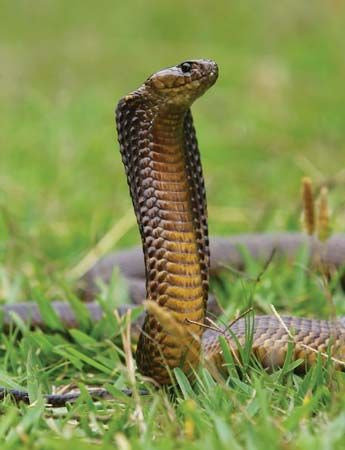
Coral snakes are a group of over 100 species of venomous snakes belonging to the family Elapidae, which also includes cobras and other related species.
What is the scientific classification of coral snakes, and to which family do they belong?
Coral snakes are a group of over 100 species of venomous snakes belonging to the family Elapidae, which also includes cobras and other related species.1
These snakes are classified into several genera based on their geographic distribution:
- New World: Primarily categorized into the genera Micrurus and Micruroides, with some classifications including Leptomicrurus.1
- Old World: Generally comprised of the genera Calliophis, Sinomicrurus, and Hemibungarus. Some classifications also include the African genus Homoroselaps.1
Characterized by their bright, ringed patterns and short, fixed fangs, these snakes deliver a potent neurotoxic venom. While they are often confused with non-venomous mimics, they are distinct members of the elapid family, which is known for having fangs fixed in the front of the upper jaw.12
What are the distinguishing physical characteristics of coral snakes?
Coral snakes are characterized by several distinct physical features that help identify them:
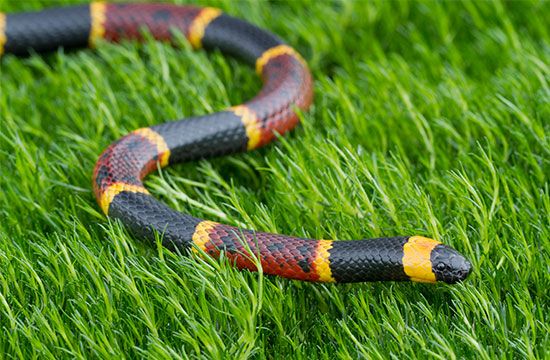
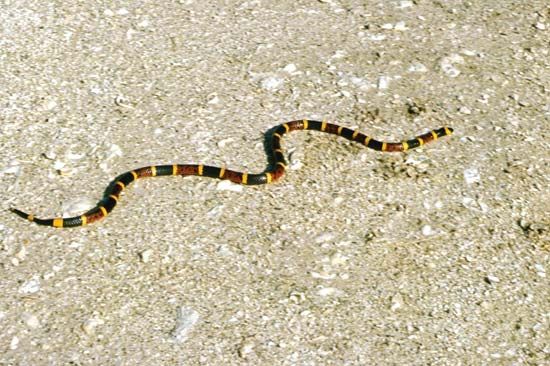
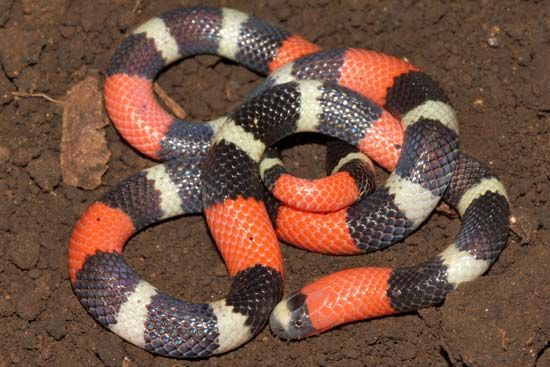
- Coloration: Most species display bright, vibrant patterns, typically tricolored with rings of red, black, and yellow or white. While the width of these rings varies, the pattern is a primary identifier.1
- Body and Scales: They are generally small, secretive snakes with smooth scales and a short tail.1
- Size: New World coral snakes range in length from approximately 40 to 160 cm (16 to 63 inches).1
- Dentition: They possess short, hollow, fixed fangs located in the front of the upper jaw, which are used to deliver a potent neurotoxic venom.1
It is important to note that many non-venomous mimics, such as the king snake and scarlet snake, share similar color patterns. While mnemonics like “red on yellow, kill a fellow” are sometimes used to distinguish them in the United States, these rhymes are not reliable for identifying coral snakes in other parts of the world.1
What is the geographic distribution of coral snakes, and how many species exist?
Coral snakes comprise a diverse group of more than 100 species of venomous snakes belonging to the family Elapidae. Their geographic distribution is broad, spanning both the New World and the Old World:1
- New World: These species are found primarily in tropical regions, with a range extending from the southern United States through to Argentina.1
- Old World: Related species are distributed across southern Asia and Africa.ica.com/place/Asia) and Africa.1
The classification of these snakes is divided by region:
- New World Genera: Primarily Micrurus (which contains the majority of species, approximately 80) and Micruroides.1
- Old World Genera: Includes Calliophis (10 species), Sinomicrurus (five species), and Hemibungarus (three species). Some classifications also include the African genus Homoroselaps.1
While most coral snakes are considered species of least concern by the International Union for Conservation of Nature and Natural Resources, certain populations in countries like Ecuador, Venezuela, Honduras, and Colombia are classified as endangered or critically endangered.1
How can people distinguish between coral snakes and their non-venomous mimics?
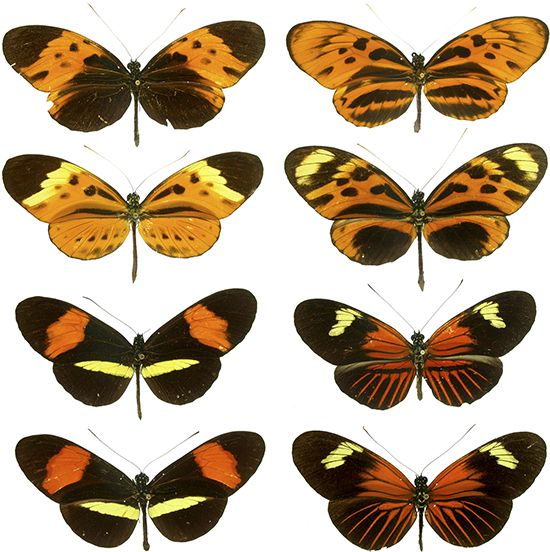
Distinguishing between venomous coral snakes and their non-venomous mimics can be challenging because many harmless species have evolved similar bright, banded patterns of red, black, and yellow or white to deter predators.415
In the United States, people often use mnemonics to tell them apart, such as:
- “Red on yellow, kill a fellow; red on black, venom lack.”
- “Red and yellow can kill a fellow; red and black, friend of Jack.”
While these rhymes are helpful for identifying species within the United States, such as the scarlet king snake, they are not reliable for identifying coral snakes in other parts of the world. Because nearly one-third of all American species exhibit some form of coral snake pattern, and there are approximately 50 genera of mimics globally, relying solely on color patterns can be dangerous.1
The most important safety principle is to avoid handling or provoking any snake you cannot positively identify, as the safest approach is to treat all brightly banded snakes with caution.16
Sources
- coral snake — Encyclopædia Britannica
- elapid — Encyclopædia Britannica
- Africa - Reptiles and amphibians — Encyclopædia Britannica
- snake - Coloration — Encyclopædia Britannica
- mimicry - Other forms — Encyclopædia Britannica
- snake - Snakes and humans — Encyclopædia Britannica
Published on · 3 min read