Corchorus
Corchorus is a genus comprising approximately 40 to 100 species of flowering plants within the mallow family (Malvaceae). These tropical herbs and…
What is Corchorus?
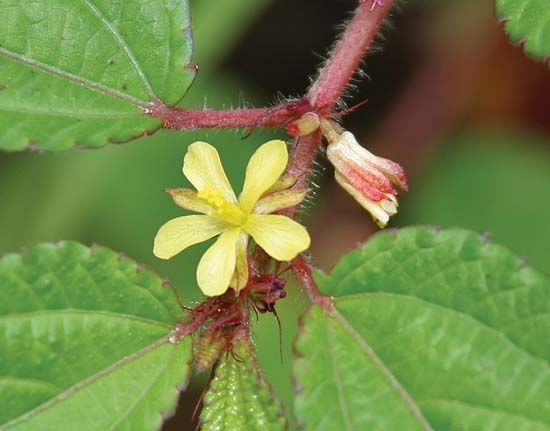
Corchorus is a genus comprising approximately 40 to 100 species of flowering plants within the mallow family (Malvaceae). These tropical herbs and undershrubs are characterized by their large leaves and yellow flowers.12
The genus is economically significant primarily as the source of jute, a natural fiber harvested from the bark of C. capsularis and C. olitorius, which are extensively cultivated in India and Bangladesh. Beyond fiber production, the leaves and young shoots of these plants are consumed as a vegetable in various regions, including West Africa, where they are used as a potherb. It is important to note that while the foliage is edible, the seeds of the plant are poisonous.1
How is jute fiber processed for industrial use?
Jute fiber is a bast fiber obtained from the inner tissue of the bark of the Corchorus plant stem. To extract these fibers for industrial use, the following steps are taken:
Extraction and Preparation
- Harvesting: The crop is harvested after the flowers have shed but before the seedpods fully mature to ensure the best balance of strength and luster.3
- Retting: Because the fibers are held together by gummy materials, the stems are submerged in pools or streams for 10–30 days. During this retting process, bacterial action breaks down the gummy tissues.3
- Separation: Once retted, the root ends are beaten with a paddle to loosen the fibers. The stems are broken near the root, and the fiber strands are jerked off, washed, dried, sorted, graded, and baled for shipment.3
Processing into Yarn
At the mill, the fibers undergo further refinement:
- Softening: Fibers are treated with oil, water, and emulsifiers.3
- Conversion: The fibers are processed through carding, drawing, roving, and spinning to separate filaments, align them, blend for uniformity, and twist them into strong yarn.3
What are the nutritional benefits of eating Corchorus leaves?
While Corchorus leaves and young shoots are widely consumed as a vegetable and used as a potherb in regions such as West Africa, the provided information does not contain specific data regarding their nutritional profile or health benefits.1
It is important to note that while the foliage is edible, the seeds of the Corchorus plant are poisonous and should not be consumed.1
In what climates do Corchorus plants thrive?
Corchorus plants, which are the primary source of jute, thrive in warm, humid climates. To achieve optimal growth, these herbaceous annuals require an environment that provides an average monthly rainfall of at least 3 to 4 inches (7.5 to 10 cm) throughout the growing season.
In addition to these climatic requirements, the plants grow best in well-drained, sandy loam soil. These conditions have historically supported extensive cultivation of the genus in the Bengal region of the Indian subcontinent, as well as in China and Brazil.1
Sources
- Corchorus — Encyclopædia Britannica
- Corchorus — Merriam-Webster
- jute — Encyclopædia Britannica
Published on · 2 min read