Cordaites
The Cordaitales were a significant group of gymnosperms that dominated Carboniferous landscapes, ranging from swampy environments to dry upland forests.…
How did the extinction of Cordaites impact the evolution of plant life?
The Cordaitales were a significant group of gymnosperms that dominated Carboniferous landscapes, ranging from swampy environments to dry upland forests. While they are often cited in the formulation of the cordaite-conifer evolutionary sequence, they were not direct ancestors to modern conifers but rather close relatives that coexisted with early forms like the Lebachiaceae.123
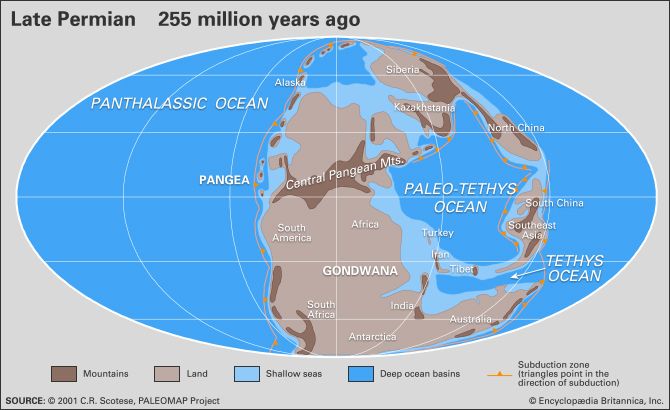
The provided search results do not specify the precise impact of the extinction of Cordaites on the subsequent evolution of plant life. However, the Permian Period that followed the Carboniferous was marked by significant climatic shifts and a massive extinction event that eliminated the vast majority of existing species. Following these environmental changes, terrestrial plants underwent broad diversification, and new lineages emerged as ecosystems reorganized.4
What types of reproductive structures did Cordaites have?
The reproductive structures of Cordaites were characterized by a complex arrangement of short shoots located in the leaf axils—the angle between a leaf stem and a branch. These structures consisted of the following components:3
- Shoot Organization: Each short shoot featured a series of bracts (modified leaves), with each bract containing a secondary, smaller axil.3
- Fertile Organs: Within these smaller axils, the plant bore both pollen sacs and ovules.3
- Pollen Characteristics: The pollen grains were structurally similar to those of many conifers, featuring a central portion surrounded by a bladder-like structure, which is believed to have increased buoyancy for wind dispersal.3
While these reproductive axes were slender and bore budlike shoots with helically arranged scales, they were distinct from the more compact, fused structures found in later conifer lineages.36
What are the key characteristics of Cordaites plants?
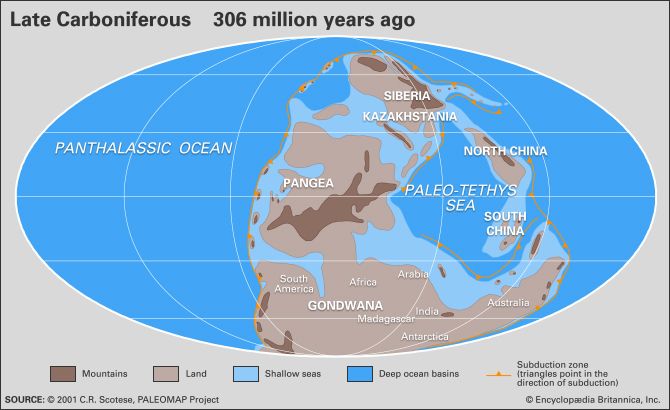
Cordaites were significant gymnosperm trees and shrubs that thrived during the Pennsylvanian Subperiod (318 to 299 million years ago). Key characteristics of these plants include:
- Physical Structure: They were often tall, branched trees reaching up to 30 metres (100 feet) in height, characterized by large, leathery, strap-shaped leaves that could grow up to 1 metre (3 feet) long.317
- Habitat: While they occupied diverse environments ranging from mangrovelike settings to dry hinterlands, they were most prevalent in swampy areas and floodplains, serving as a major component of upland forests in the paleocontinent of Laurussia.3
- Reproductive System: Their reproductive structures were compound and open, consisting of short shoots located in the leaf axils. These shoots contained bracts (modified leaves) that held secondary shoots, which in turn bore pollen sacs and ovules.31
- Evolutionary Context: Though they are considered close relatives and potential ancestors to the conifers, they were not direct ancestors because they coexisted with early conifer groups like the Lebachiaceae.37
During which geological time period did Cordaites flourish?
Cordaites flourished during the Pennsylvanian Subperiod, which lasted from approximately 318 to 299 million years ago. More broadly, the order to which they belong, the Cordaitales, was dominant throughout the Carboniferous Period, spanning from 359 million to 299 million years ago.84
Sources
- Carboniferous Period - Plants — Encyclopædia Britannica
- Cordaitales — Merriam-Webster
- Cordaites — Encyclopædia Britannica
- Cordaitales — Encyclopædia Britannica
- Permian Period — Encyclopædia Britannica
- gymnosperm - Appearance of gymnosperm divisions — Encyclopædia Britannica
- conifer - Annotated classification — Encyclopædia Britannica
- Pennsylvanian Subperiod — Encyclopædia Britannica
Published on · 2 min read