Cordaitales
Cordaitales is an order of extinct gymnospermous plants that were dominant during the Carboniferous Period (approximately 359 to 299 million years ago).…
What is Cordaitales?
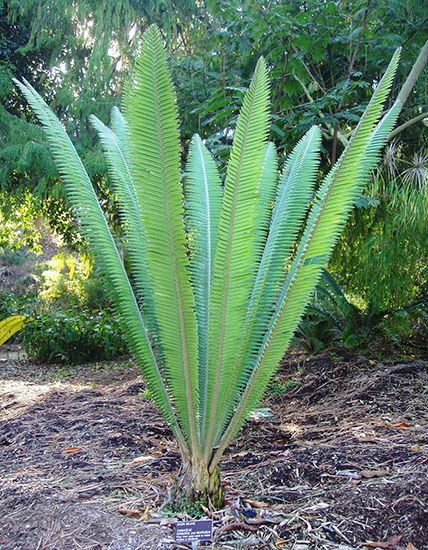
Cordaitales is an order of extinct gymnospermous plants that were dominant during the Carboniferous Period (approximately 359 to 299 million years ago). These plants were typically tall, arborescent trees that reached heights of up to 30 meters (100 feet), featuring branched upper trunks and long, leathery, strap-shaped leaves arranged in a spiral pattern.12
Classified within the coniferophytes, the order is generally considered to be closely related to, or ancestral to, the modern conifers. The group includes three families: Pityaceae, Poroxylaceae, and the best-known family, Cordaitaceae. The genus Cordaites, a prominent member of this order, was a significant component of upland forests and swampy environments during the Pennsylvanian Subperiod. Their reproductive structures consisted of separate male and female strobili, which shared similarities with those of early conifers.1342
How did the Carboniferous environment support such large trees?
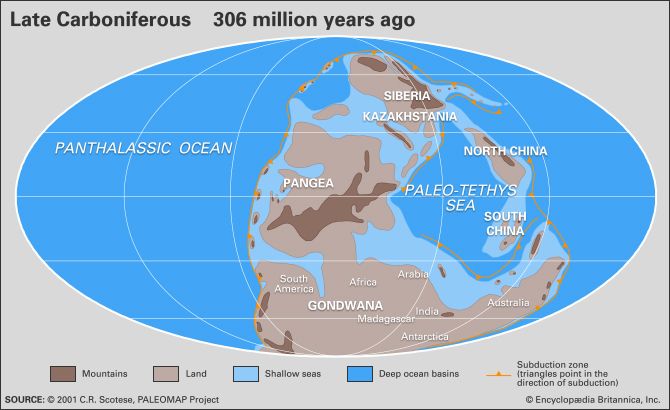
The Carboniferous environment supported the growth of massive vascular land plants—some exceeding 30 meters (100 feet) in height—primarily due to the favorable climatic conditions of the era.56
During this period, equatorial regions experienced consistent tropical conditions, which provided the warmth and moisture necessary for lush, year-round plant growth. Unlike plants in higher latitudes that exhibit seasonal growth rings, fossil plants from these equatorial coal swamps lack such rings, indicating a stable, non-seasonal climate that allowed for continuous development.7
These environments were dominated by diverse groups, including lycopods, sphenopsids, cordaites, and seed ferns. While some scientists suggest that higher atmospheric oxygen concentrations (reaching approximately 30 percent) may have facilitated the growth of large organisms, this theory is most frequently cited in the context of the period’s giant insects rather than the plants themselves. Instead, the combination of stable tropical temperatures and the proliferation of expansive, nutrient-rich swamp ecosystems provided the ideal foundation for these towering forests to thrive.657
What are the main differences between Cordaitales and modern conifers?
The order Cordaitales and modern conifers share an evolutionary history, but they exhibit distinct morphological differences, particularly regarding their foliage and reproductive structures.
Key Differences
- Leaf Morphology: Cordaitales were characterized by large, leathery, strap-shaped leaves that could reach up to 1 meter (3 feet) in length. In contrast, most modern conifers possess significantly smaller, often needlelike or scalelike leaves.4
- Reproductive Structures: The reproductive organs of Cordaitales were compound and open, consisting of short shoots borne in leaf axils. Each bract held a secondary shoot with numerous scale leaves surrounding the pollen sacs or ovules. Modern conifers, by comparison, have evolved more condensed, unified seed cones where the ovules are typically attached to scales that are often fused to the bracts.14
- Evolutionary Status: While Cordaitales are considered the ancestors of the order Coniferales, they are an extinct group. The transition from the cordaitean “dwarf shoot” to the flattened, unified seed scales seen in modern conifers occurred through intermediate fossil families, such as the Walchiaceae and Voltziaceae.34
How do scientists use fossils to reconstruct extinct plant species?
Scientists reconstruct extinct plant species by analyzing a variety of fossilized remains, ranging from large structures to microscopic evidence. The process relies on several key techniques:
- Macro-fossil Analysis: Paleobotanists examine larger plant parts, such as leaves and stems, which are often preserved through carbonization—a process that leaves a carbon film and an impression between layers of rock.9
- Palynology: This discipline involves the study of pollen and spores. Because these microfossils are highly resistant to decay and produced in vast quantities, they allow scientists to map the geographical distribution of plant groups and track changes in forest composition over time.10
- Microscopic Analysis: Scientists also utilize phytoliths—microscopic silica bodies that retain the shape of the plant cells in which they formed—and starch grains. These can be recovered from sediments or artifacts to identify specific plant types even when larger remains are absent.11
- Comparative Studies: By examining homology and structural similarities, researchers compare fossilized remains with extant plants to delineate phylogenetic relationships and evolutionary history.1012
Sources
- Cordaitales — Encyclopædia Britannica
- Cordaitales — Merriam-Webster
- conifer - Annotated classification — Encyclopædia Britannica
- Cordaites — Encyclopædia Britannica
- Carboniferous Period - Paleoclimate — Encyclopædia Britannica
- A Journey Through Time Since the Precambrian - Carboniferous Period: 358.9 million to about 298.9 million years ago — Encyclopædia Britannica
- Carboniferous Period - Plants — Encyclopædia Britannica
- evolution of the atmosphere - Attainment of the modern O 2 level — Encyclopædia Britannica
- palynology — Encyclopædia Britannica
- geology - Paleobotany — Encyclopædia Britannica
- evolution - Convergent and parallel evolution — Encyclopædia Britannica
- fossil — Encyclopædia Britannica
- Origins of agriculture - Research techniques — Encyclopædia Britannica
Published on · 3 min read