Cordia
Cordia is a genus comprising more than 200 species of trees and shrubs within the Boraginaceae family. These plants are primarily found in warm regions…
What is Cordia?
Cordia is a genus comprising more than 200 species of trees and shrubs within the Boraginaceae family. These plants are primarily found in warm regions across both the New and Old Worlds.12
They are widely valued for several characteristics:
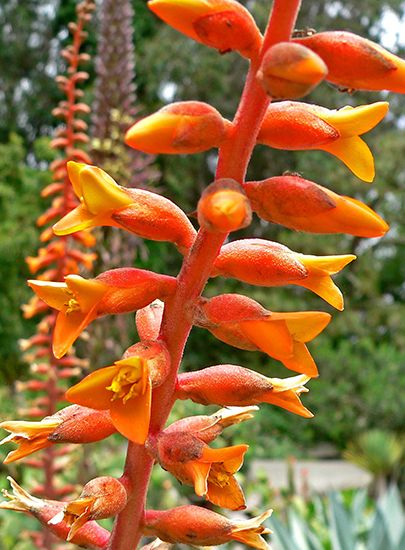
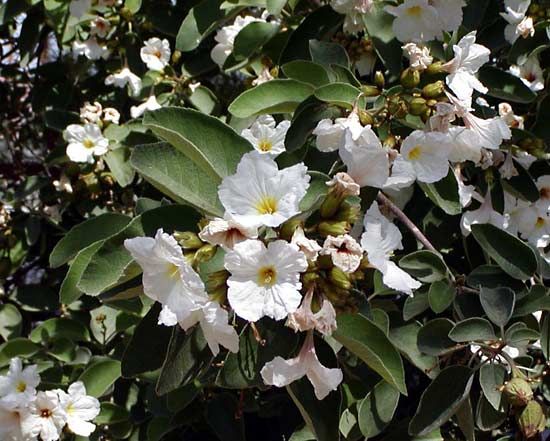
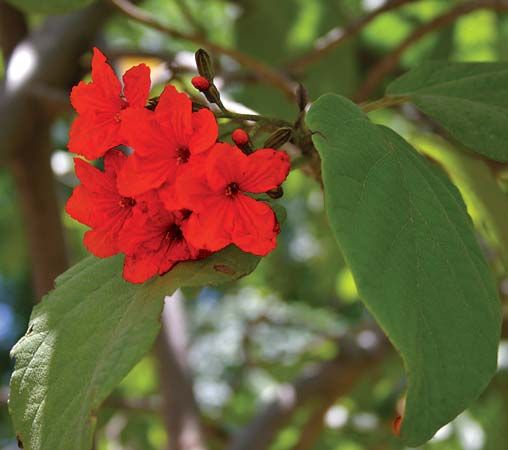
- Ornamental Value: Many species are cultivated for their striking, papery flower clusters, which appear in shades of red-orange, yellow, or white.1
- Utility: The wood of various species is used in cabinetmaking and construction, ranging from dense and dark to light and pale varieties.2
- Edibility: Several species produce fleshy, edible fruits.12
- Practical Uses: The foliage is often rough-surfaced; for example, the leaves of the geiger tree (C. sebestena) have historically been used as a substitute for sandpaper.1
The genus was named in honor of the German scholars Euricius and Valerius Cordus.2
What are some other plants in the Boraginaceae family?
The Boraginaceae family is a diverse group of flowering plants containing 148 genera and over 2,700 species. While the family includes the genus Cordia, it is home to many other notable plants, ranging from garden favorites to medicinal herbs and unique parasitic species.
Popular Garden Ornamentals
Many members of this family are cultivated for their aesthetic appeal:
- Heliotropium (heliotrope)
- Mertensia virginica (Virginia bluebell)
- Phacelia (scorpion weed)
- Pulmonaria (lungwort)
- Myosotis (forget-me-not)
Medicinal and Useful Plants
Several species have a history of medicinal use or other practical applications:
- Borago officinalis (borage)
- Symphytum officinale (comfrey)
- Lithospermum (puccoon or stoneseed)
Specialized Subfamilies
Recent botanical classification has reassigned two groups as subfamilies within Boraginaceae:
- Lennooideae: A group of rare, root-parasitic plants that lack chlorophyll and inhabit desert regions.
- Hydrophylloideae: A group including Hydrophyllum and Wigandia, which are distinguished by their specific seed development and placentation.
How do tropical trees adapt to their environments?
Tropical trees have evolved a wide array of structural and physiological adaptations to thrive in the intense competition and varied conditions of their environments.
Competition for Light
In the dense tropical rainforest, light is the primary limiting factor. Trees compete for solar energy through several strategies:
- Canopy Gaps: Many species remain as slow-growing seedlings or dormant seeds in the shade, accelerating their growth only when a gap in the canopy—caused by tree falls or storms—allows sunlight to reach the forest floor.5
- Mechanical Dependence: Some plants avoid the energy cost of building large trunks by using other trees for support. Lianas use hook-like devices to climb toward the canopy, while stranglers (such as Ficus) begin life as epiphytes before sending roots to the ground to eventually envelop and replace their host.5
- Aerial Dispersal: To ensure offspring reach well-lit areas, many trees produce aerodynamic, winged fruits or fibrous seeds that exploit wind currents.6
Nutrient and Water Management
Because nutrients are often scarce in deep soil, tropical trees frequently concentrate their roots in the uppermost, nutrient-rich layers of humus.
- Root Adaptations: To stabilize themselves in shallow, saturated soils, many trees develop buttress roots—planklike extensions that provide structural support.7
- Symbiosis: Most trees form mycorrhizal associations with fungi, which efficiently absorb phosphorus and other nutrients from the soil in exchange for energy from the tree.57
- Hydrophytic Modifications: Trees in aquatic environments, such as mangroves, utilize pneumatophores for aeration and stilt roots for support in unstable, waterlogged mud.7
Leaf Adaptations
Leaves are highly responsive to environmental signals. In supermoist habitats, leaves often have thinner walls and larger stomata to facilitate gas exchange. Conversely, in drier or seasonally dry tropical forests, trees may exhibit xeromorphic traits, such as thicker cuticles, waxy surfaces, or smaller, sunken stomata to minimize water loss.8
What are the traditional uses of wood in cabinetmaking?
Cabinetmaking has long relied on the unique properties of wood, balancing its natural beauty with the technical challenges posed by its tendency to shrink and swell with moisture changes.111213
Traditional Construction Methods
Historically, cabinetmakers utilized two primary systems of construction:
- Framed Construction: This traditional method uses rails and stiles joined by mortise and tenon or mitre joints. The panels are held in grooves, allowing the wood to move without compromising the structural integrity of the frame.14
- Veneering: Emerging as a hallmark of the cabinetmaker’s profession, this technique involves gluing a thin layer of fine wood onto a more stable or inferior base. This allowed craftsmen to utilize visually striking wood features—such as burrs, butts, and curls—that would be unstable if used as solid boards. It also enabled the creation of complex, curved surfaces, such as those found on Rococo-era chests.1114
Decorative and Structural Techniques
- Inlay and Marquetry: Cabinetmakers used the natural variations in wood grain and color to create intricate patterns, often employing marquetry to decorate flat surfaces.1114
- Joint Design: To ensure durability, cabinetmakers perfected joints like the dovetail, which provides high mechanical strength for drawer sides and other right-angle connections.1412
Sources
- Cordia — Encyclopædia Britannica
- Cordia — Merriam-Webster
- Boraginaceae — Encyclopædia Britannica
- Boraginaceae — Merriam-Webster
- Tropical rainforest - General structure of the rainforest — Encyclopædia Britannica
- tree - Tree roots — Encyclopædia Britannica
- "Flying" trees — Encyclopædia Britannica
- Tropical rainforest - Environment — Encyclopædia Britannica
- tree - Leaf adaptations — Encyclopædia Britannica
- succulent — Encyclopædia Britannica
- Furniture - Wood — Encyclopædia Britannica
- furniture industry - History — Encyclopædia Britannica
- Joint — Encyclopædia Britannica
- wood - Mechanical properties — Encyclopædia Britannica
- furniture industry - Materials — Encyclopædia Britannica
Published on · 4 min read