Corn Poppy
The corn poppy (Papaver rhoeas) holds profound cultural significance as a symbol of remembrance, particularly for those who lost their lives during World War…
What is the cultural significance of the corn poppy, especially in relation to Remembrance Day?
The corn poppy (Papaver rhoeas) holds profound cultural significance as a symbol of remembrance, particularly for those who lost their lives during World War I.12
This association emerged because the plant, which typically grows as a weed in cultivated fields, thrived in the soil disturbed by heavy shelling and trench warfare in Belgium and northern France. The image of these vibrant red flowers blooming amidst the devastation of the battlefield was immortalized in the 1915 poem “In Flanders Fields” by Canadian surgeon John McCrae1.12
The poem’s popularity helped establish the poppy as an enduring emblem of sacrifice. Following the war, the tradition of wearing artificial red poppies became a central feature of Remembrance Sunday and Remembrance Day ceremonies. In 1921, the British Legion began selling these poppies to raise funds for veterans, a practice that continues today through annual appeals. Beyond personal wear, wreaths of poppies are frequently displayed at memorial sites to honor the fallen.32
How does the corn poppy reproduce and spread in agricultural fields?
The corn poppy (Papaver rhoeas) reproduces primarily through its seeds, which are contained within egg-shaped capsules.2 A key feature of its survival strategy in agricultural fields is its ability to maintain a soil seed bank.2
These seeds can remain dormant in the soil for many years, effectively waiting for favorable conditions to germinate. The plant is particularly well-adapted to environments where the ground has been disturbed; when the soil is turned—whether through traditional agricultural practices or, historically, by the shelling associated with warfare—the dormant seeds are brought to the surface, where they sprout and bloom. This mechanism allows the corn poppy to colonize areas following human-induced disturbances and ensures the species can reestablish itself even after long periods of inactivity.26
What are the physical characteristics of the corn poppy plant?
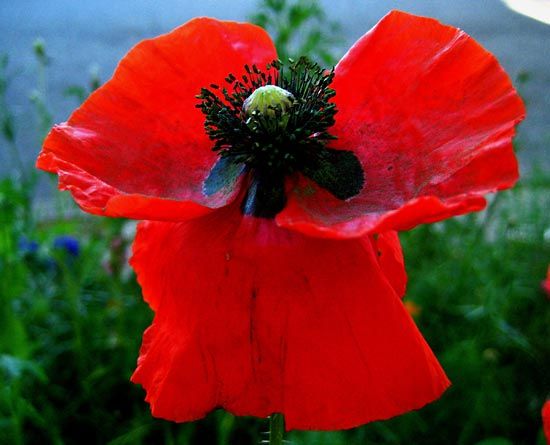
The corn poppy (Papaver rhoeas) is an erect herb belonging to the Papaveraceae family. It typically grows as an annual and reaches a height of no more than 70 cm (28 inches).2
Key physical characteristics include:
- Stems and Buds: The plant features stems ranging from 25 to 90 cm (10 to 35 inches) in length, which support solitary flowers that emerge from drooping, hairy buds.2
- Flowers: The blossoms are 7 to 10 cm across and consist of four petals, which are usually a brilliant red and sometimes feature a black spot at the base. They also contain numerous dark stamens.2
- Seeds: The plant produces edible seeds housed within egg-shaped capsules.2
How has the corn poppy been depicted in art and literature throughout history?
The corn poppy (Papaver rhoeas) holds a profound place in cultural memory, primarily as a symbol of World War I. Because the plant’s seeds remain dormant in the soil for years and sprout readily when the ground is disturbed, the battlefields of the Great War were famously blanketed in red poppies, transforming the scarred landscape into a poignant visual of loss and resilience.2
This imagery was immortalized in literature through the iconic poem “In Flanders Fields” by John McCrae. His work cemented the flower’s status as a lasting emblem of remembrance for those who served and died in conflict. Today, this legacy continues in the form of paper poppies worn on lapels to honor veterans and support their well-being, and the flower remains a central symbol for Remembrance Sunday in the United Kingdom and other Commonwealth nations.82
Sources
- In Flanders Fields — Encyclopædia Britannica
- corn poppy — Encyclopædia Britannica
- Poppy Day — Merriam-Webster
- Remembrance Sunday — Encyclopædia Britannica
- Popcorn — Encyclopædia Britannica
- corn poppy — Merriam-Webster
- Seed dispersal — Encyclopædia Britannica
- Veterans Day — Encyclopædia Britannica
Published on · 3 min read