Cowrie
A cowrie is a type of marine snail belonging to the family Cypraeidae and the class Gastropoda. These mollusks are primarily found in the coastal waters of…
What is cowrie?
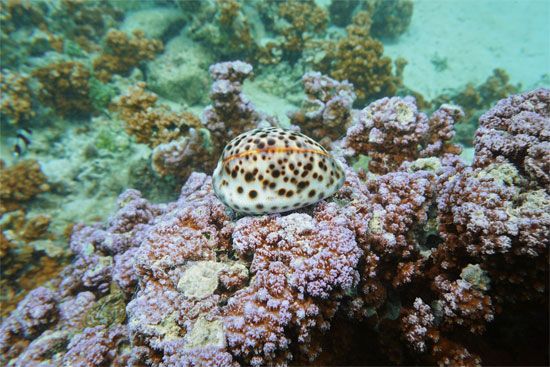
A cowrie is a type of marine snail belonging to the family Cypraeidae and the class Gastropoda. These mollusks are primarily found in the coastal waters of the Indian and Pacific oceans and are characterized by their thick, humped, and glossy shells, which often feature intricate, speckled patterns and inrolled, toothed apertures.1
Throughout history, various species have held cultural and economic significance:
- Currency: The money cowrie (Cypraea moneta) has historically served as a form of currency in Africa and other regions.12
- Ornamentation and Symbolism: The golden cowrie (C. aurantium) was traditionally worn by royalty in the Pacific Islands, while the egg cowry (Amphiperas ovum) is prized as an ornament and a fertility symbol.13
- Diversity: Other notable species include the tiger cowry (Cypraea tigris), known for its distinct mottled brown and ivory shell.4
These creatures are classified under the subclass Prosobranchia, representing a fascinating intersection of marine biology and human cultural history.
How were cowrie shells used as currency in ancient trade?
Cowrie shells, specifically the money cowrie (Cypraea moneta), functioned as a form of currency due to their social convention and general acceptability in trade. These small, yellow or white shells were utilized as a medium of exchange across various regions, including Africa and India.21
The use of cowries as money is an example of how diverse items—ranging from wampum beads to tobacco—have historically served as currency based on habit and successful experience. Unlike modern fiat currency, these shells derived their value from their status as a recognized commodity within their respective trade networks. While other species, such as the egg cowry, were primarily valued for ornamentation or as fertility symbols, the money cowrie was specifically distinguished by its role in economic transactions.123
What makes the cowrie shell biologically unique among marine snails?
The cowrie shell is biologically unique among marine snails primarily due to its distinct, conservative morphology within the family Cypraeidae. Unlike many other gastropods that exhibit a wide variety of shell shapes, cowries maintain a consistent, humped, and thick structure.16
Key features that define their unique appearance include:
- Glossy Finish: The shells are characterized by a highly polished, glossy surface, often featuring intricate, speckled, or beautifully colored patterns.1
- Apertural Structure: The opening of the shell, known as the aperture, is notably distinct. Its lips are inrolled toward the center and are frequently lined with fine, tooth-like ridges.1
- Morphological Stability: While many other marine families have evolved diverse shell shapes—such as spines, ridges, or elongated spirals—to adapt to specific environmental pressures or predation, the Cypraeidae family remains remarkably conservative in its overall shape.6
These traits distinguish the cowrie from other members of the class Gastropoda, which typically follow a more standard logarithmic spiral pattern.6
What cultural or religious meanings do cowrie shells hold in different societies?
Beyond their historical role as currency, cowrie shells have held significant cultural and symbolic value across various societies:
- Royalty and Status: In the Pacific Islands, the golden cowrie (Cypraea aurantium) was traditionally reserved for and worn by royalty, serving as a powerful marker of social rank and authority.1
- Fertility and Ornamentation: The egg cowry (Amphiperas ovum), a large, smooth, spindle-shaped shell, is highly prized by indigenous peoples in the Indian and southwest Pacific oceans. It is frequently utilized as an ornamental object and is widely regarded as a potent fertility symbol. regarded as a potent fertility symbol.3
- Economic Symbolism: The money cowrie (C. moneta) transcended its practical function as currency in Africa and other regions, often becoming deeply embedded in the social and economic fabric of the cultures that adopted it as a medium of exchange.1
These diverse uses highlight how the cowrie shell has functioned as more than just a biological specimen, serving as a medium for expressing status, spiritual beliefs, and social identity.13
Sources
- cowrie — Encyclopædia Britannica
- money cowrie — Merriam-Webster
- egg cowry — Merriam-Webster
- tiger cowry — Merriam-Webster
- money - Varieties of money — Encyclopædia Britannica
- gastropod - The shell — Encyclopædia Britannica
- Cypraeidae — Merriam-Webster
- gastropod - Size range and diversity of structure — Encyclopædia Britannica
- ostariophysan - Secondary sexual characteristics — Encyclopædia Britannica
Published on · 3 min read