Cuttlefish
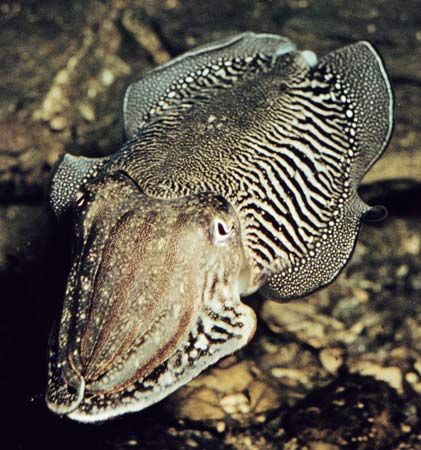
Cuttlefish possess highly specialized chromatophoric organs that allow them to perform some of the most rapid and complex color changes in the animal…
How do cuttlefish use chromatophores for camouflage and communication?
Cuttlefish possess highly specialized chromatophoric organs that allow them to perform some of the most rapid and complex color changes in the animal kingdom, often in half a second or less.12
Mechanism of Action
Unlike vertebrates, which often rely on hormonal regulation, cephalopod chromatophores are controlled directly by the nervous system. Each organ consists of an elastic sac filled with biochrome, surrounded by a ring of radiating muscle fibers. When these muscles contract in response to neural stimulation, they stretch the sac into a broad, thin disk, displaying the pigment. When the muscles relax, the sac shrinks, concealing the color.12
Camouflage and Communication
- Camouflage: Cuttlefish use these organs to achieve background matching, allowing them to blend seamlessly into their surroundings to avoid predation.13
- Communication: Beyond concealment, these animals use their chromatophores for social interaction. Excited cephalopods often exhibit spectacular displays, with waves of color rippling across their bodies. This ability allows them to switch rapidly between cryptic (concealing) coloration and non-cryptic display coloration to communicate during social or reproductive interactions.14
What role do cuttlefish play in marine ecosystems?
Cuttlefish serve as both predators and prey within shallow tropical and temperate coastal marine ecosystems. As active hunters, they primarily feed on crustaceans and small fishes, helping to regulate the populations of these organisms. Conversely, they occupy a position as a food source for larger aquatic animals, which rely on them as part of the marine food web.7
Beyond their ecological role, cuttlefish are notable for their high level of animal intelligence. Research indicates they possess the capacity for self-control, demonstrating an ability to delay gratification by choosing a preferred food source over an immediate, lower-quality option. Humans also interact with these cephalopods by utilizing them as a food source, harvesting their ink, and collecting their cuttlebone for use as a calcium supplement for birds.7
What are the unique physical characteristics of cuttlefish that distinguish them from other cephalopods?
Cuttlefish are distinguished from other cephalopods by several unique physical and biological characteristics:
- Internal Shell: Unlike the external shells of the Nautilus or the reduced or absent shells of octopuses and squids, cuttlefish possess a thick, internal calcified shell known as the cuttlebone.
- Body Shape: They are characterized by somewhat flattened bodies that are bordered by a pair of narrow fins, which helps distinguish them from the more streamlined or saccular forms of other cephalopods.
- Tentacle Pouches: While they share the common cephalopod trait of having eight arms and two tentacles, cuttlefish have the unique ability to withdraw their two longer tentacles entirely into specialized pouches when they are not being used to capture prey.
- Reproductive Behavior: During egg-laying, cuttlefish exhibit a distinct protective behavior by squirting their eggs with ink to camouflage them, as the eggs are otherwise white and vulnerable.
- Brain Specialization: Morphological studies indicate that cuttlefish possess highly developed brains. In some species, the cerebral centers are subdivided for specialization, with the pedal ganglia divided into distinct brachial and epipodal elements that innervate the arms and funnel, respectively.
How do cuttlefish compare to other cephalopods like octopuses and squid in terms of intelligence?
Cuttlefish, octopuses, and squids are all highly intelligent cephalopods that possess complex brains and advanced nervous systems, which correlate with their active, predatory lifestyles. While they share a high degree of cephalization, their specific cognitive behaviors often reflect their different ecological niches.710911
Cognitive Abilities and Learning
Research has demonstrated that these animals are capable of significant learning and memory, with associative areas in their brains dedicated to discriminating between objects.119
- Cuttlefish: Behavioral studies have shown that cuttlefish possess the capacity for self-control, a trait similar to that of intelligent vertebrates. They can learn to delay immediate gratification, choosing to forgo a lower-quality food item to receive a preferred reward later.7
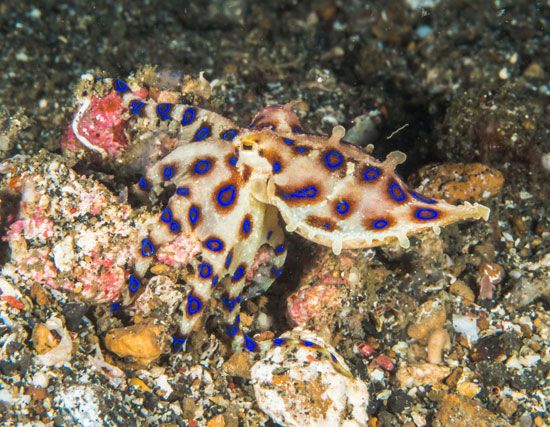
- Octopuses: Octopuses are well-documented for their problem-solving skills. They have been observed using tools, such as carrying coconut shells to use as portable shelters, which is considered the first recorded instance of tool use by an invertebrate. They also exhibit complex hunting behaviors, such as stalking prey or using their arms as lures.11
- Squids: While laboratory studies on squids often focus on their rapid movement and nerve impulse conduction—facilitated by their giant-fibre system—they also display considerable cunning in hunting and luring prey.119
Ultimately, all three groups exhibit a high level of behavioral flexibility, allowing them to adapt to their environments through camouflage, complex social signaling, and sophisticated predatory strategies.119
Sources
- coloration - Short-term changes — Encyclopædia Britannica
- coloration - Physiological control — Encyclopædia Britannica
- scorpaeniform - Camouflage and coloration — Encyclopædia Britannica
- coloration - Background matching — Encyclopædia Britannica
- coloration - Optical functions: combination of concealing and advertising coloration — Encyclopædia Britannica
- Integument - Pigment cells — Encyclopædia Britannica
- cuttlefish — Encyclopædia Britannica
- cephalopod - Reproduction and life cycles — Encyclopædia Britannica
- cephalopod - Form and function — Encyclopædia Britannica
- cephalopod - Behaviour — Encyclopædia Britannica
- nervous system - Complex mollusks — Encyclopædia Britannica
Published on · 4 min read