Coyote
The coyote (Canis latrans) is a highly adaptable member of the dog family native to North America/animal/dog) family native to North America.
Where are coyotes found, and how has their range expanded over time?
The coyote (Canis latrans) is a highly adaptable member of the dog family native to North America/animal/dog) family native to North America.1
Geographic Range and Expansion
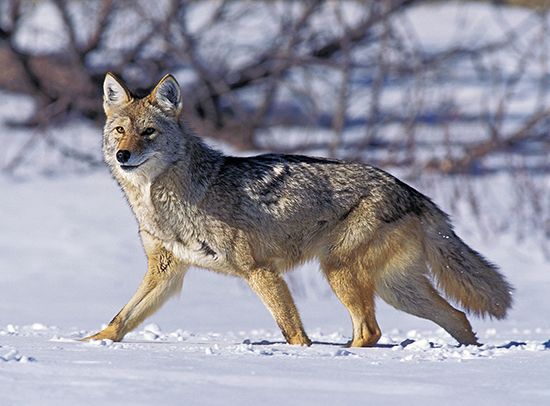
Historically, the coyote’s range was primarily centered in the central plains and deserts of North America, with the Appalachian Mountains serving as its eastern border. Over time, the species has significantly expanded its territory. Today, coyotes are found throughout the United States and Canada, ranging from Alaska southward into Central America.21
This expansion is largely attributed to the coyote’s remarkable ability to adapt to diverse environments, including human-modified landscapes and urban settings like Chicago and Los Angeles. As a result of this success, coyote populations at the start of the 21st century are greater than ever before.213
What are the physical characteristics and appearance of coyotes?
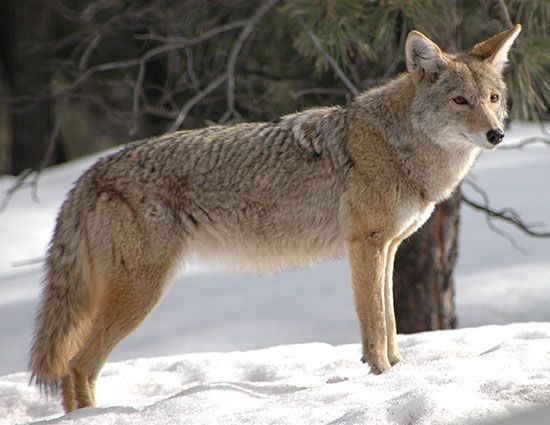
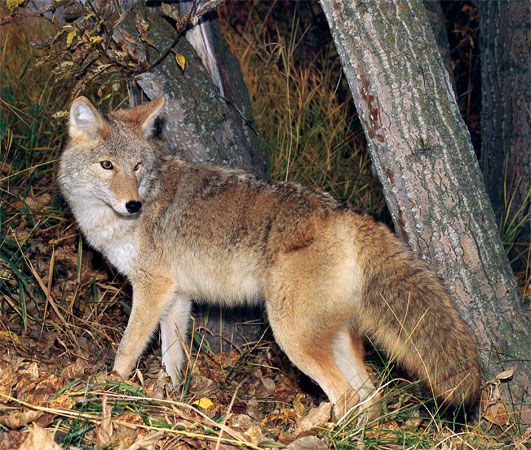
The coyote (Canis latrans) is a member of the dog family that is smaller and more lightly built than the wolf. While physical size and color can vary by region, the following characteristics are typical for the species:1
- Dimensions: Coyotes generally stand about 60 cm (24 inches) at the shoulder. They typically weigh between 9 and 23 kg (20–50 pounds) and measure 1–1.3 meters (3.3–4.3 feet) in length, including a 30–40 cm tail.1
- Coat: Their fur is long and coarse. The coloration is usually a grizzled buff on the upper body and whitish on the underbelly, with reddish tones on the legs. They possess a bushy, black-tipped tail.1
- Variations: There is notable local variation in appearance; for instance, the largest coyotes are found in the northeastern United States and eastern Canada. Some populations in the east are also influenced by hybridization with wolves and dogs, making them roughly 4.5 kg (10 pounds) heavier than the average coyote.1
How long do coyotes typically live, and what is their lifecycle like?
Coyotes typically live for 6 to 8 years in the wild, though they can survive for 21 years or more in captivity. In their natural environment, most deaths are caused by human activity—such as hunting, trapping, or vehicle collisions—or by infectious diseases like mange, canine distemper, and rabies.4
Lifecycle and Reproduction
The coyote lifecycle follows a seasonal pattern centered on family units:
- Mating and Gestation: Coyotes mate between January and March. Females have a gestation period of 58 to 65 days.4
- Denning: Births occur in underground dens, often located on well-drained hillsides. A typical litter consists of four to seven pups.4
- Development: Pups are born blind and helpless. They begin emerging from the den to play after two to three weeks and are weaned by five to seven weeks of age.4
- Independence: Both parents provide care until the offspring are fully grown and independent, usually between six and nine months of age. While young coyotes typically disperse in the fall, some older siblings may remain to help raise subsequent litters, and family groups sometimes stay together to form packs during the winter.4
How have coyotes been portrayed in Native American folklore and modern popular culture?
In the mythology of Indigenous peoples of the Great Plains, California, and the American Southwest, the Coyote is a central figure of the era preceding human existence. Often characterized as a trickster, he is depicted as a complex demiurge who acts as a creator, magician, and lover, while simultaneously embodying traits like gluttony and incompetence. These oral traditions celebrate his role in securing essential gifts for humanity, such as fire and daylight, while noting that his frequent disregard for social boundaries often leads to chaos that must be resolved by the story’s end.5
While the provided search results detail the rich history of the coyote in Native American folklore, they do not contain information regarding the animal’s portrayal in modern popular culture.
Sources
- coyote — Encyclopædia Britannica
- What is the difference between a wolf and a coyote? — Encyclopædia Britannica
- coyote: Top Questions — Encyclopædia Britannica
- wolf: Top Questions — Encyclopædia Britannica
- Coyote — Encyclopædia Britannica
- coyote — Merriam-Webster
Published on · 3 min read