Mesopredator Release
In ecology, the distinction between an apex predator and a mesopredator is defined by their position in the food web and their interactions with other…
What is a mesopredator and how does it differ from an apex predator?
In ecology, the distinction between an apex predator and a mesopredator is defined by their position in the food web and their interactions with other species.
Apex Predators
An apex predator is a flesh-eating animal that occupies the top rank of an ecosystem’s trophic pyramid. These animals have no natural predators or enemies within their environment, making them the final destination for energy flow in a biological community. They often act as keystone species, maintaining biodiversity by controlling the populations of other species.1
Mesopredators
Mesopredators are medium-sized predators that typically occupy a lower position in the food chain. They are often outcompeted by apex predators for resources and may even be consumed by them. Consequently, mesopredators often alter their behavior or avoid areas frequented by top carnivores to reduce the risk of an encounter.2
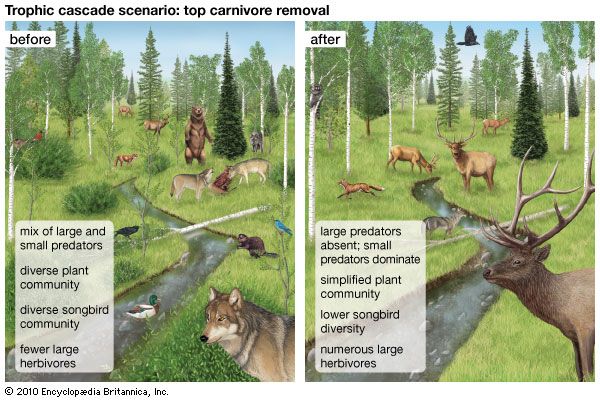
The relationship between these two groups is best illustrated by mesopredator release, a phenomenon where mesopredator populations increase rapidly following the removal of apex predators, often leading to a decline in local biodiversity.23
How does human activity contribute to mesopredator release in various ecosystems?
Human activity is a primary driver of mesopredator release, a phenomenon where populations of medium-sized predators surge following the decline or removal of top carnivores. This ecological disruption occurs through several human-influenced pathways:23
- Persecution and Overharvesting: The systematic hunting, trapping, and poisoning of apex predators—such as wolves, cougars, and large sharks—by humans has effectively removed the natural checks on mesopredator populations.23
- Resource Availability: When top carnivores are eliminated, mesopredators like coyotes, foxes, raccoons, and baboons gain access to hunting grounds, den sites, and food resources that were previously restricted by the presence of dominant predators.23
- Aquatic Exploitation: Overfishing of large predatory fish, such as cod and large sharks, has triggered similar releases in marine environments, allowing smaller-bodied sharks and rays to proliferate and decimate other species, such as scallop populations.23
The resulting increase in mesopredator populations often leads to a decline in biodiversity, as these animals place intense pressure on their prey, including songbirds and small mammals. Furthermore, some mesopredators adapt to human-dominated landscapes, becoming nuisance species that plunder resources or pose health risks.23
How might climate change influence mesopredator release in different ecosystems?
While the provided search results explain that mesopredator release is primarily driven by the removal of top carnivores through human persecution and overharvesting, they do not explicitly detail how climate change influences this specific ecological phenomenon.
Traditionally, climate and other physical or chemical factors were viewed as the primary controllers of plant production and nutrient cycling. However, modern research emphasizes that these processes are also significantly influenced by trophic cascades, which involve the complex interactions between predators, prey, and primary producers. While climate change is a major environmental stressor, the current Britannica knowledge base does not contain specific information regarding its direct role in triggering or exacerbating mesopredator release.
How do trophic cascades relate to mesopredator release?
Mesopredator release and trophic cascades are closely linked ecological concepts that describe how the removal of top-tier predators fundamentally alters ecosystem structure.
The Relationship
A trophic cascade is a broad phenomenon where the addition or removal of a top predator triggers reciprocal changes in the populations of species across multiple levels of a food chain. Mesopredator release is a specific type of trophic cascade that occurs when the removal of an apex predator allows medium-sized predators (mesopredators) to proliferate.
Mechanisms of Change
- Removal of Top-Down Control: In a stable ecosystem, top carnivores (such as wolves or large sharks) suppress mesopredator populations through direct predation and by forcing them to avoid certain hunting grounds or foraging patterns.
- Resource Availability: When top predators are removed—often due to human persecution or overfishing—mesopredators like coyotes, raccoons, or smaller rays face less competition and mortality. They subsequently claim resources previously controlled by the apex species.
- Ecosystem Impact: This release leads to a “cascade” of negative effects, including the dramatic decline of the mesopredators’ prey (such as songbirds or scallops) and an overall reduction in biodiversity.
Sources
- apex predator — Encyclopædia Britannica
- mesopredator release — Encyclopædia Britannica
- trophic cascade — Encyclopædia Britannica
Published on · 3 min read