Creodonta
Creodonta were an order of extinct carnivorous mammals that existed for over 50 million years, appearing in the Paleocene Epoch and persisting until…
How did the evolution of Creodonts differ from that of other mammalian carnivores?
Creodonta were an order of extinct carnivorous mammals that existed for over 50 million years, appearing in the Paleocene Epoch and persisting until approximately 9 million years ago. While they coexisted with members of the order Carnivora for much of their history, the two groups likely occupied different ecological niches.1
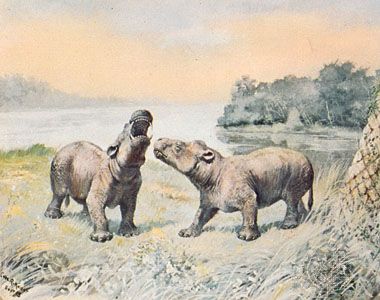
Creodonts are often compared to living carnivorous marsupials, suggesting their evolutionary path and ecological specializations differed from those of modern placental carnivores. Unlike the order Carnivora, which remains extant, the last creodont, Dissopsalis carnifex, went extinct millions of years ago. The group was divided into two primary families: the Oxyaenidae, which featured short faces and powerful limbs, and the Hyaenodontidae, which were more diverse and included forms resembling dogs or wolves. Their decline through the Miocene Epoch eventually led to their total disappearance from the fossil record.12
How did the size of Creodonts compare to modern carnivorous mammals?
Creodonts exhibited a wide range of sizes, comparable to the diversity seen in modern carnivorous mammals. Throughout their 50-million-year history, these animals occupied various ecological niches, resulting in a broad spectrum of body types.1
- Small-sized species: Many creodonts were relatively small, with some species resembling modern weasels, foxes, or civets.1
- Medium-sized species: Several forms were similar in size and build to modern dogs or wolves.14
- Large-sized species: The group also included massive, giant predators such as the bearlike Megistotherium, which reached sizes significantly larger than many contemporary carnivores.1
While their body plans often mirrored those of modern animals—such as the doglike appearance of Hyaenodon or the badger-like build of certain oxyaenids—creodonts were distinct from the order Carnivora. Their evolutionary trajectory suggests they were ecologically analogous to living carnivorous marsupials, such as the thylacine, rather than direct ancestors of today’s placental carnivores.14
How are Creodonts related to modern carnivorous mammals?
It is inaccurate to classify Creodonts as a suborder of the order Carnivora, as some sources suggest; they are recognized as a distinct order of extinct mammals known as Creodonta.
Creodonts were not the direct ancestors of modern carnivorous mammals. Instead, they were a separate group that coexisted with members of the order Carnivora for over 50 million years. While they occupied similar ecological niches, creodonts likely possessed different specializations, functioning in a manner analogous to living carnivorous marsupials like the thylacine.12
Although they shared a predatory lifestyle, the two groups followed distinct evolutionary paths. Creodonts were highly diverse, ranging from small, weasel-like creatures to massive, bearlike predators, but they ultimately declined and went extinct approximately 9 million years ago, whereas the order Carnivora remains extant today.1
What were some of the notable genera or species within the Creodonta order?
The order Creodonta comprised over 180 species, categorized primarily into two families: the Oxyaenidae and the Hyaenodontidae. Notable genera include:
- Hyaenodon: A well-known hyaenodontid genus that appeared during the middle Eocene Epoch. It was a large, efficient predator with a long, narrow skull and doglike body, often compared to the thylacine.11
- Megistotherium: A giant, bearlike predator representing the larger end of the creodont size spectrum.4
- Sinopa: Another significant genus within the diverse hyaenodontid family.4
- Oxyaena: The type genus for the family Oxyaenidae, characterized as a long-bodied, short-legged, plantigrade animal from the North American Eocene.45
- Isohyaenodon: A genus representing the smaller, weasel-like forms of these ancient carnivores.4
- Dissopsalis carnifex: Notable for being the last known creodont, which survived until approximately 9 million years ago.4
These genera illustrate the vast ecological diversity of the order, which spanned from the Paleocene Epoch through the Miocene.4
Sources
- Creodonta — Encyclopædia Britannica
- Creodonta — Merriam-Webster
- cynodont — Encyclopædia Britannica
- Hyaenodon — Encyclopædia Britannica
- creodont — Merriam-Webster
- Oxyaena — Merriam-Webster
Published on · 3 min read