Hyaenodon
Hyaenodon is an extinct genus of carnivorous mammals belonging to the order Creodonta. These predators first appeared in the fossil record during the middle…
What is Hyaenodon?
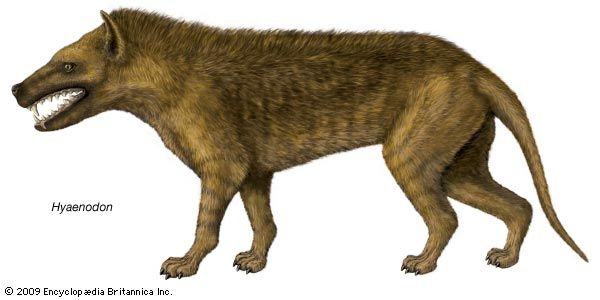
Hyaenodon is an extinct genus of carnivorous mammals belonging to the order Creodonta. These predators first appeared in the fossil record during the middle of the Eocene Epoch, approximately 42 million years ago, and persisted until the end of the Oligocene Epoch, about 25 million years ago.12
The genus comprised roughly 30 species that inhabited regions across Eurasia, Africa, and North America. Physically, Hyaenodon was a large, efficient predator characterized by a long, narrow skull and large, catlike teeth. While its head had feline features, its body was more doglike, bearing a resemblance to the recently extinct thylacine, or Tasmanian wolf. As a member of the family Hyaenodontidae, it represents one of the most well-known groups of creodonts, which were diverse, ecologically varied mammals that coexisted with members of the order Carnivora for much of their history.132
What are creodonts and how do they differ from modern carnivores?
Creodonta is an order of extinct carnivorous mammals that existed for over 50 million years, appearing in the Paleocene Epoch and persisting until approximately 9 million years ago.4
Characteristics and Diversity
Creodonts were ecologically diverse, with over 180 described species ranging from small, weasel-like animals to giant, bearlike forms such as Megistotherium. The order is divided into two primary families:4
- Oxyaenidae: Characterized by relatively short faces and powerful limbs, these animals may have resembled modern badgers, wolverines, or bears.4
- Hyaenodontidae: A more diverse and abundant group, including genera like Sinopa and Hyaenodon. Smaller species resembled foxes or civets, while larger ones were similar to dogs or wolves.41
Differences from Modern Carnivores
While creodonts coexisted with members of the order Carnivora for much of their history, they occupied different ecological niches. Creodonts are often considered analogous to living carnivorous marsupials, such as the thylacine, rather than direct ancestors of modern placental carnivores.41
How did the Eocene and Oligocene environments shape the evolution of predators?
The environmental shifts during the Eocene and Oligocene epochs were primary drivers in the evolution and turnover of predatory mammals.
Eocene: Warmth and Forested Habitats
During the early and middle Eocene, the Earth experienced a period of significant warmth and humidity, characterized by widespread subtropical and temperate forests. These environments supported a diverse array of early mammals, including the rise of Creodonta, which occupied various ecological niches. The relative stability of these forested habitats allowed for the diversification of archaic predatory groups, such as the Oxyaenidae and Hyaenodontidae, which coexisted with early members of the order Carnivora.456
The Eocene-Oligocene Transition
A major turning point occurred near the Eocene-Oligocene boundary (approximately 33.9 million years ago), when global cooling triggered a shift from dense rainforests to more open forests and grasslands. This climatic transition caused:74
- Faunal Turnover: The cooling led to the extinction of many archaic vertebrate groups, including the last of the oxyaenids.68
- Modernization: The resulting landscape favored the rise of modern mammalian groups, including early felines and canines, which were better adapted to the changing terrain.78
- Provincialism: As climates became more differentiated, animal communities became more geographically distinct, leading to greater provincialism in vertebrate faunas.89
By the Oligocene, while creodonts like Hyaenodon remained significant, the environment increasingly favored the specialized traits of modern carnivores, setting the stage for their eventual dominance in the Miocene.678
What other prehistoric mammals lived alongside Hyaenodon?
Hyaenodon, which lived from approximately 42 to 25 million years ago, coexisted with a diverse array of prehistoric mammals during the Eocene and Oligocene epochs. Because these epochs were periods of significant faunal transition, the animals sharing the landscape with Hyaenodon varied by region and time.
Notable Contemporaries
- Early Herbivores: During the Oligocene, the landscape featured primitive horses such as Mesohippus and Miohippus, as well as early pigs and peccaries.4
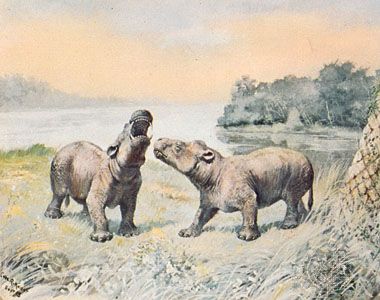
- Giant Mammals: The Oligocene saw the existence of the largest land mammal of all time, the giant hornless rhinoceros Indricotherium, found in Asia.4
- Early Primates: The fossil record from this era includes early apelike forms such as Parapithecus and various Old World monkeys, particularly in African deposits.4
- Other Mammals: Bats became widespread and locally abundant during the Oligocene, and primitive beavers appeared late in the epoch.4
Additionally, Hyaenodon shared its environment with other members of the order Creodonta, such as the genus Sinopa, as well as early representatives of the order Carnivora that were beginning to diversify as archaic groups declined.104
Sources
- Hyaenodon — Encyclopædia Britannica
- hyaenodont — Merriam-Webster
- hyaenodon — Merriam-Webster
- Creodonta — Encyclopædia Britannica
- Tertiary Period - The rise of mammals — Encyclopædia Britannica
- Climate change - Cenozoic climates — Encyclopædia Britannica
- Oligocene Epoch — Encyclopædia Britannica
- Eocene Epoch — Encyclopædia Britannica
- Cenozoic Era - Cenozoic life — Encyclopædia Britannica
- Tertiary Period - Mammalian migration from Eurasia to North America — Encyclopædia Britannica
- Hyaenodontidae — Merriam-Webster
- Miocene Epoch — Encyclopædia Britannica
Published on · 3 min read