Crocodile
Crocodiles exhibit complex reproductive behaviors and provide significant parental care compared to most other reptiles.
How do crocodiles reproduce and care for their young?
Crocodiles exhibit complex reproductive behaviors and provide significant parental care compared to most other reptiles.1
Reproduction
Crocodiles are sexually dimorphic, with males typically being larger than females. Their courtship involves vocalizations, touch, and body posturing, followed by mating in the water. All species lay hard-shelled eggs, typically in clutches of 12 to 48, though some larger species may lay more. Depending on the species, females build nests by either digging holes in the ground or constructing mounds of soil and vegetation.21
The sex of the offspring is determined by the temperature of the nest during the first half of the incubation period. Generally, cooler and warmer temperatures produce females, while intermediate temperatures produce males.21
Parental Care
Parental care is a hallmark of crocodile behavior. The female remains near the nest to protect the eggs from predators throughout the 55- to 100-day incubation period. When the young are ready to hatch, they emit chirping sounds, prompting the mother to uncover the nest. She may assist them by gently opening the eggshells with her tongue and carrying the hatchlings to the water in her mouth. The mother continues to guard her offspring for several months until they are capable of surviving independently.12
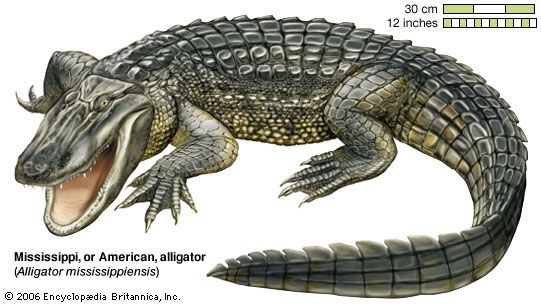
What adaptations do crocodiles have for living in both water and on land?
Crocodiles possess a suite of specialized adaptations that allow them to thrive in both aquatic and terrestrial environments.
Aquatic Adaptations
- Sensory Positioning: The eyes, ears, and nostrils are located on the highest part of the head, allowing these organs to remain above the water surface while the body is submerged.4
- Diving Mechanisms: Membranous flaps can close the nostrils when diving. Furthermore, a specialized nasal passage and a flap at the back of the throat allow crocodiles to breathe even when their mouths are open underwater.4
- Eye Protection: A nictitating membrane (a translucent third eyelid) can be drawn over the eye to protect it while maintaining some vision underwater.4
- Circulatory Efficiency: Crocodiles have a unique heart structure with completely separate ventricles. A connection called the foramen of Panizza allows blood to bypass the lungs while submerged, which helps stabilize blood oxygen levels during breath-holding.4
- Locomotion: A muscular, laterally flattened tail provides powerful propulsion for swimming.45
Terrestrial Adaptations
- Respiration: Crocodiles utilize a specialized muscle attached to the liver to expand the lungs, an efficient mechanism for breathing on land.6
- Locomotion: On land, crocodiles can hold their bodies high on all four legs. They are capable of walking with a side-to-side flexure and can even gallop short distances.5
- Integumentary Protection: Their skin is covered in thick, horny plates and bony structures called osteoderms, which provide protection and prevent desiccation (water loss) while on land.47
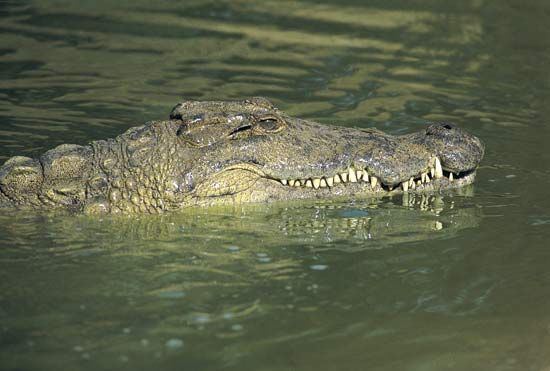
How many species of crocodiles exist, and where are they found in the world?
There are currently 27 recognized species of crocodilians, which are categorized into three distinct families:910
- Alligatoridae: Comprising 8 species, including alligators and caimans. These are primarily found in the tropical regions of Central and South America, with some species also inhabiting temperate zones in the United States and China.910
- Crocodylidae: Known as the “true crocodiles,” this family includes 17 species. They are widely distributed across Africa (south of the Sahara), Madagascar, India, Sri Lanka, Southeast Asia, the East Indies, northern Australia, Mexico, Central America, the West Indies, and northern South America.910
- Gavialidae: This family consists of 2 species: the gavial (or gharial), found in parts of South Asia including India, Nepal, and Myanmar, and the false gharial, which inhabits freshwater areas in parts of Indonesia and Malaysia.910
These animals generally inhabit lowland, humid tropical regions, though their specific ranges are often threatened by habitat loss and human activity.9
What are some unique behaviors or abilities of crocodiles that set them apart from other animals?
Crocodiles possess several remarkable behaviors and physiological abilities that distinguish them as highly specialized apex predators.
Unique Sensory and Hunting Adaptations
- Pressure Sensitivity: Crocodiles have sensitive pressure receptors located in pits around their mouths. These structures allow them to detect motion in dark or murky water, enabling them to capture prey even when visibility is poor.6
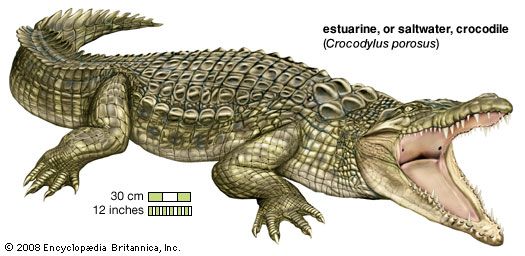
- Bite Force: The saltwater crocodile possesses one of the most powerful bite forces in the animal kingdom, measured at approximately 16,460 newtons.1
- Death Roll: When dealing with large prey, crocodiles often grip portions of the victim in their jaws and rotate their bodies rapidly in the water to tear the prey apart.6
Communication and Intelligence
- Vocalization: Crocodiles are surprisingly vocal. They communicate through grunts, hisses, and growls. During the breeding season, both sexes may produce a loud roar, which causes their flanks to vibrate so violently that water is sprayed into the air.6
- Learning and Recognition: Despite having a relatively small brain, crocodiles exhibit rapid learning. In captivity, some individuals have been observed recognizing their keepers, showing reduced fear, and even begging for food.6
Specialized Physiology
- Circulatory Control: Unlike other reptiles, crocodiles have a four-chambered heart. A unique connection called the foramen of Panizza allows them to bypass their lungs while submerged, which helps stabilize blood oxygen levels during long dives.4
- Reproductive Strategy: While most reproduce sexually, some species, such as the American crocodile, are capable of parthenogenesis, a process where offspring develop without fertilization. Additionally, the sex of the embryos is determined by the temperature of the nest during incubation.13
Sources
- crocodile - Reproduction — Encyclopædia Britannica
- crocodile - Life cycle — Encyclopædia Britannica
- reptile - Embryonic development and parental care — Encyclopædia Britannica
- crocodile - Form and function — Encyclopædia Britannica
- crocodile - Locomotion — Encyclopædia Britannica
- crocodile - Behavior — Encyclopædia Britannica
- Respiratory system - Reptiles — Encyclopædia Britannica
- Integument - Reptiles — Encyclopædia Britannica
- 7 Crocodilian Species That Are Dangerous to Humans — Encyclopædia Britannica
- crocodile - Distribution and abundance — Encyclopædia Britannica
- crocodile - Annotated classification — Encyclopædia Britannica
- crocodile - Ecology — Encyclopædia Britannica
- How strong is a shark’s bite? — Encyclopædia Britannica
Published on · 4 min read