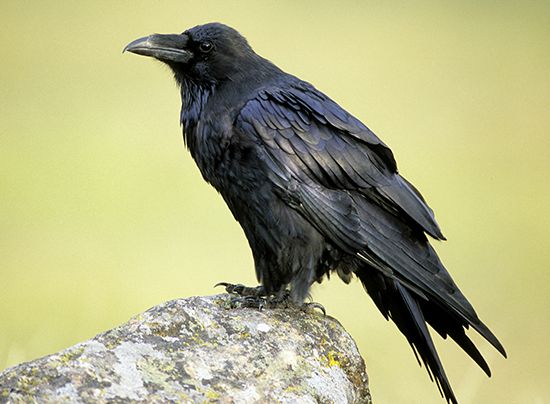
Crow
Crows are widely recognized as highly intelligent birds, often demonstrating cognitive abilities that rival those of primates and even human children in…

How intelligent are crows compared to other birds?
Crows are widely recognized as highly intelligent birds, often demonstrating cognitive abilities that rival those of primates and even human children in specific tasks. Within the Corvidae family, which includes jays, magpies, and ravens, individual birds frequently exhibit exceptional problem-solving skills, curiosity, and complex social behaviors.1234
Key indicators of their intelligence include:
- Tool Use: Certain species, such as the New Caledonian crow, use stick-type tools to extract food from crevices. In experimental settings, crows have demonstrated an instinctive understanding of physics, such as adding pebbles to a water-filled cylinder to raise the water level and reach a floating reward—a task that young children often struggle to solve.31
- Cognitive Processing: Crows exhibit advanced decision-making, such as adjusting the height from which they drop walnuts based on the nut’s hardness and the presence of potential competitors. They are also capable of distinguishing between geometric shapes.53
- Communication and Learning: Crows are masterful mimics, capable of learning over 100 words and dozens of sentences. They also possess the ability to recognize individual humans.31
While ravens are sometimes considered slightly more intelligent than crows, both are among the most cognitively advanced birds.4
How long do crows typically live in the wild and in captivity?
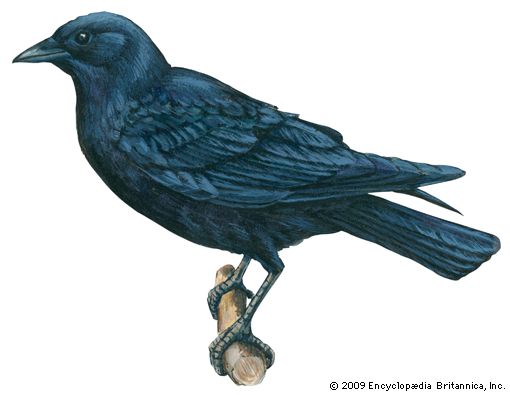
Crows typically live for about 13 years in the wild, while in captivity, they can live for more than 20 years.6
It is important to note that these figures apply specifically to members of the genus Corvus commonly referred to as crows. They are distinct from their relatives, the common ravens, which have a different typical life span of 10 to 15 years in the wild and 40 to 50 years in captivity.61
What are some common species of crows found around the world?
There are approximately 40 species within the genus Corvus that are commonly referred to as crows. These birds are found across most of the world, with the notable exception of southern South America.1
Some of the most common species include:
- American crow (C. brachyrhynchos): Widely distributed throughout North America.1
- Carrion crow (C. corone): Found across Europe and most of Asia.1
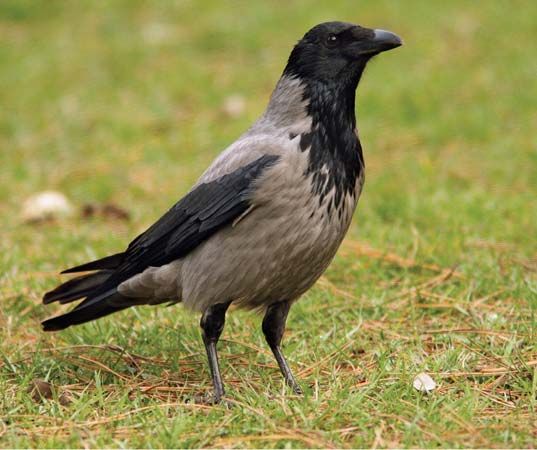
- Hooded crow (C. corone cornix): Often considered a subspecies of the carrion crow, it is distinguished by gray markings on the neck and breast and is found from western Europe to eastern Asia and the northern British Isles.1
- House crow (C. splendens): Native to the Indian subcontinent and introduced to parts of eastern Africa.1
- Pied crow (C. albus): Found in tropical Africa, characterized by a white nape and breast.1
- Fish crow (C. ossifragus): Native to the southeastern and central regions of North America.1
- New Caledonian crow (C. moneduloides): Notable for its sophisticated use of tools.1
- ’Alalā, or Hawaiian crow (C. hawaiiensis): Also recognized for its advanced tool-using capabilities.1
How do crows differ from their close relatives, such as ravens?
While crows and ravens are closely related members of the Corvidae family and the genus Corvus, they exhibit distinct physical and behavioral differences.57
Physical Differences
- Size: Ravens are significantly larger than crows, often weighing nearly twice as much.59
- Bill: Ravens possess thicker, more robust bills compared to the relatively slender bills of crows.57
- Tail Shape: When in flight, a raven’s tail appears wedge- or diamond-shaped, whereas a crow’s tail is typically rounded or paddle-shaped, spreading like a fan.57
- Flight Patterns: Ravens often soar with outstretched wings, while crows tend to flap their wings more frequently.7
Behavioral Differences
- Sociability: Crows are highly social birds that frequently gather in large flocks. In contrast, ravens are generally more solitary and are most often seen alone or in pairs.579
- Vocalization: The sounds they produce differ notably; the common raven is known for a low-toned “croaking” sound, while the crow is characterized by its familiar “caw”.57
Both birds are highly intelligent, though ravens are often cited as being particularly adept at complex problem-solving.57
Sources
- Crow — Encyclopædia Britannica
- Which Animal Is the Smartest? — Encyclopædia Britannica
- Animal behaviour - Cognitive mechanisms — Encyclopædia Britannica
- Corvidae — Encyclopædia Britannica
- What's the difference between ravens and crows? — Merriam-Webster
- Falconiform - The breeding adult — Encyclopædia Britannica
- Common raven — Encyclopædia Britannica
- crow-shrike — Merriam-Webster
- 12 Pairs of Commonly Confused Animal Words | Crow/Raven — Merriam-Webster
Published on · 3 min read