Ctenophore
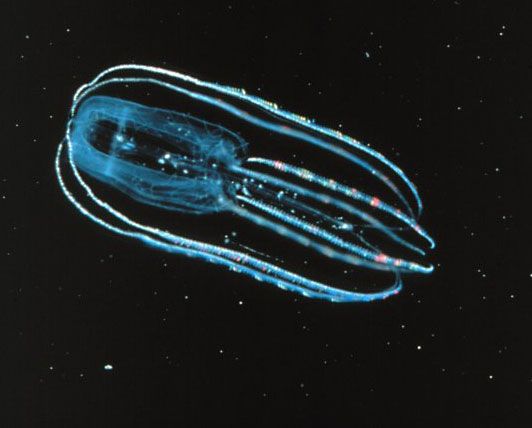
Ctenophores, commonly known as comb jellies, are a diverse phylum of marine invertebrates characterized by eight longitudinal rows of ciliary combs used for…
What are some of the most common species of ctenophores, and how do they vary?
Ctenophores, commonly known as comb jellies, are a diverse phylum of marine invertebrates characterized by eight longitudinal rows of ciliary combs used for locomotion. While they share a basic body plan, they exhibit significant variation in form and lifestyle:12
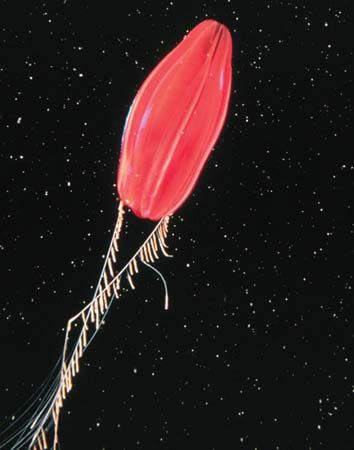
- Sea Gooseberries (Pleurobrachia and Hormiphora): These are spherical or pear-shaped, transparent animals that use two long, retractable, branched tentacles armed with colloblasts to ensnare small planktonic prey.12
- Venus’s Girdle (Cestum veneris): Unlike the typical globular shape, this species is flattened and ribbon-like, capable of reaching lengths of more than 1 meter (3 feet). It is noted for its delicate violet coloration.2
- Beroe (Beroe cucumis): These are distinct for their pinkish hue and lack of tentacles, representing a different predatory strategy compared to the tentacled cydippids.2
- Parasitic Forms: A few species, such as Gastrodes, have evolved a parasitic lifestyle, which is a significant departure from the free-swimming, carnivorous nature of most other comb jellies.2
Most ctenophores are bioluminescent, producing brilliant displays of light, and they play a critical role in marine ecosystems by consuming vast quantities of plankton.12
What is the significance of bioluminescence in ctenophores?
Bioluminescence in ctenophores, as in other marine organisms, is a form of bioluminescence produced through a highly efficient chemical reaction. This process occurs when the pigment luciferin is oxidized by the enzyme luciferase, resulting in the emission of light with minimal heat production.56
While the provided search results do not detail the specific behavioral functions of bioluminescence exclusively within ctenophores, they establish that bioluminescence generally serves critical survival roles across marine life. These functions include:
- Defense: Startling predators or using light to confuse enemies to facilitate an escape.57
- Predation: Acting as a lure to attract prey.576
- Communication and Recognition: Serving as signals for species recognition or mating, which are essential for reproductive success.57
- Camouflage: Matching the intensity of ambient light to disguise an organism’s form or shadow from predators.57
In the marine environment, this light is typically blue-green, as this wavelength is most visible and transmits best through seawater.6
What are the main characteristics that distinguish ctenophores from other marine invertebrates?
Ctenophores, or comb jellies, are distinct from other marine invertebrates, particularly cnidarians, due to several unique biological and structural characteristics:28
- Locomotion: Ctenophores are defined by eight longitudinal rows of ciliary combs (ctenes) that serve as their primary organs of movement.28
- Adhesive Cells: Unlike cnidarians, which use stinging cells (nematocysts) to capture prey, ctenophores possess specialized adhesive cells called colloblasts. These cells produce a sticky secretion that traps planktonic organisms upon contact.2
- Body Symmetry: While many marine invertebrates exhibit radial symmetry, ctenophores are characterized by a distinct biradial symmetry.28
- Mesoderm: Ctenophores possess a true mesoderm within their gelatinous mesoglea. This layer contains specialized cells, such as muscle cells, making them more highly evolved in this regard than cnidarians.2
- Anatomy: They feature a conspicuous sense organ known as a statocyst at the aboral end and a gastrovascular cavity that functions for both digestion and circulation.2
How do ctenophores reproduce, and what is unique about their embryonic development?
Ctenophores are hermaphroditic organisms, meaning each individual produces both eggs and sperm. These gametes are generated in separate gonads located along the meridional canals, which are the same structures that house the comb rows. In the majority of ctenophore species, these gametes are released directly into the water, where fertilization and subsequent embryonic development occur.2
Regarding their development, most ctenophores pass through a larval stage known as a cydippid larva. This larva is typically spherical or ovoid and equipped with two retractable tentacles. The transition from this larval form to the adult stage is generally direct for ovoid-shaped species, though it can be more prolonged in flattened groups. In the order Cydippida, the larva closely resembles the adult, resulting in minimal change during maturation.
A notable exception is the parasitic Gastrodes, which is unique among ctenophores for having a free-swimming planula larva, a feature more commonly associated with cnidarians. These fundamental differences in embryological development are among the key characteristics used by modern authorities to distinguish ctenophores from cnidarians.2
Sources
- sea gooseberry — Encyclopædia Britannica
- ctenophore — Encyclopædia Britannica
- Ctenophora — Merriam-Webster
- bivalve - Food and feeding — Encyclopædia Britannica
- Bioluminescence: Top Questions — Encyclopædia Britannica
- Bioluminescence - The role of bioluminescence in behavior — Encyclopædia Britannica
- Marine bioluminescence — Encyclopædia Britannica
- ctenophore — Merriam-Webster
- Animal - Radiata: a tissue level of organization — Encyclopædia Britannica
- cnidarian - Reproduction and life cycles — Encyclopædia Britannica
Published on · 3 min read