Lion’s Mane Jellyfish
The provided search results do not contain information regarding the specific scientific methods used to study the lion’s mane jellyfish or the challenges…
How do scientists study lion’s mane jellyfish, and what challenges do they face?
The provided search results do not contain information regarding the specific scientific methods used to study the lion’s mane jellyfish or the challenges researchers face when observing them.
The available data confirms that the lion’s mane jellyfish (Cyanea capillata) is the largest known jellyfish, inhabiting cold oceans and utilizing nematocysts on its 70–150 tentacles per cluster to capture prey. While studies on jellyfish in general have shown that some species use bell pulsing to assist in the circulation of nutrients and gases, the specific research protocols and logistical difficulties associated with studying this particular species are not addressed in the provided documentation.123
How does the lion’s mane jellyfish hunt and what does it typically eat?
The lion’s mane jellyfish (Cyanea capillata) is a predatory marine animal that primarily inhabits the upper 20 meters of the ocean’s surface. Its diet consists of zooplankton, small fishes, ctenophores, and other jellyfish.1
To hunt, the jellyfish utilizes its 70–150 trailing tentacles, which are equipped with nematocysts—specialized stinging cells. When prey comes into contact with these tentacles, the jellyfish delivers a sting loaded with neurotoxins to immobilize the target. Once the prey is incapacitated, specialized structures known as oral arms transport the food to the jellyfish’s mouth for consumption.1
What are the distinctive physical features of the lion’s mane jellyfish?
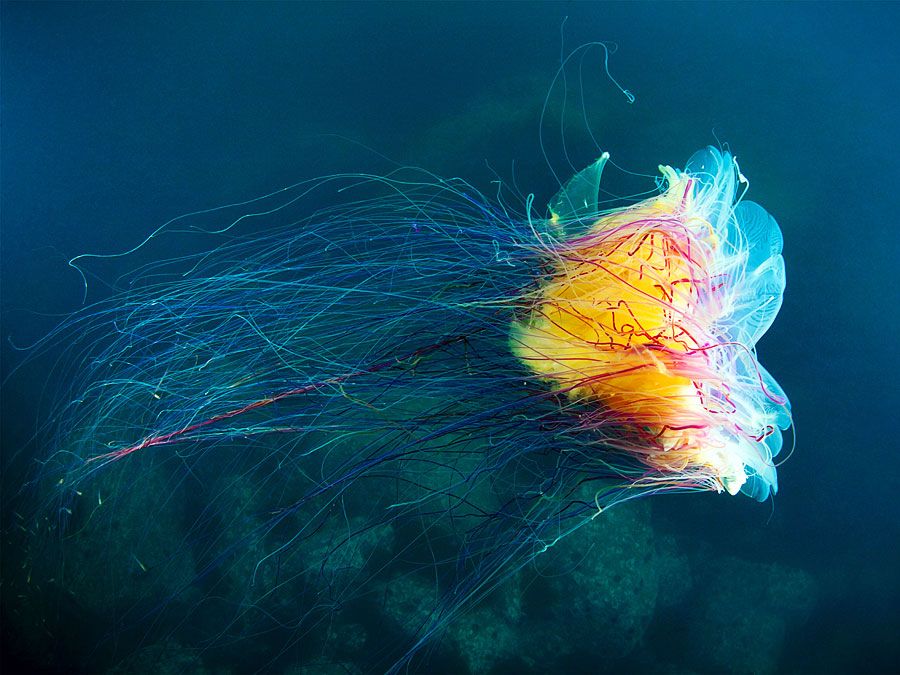
The lion’s mane jellyfish (Cyanea capillata) is recognized as the largest known jellyfish in the world, possessing several distinct physical characteristics:
- Bell Structure: The body features an eight-lobed bell. In smaller specimens, the color ranges from light orange to tan, while larger individuals exhibit deep orange to dark crimson hues.1
- Size: The largest specimens, typically found in the Arctic Ocean, can reach diameters of up to 2.4 meters (8 feet) and lengths of 36.5 meters (about 120 feet).1
- Tentacles: This species is noted for its impressive tentacle count, which can total up to 1,200. These are organized into eight distinct clusters, each containing between 70 and 150 trailing tentacles.13
- Specialized Structures: The tentacles are equipped with nematocysts—stinging cells used to deliver neurotoxins—and the animal also features specialized oral arms that transport immobilized prey to its mouth.1
What role do lion’s mane jellyfish play in their marine ecosystem?
The lion’s mane jellyfish serves as both a predator and a source of prey within its marine ecosystem, playing a critical role in the food web of colder northern waters.1
As a predator, it helps regulate populations of zooplankton, small fishes, ctenophores, and other jellyfish by capturing them with its stinging tentacles. Conversely, the jellyfish itself acts as a vital food source for several marine animals, including sea turtles, various birds, and larger fishes.1
Additionally, the jellyfish’s life cycle contributes to the nutrient cycle of nearshore environments. Toward the end of their one-year lifespan, these jellyfish often congregate in sheltered coastal areas, where they may be washed onto beaches and rocks, potentially providing organic matter to shoreline ecosystems.1
Sources
- lion’s mane jellyfish — Encyclopædia Britannica
- Do jellyfish have a heart? — Encyclopædia Britannica
- How many tentacles does a jellyfish have? — Encyclopædia Britannica
Published on · 2 min read